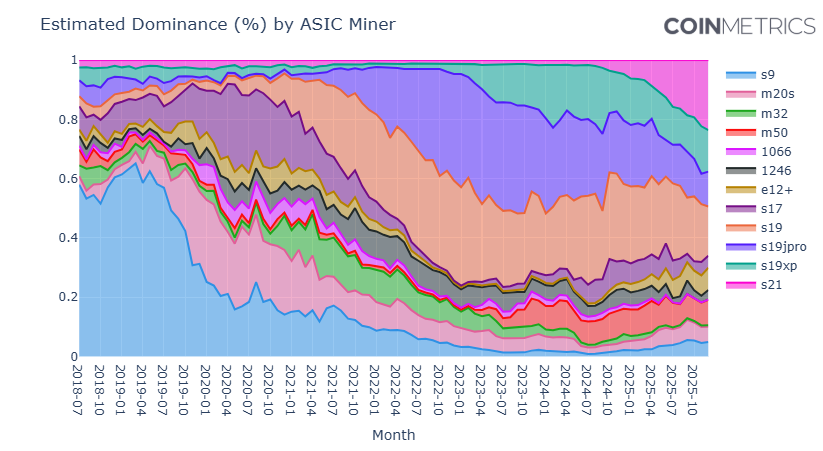
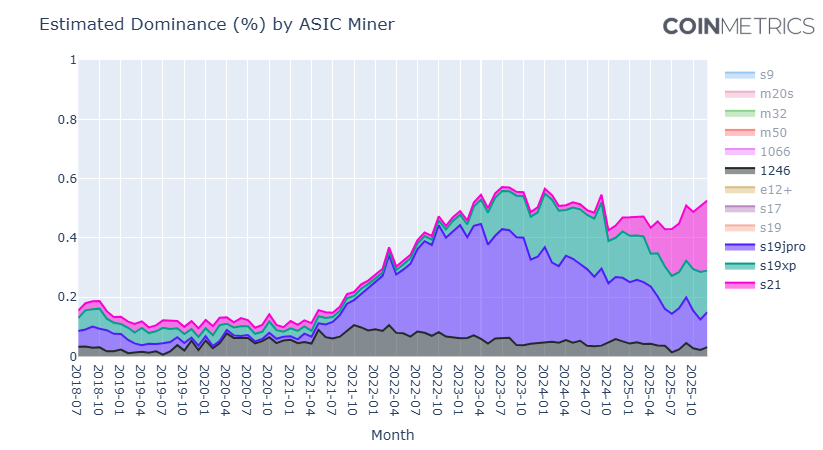
The best ASIC is not always the most expensive or the most powerful one. Surprisingly, the majority of miners operating at the turn of 2025-2026 are models released a year and a half ago or more, such as the Bitmain Antminer S21 series (representing 23% of Bitcoin's total hashrate according to CoinMetrics — more on that below). Today, adequate ASIC miner profitability is ensured by equipment with an energy efficiency range of 13 to 16.5 W/TH. Profitability analysis in mining calculators is best when based on commonly used models than on top models.
It's important to understand the concept of the "sweet spot" correctly: mining is a rather inertia-prone sector where equipment cannot be changed on a whim. Selecting hardware involves considering a vast number of factors, all aimed at anticipating the future. Mining is a long-term investment that won't pay off in just six months. You should plan for a minimum three-year horizon, and if your approach is a serious one, be prepared to dedicate a significant portion of your time and resources to mining.
However, Cuverse has already traveled this path and grown to become a major Bitcoin company. You can embark on this journey independently or partner with Cuverse under a hosted mining arrangement. This is significantly simpler than building your own mining infrastructure from scratch. Moreover, we utilize top-tier ASIC models and have access to low-cost electricity. Before starting your own venture, consider that the best solution might be right here, and it won't require your full immersion into technical details.
How ASIC mining works
ASIC is a device for mining Bitcoin or other cryptocurrencies. The acronym stands for Application-Specific Integrated Circuit, and as the name suggests, it could refer to any chip designed for a specific purpose. However, in common parlance and within our industry, "ASICs" are exclusively associated with cryptocurrency mining.
The core task of mining boils down to calculating a hash function — a long hexadecimal string of numbers and letters. Strictly speaking, an ASIC doesn't perform "computations" using complex mathematical functions. Instead, it essentially brute-forces numbers by comparing them through relentless iteration. Even this simplified operation, however, consumes significant energy resources, especially given the intensely competitive and perpetual race that defines modern mining.
There are numerous mining algorithms. The best-known and widely used is Bitcoin's SHA-256. Among notable alternative algorithms are Scrypt, used for mining Litecoin (LTC) and Dogecoin (DOGE), kHeavyHash for Kaspa (KAS), and EtHash for Ethereum Classic (ETC).
It's crucial to understand that the best crypto miners are not always the latest, most cutting-edge devices fresh off the production line. This leads us to a critical question: what hardware is actually powering the global mining network right now, and where is the majority of investment flowing?
In the early days, cryptocurrencies were widely mined using graphics cards (GPUs), and there were even FPGA-based solutions (with programmable logic). However, as competition in the mining market intensified, ASICs completely displaced all other approaches. This is hardly surprising — in highly competitive environments, specialized solutions always win. In other words, a chess grandmaster will always defeat a philosopher, no matter how knowledgeable the latter may be in general matters or even in the theory of chess.
Bitcoin Mining: How It Works & How to get started in 2025-2026
How to mine Bitcoins every day in a mature market?
Profitability metrics explained
To compile a ranking of the most profitable ASICs, it's essential to use the concept of ROI while accounting for electricity costs, network difficulty, and cryptocurrency volatility. The ROI calculation formula applied to mining is as follows: ROI = ((Mining Revenue - Mining Costs) / Mining Costs) * 100%. Near the break-even point, ROI approaches zero. An ROI of 20% is considered a good result, and anything higher is excellent.
Electricity price has the strongest impact on ROI, as energy is the primary and inevitable operational cost in mining. The growing difficulty of the Bitcoin network also affects crypto miners’ profitability, but to a significantly lesser degree. Bitcoin's volatility is a substantial factor since we pay for electricity in fiat currency but earn revenue in Bitcoin. Essentially, we pay in fiat for the produced asset, and if its exchange rate falls, such production risks lead to unprofitability. Mining performance should be high enough to withstand market negativity. It is advisable to exceed the performance benchmark by 10-15%.
Therefore, when selecting a miner (ASIC), we must be guided by a clear strategy. This means defining the mining parameters within which we plan to operate long enough to recoup the equipment cost and generate solid earnings. The first step is to determine our target profitability and identify our break-even point—the lowest market level we believe is sustainable.
Today, a "good" electricity price is considered to be around $0.04 per kWh, though such rates are not available in all regions. In Europe, prices are an order of magnitude higher, which is why mining is primarily concentrated in the USA, Russia, and certain countries in Africa and Latin America. Despite restrictions, illegal Bitcoin mining persists in China as well, driven by the highly attractive electricity prices there.
Top 10 ASIC miners of 2025
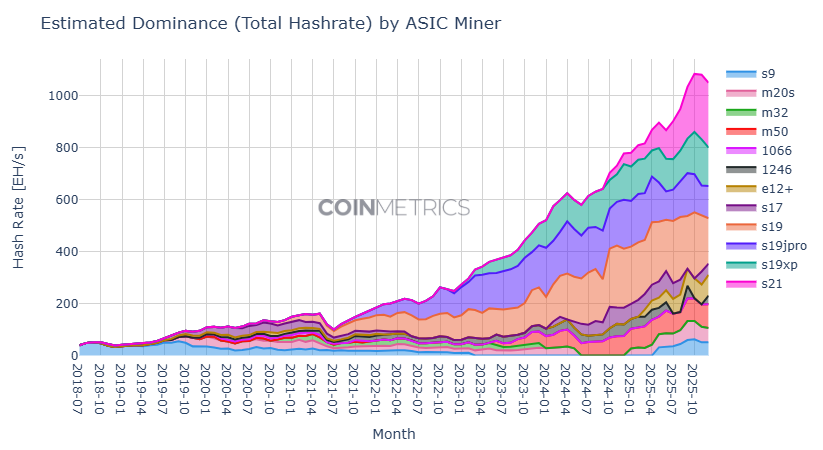
Looking at the top of any mining calculator's list, one might think that the higher the profitability, the better the miner. In reality, the distribution of miners by total hashrate paints a completely different picture. Typically, the most popular models are those released a year and a half ago or more, as seen with the Bitmain Antminer S21 series.
Here is top 10 ASIC miner list according to the asicminervalue.com calculator as of mid-January 2026:
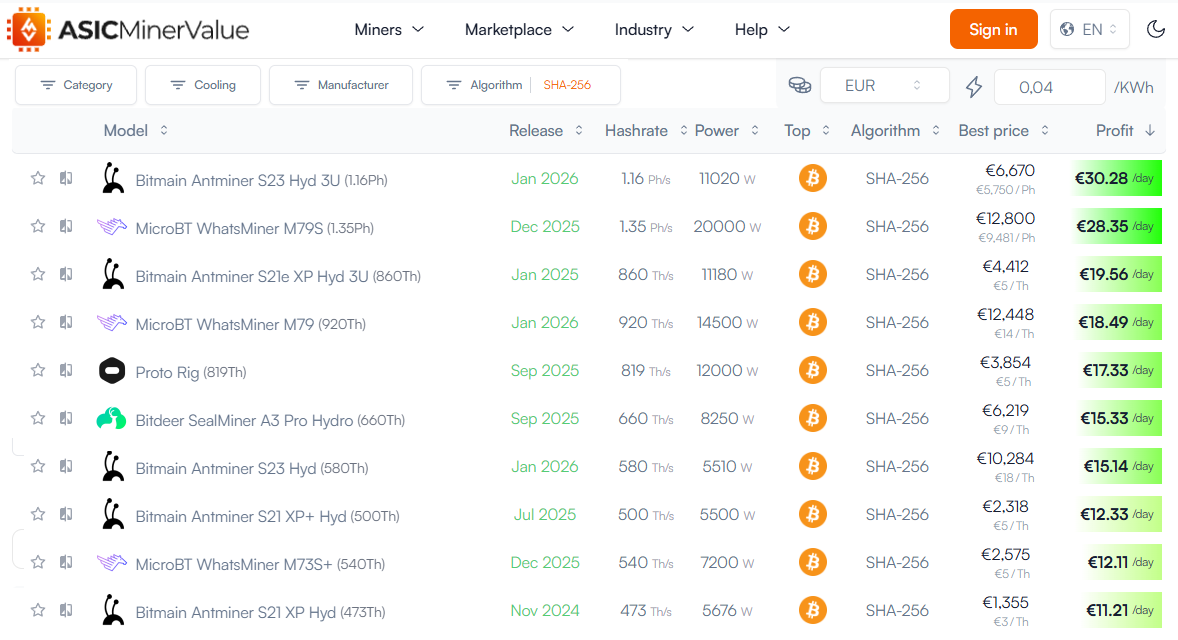
Despite high profitability, the following is evident: recent releases are very expensive, and their delivery times are quite long. Furthermore, liquid-cooled devices require even more meticulous attention than conventional fan-based miners and are increasingly designed by manufacturers for professional-grade infrastructure. It's also clear that these miners currently occupy a minuscule fraction of the total network hashrate and cannot claim the mass-market segment with readily available service and support.
Today, Cuverse offers the top-tier miners discussed in this article. Primarily, these are Bitmain devices, as Bitmain is the industry leader in mining hardware production with maximum geographical coverage, access to service support, regular firmware upgrade, and so on.
Here is a hardware comparison of the top models according to Cuverse's strategy as of mid-January 2026:
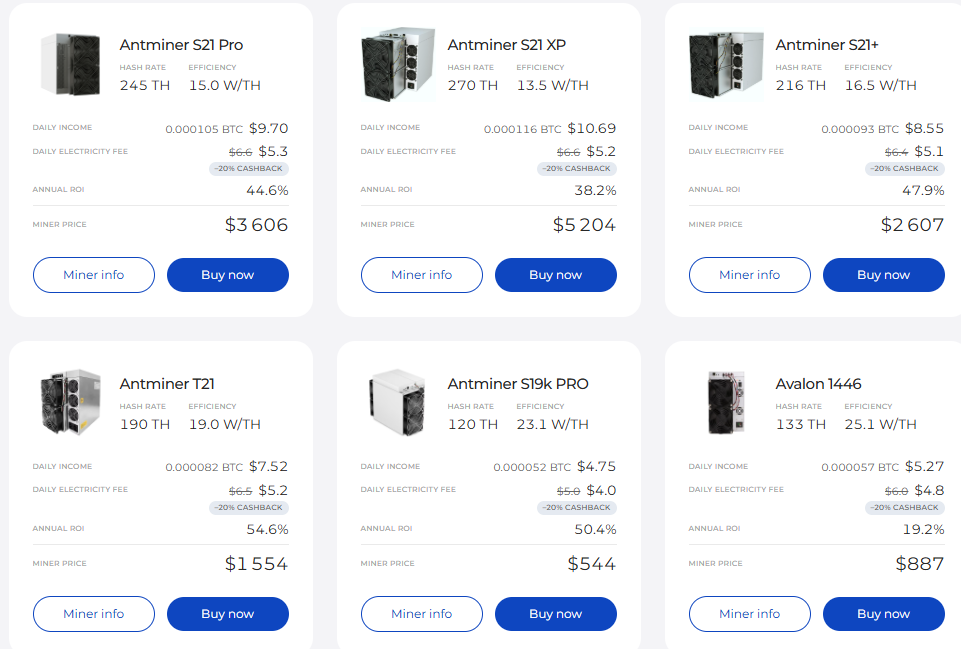
This lineup consists of miners with energy efficiency ranging from 25.1 to 13.5 W/TH, allowing for the creation of a well-diversified portfolio with varying payback periods and high payout threshold. This approach enables resilience during challenging market conditions and maximizes earnings during prosperous market phases.
Cuverse does not offer altcoin mining, as Cuverse is, first and foremost, a Bitcoin company. Cuverse's entire mining infrastructure is built specifically for Bitcoin. Miner hosting with Cuverse is one of the most attractive mining solutions for regular users. Mining on real hardware with low operational costs represents tremendous value in today's market!
Detailed miner reviews
What, then, are the most profitable ASIC miners?
According to CoinMetrix data, among all popular 2025 models, only the share of the Antminer S21 (in various modifications) grew, reaching 23% of all operational miners by the year's end. The share of all other popular ASICs steadily declined. The energy efficiency of the S21 series ranges from 13 to 16 W/TH. Therefore, we can reasonably conclude that at the turn of 2025-2026, this range represents the optimal and generally accepted mining standard under current market conditions.
The Cuverse catalog features three models from the Bitmain Antminer S21 series:
|
ASIC Model |
Hashrate (TH/s) |
Energy Efficiency (W/TH) |
Price (USD) |
ROI* |
|
Antminer S21+ |
216 |
16.5 |
$2,607 |
47.9% |
|
Antminer S21 Pro |
245 |
15.0 |
$3,606 |
44.6% |
|
Antminer S21 XP |
270 |
13.5 |
$5,204 |
38.2% |
* ROI (Return on Investment) is an estimated indicator based on current market conditions.
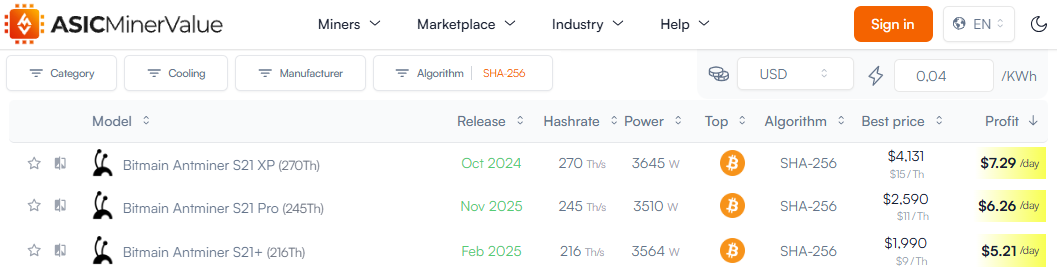
If we turn to the mining calculator asicminervalue.com, we won't find the Antminer S21 on the list of top Bitcoin miners. Why doesn't top profitability equal top popularity? This is due to a multitude of factors, such as supply volume, delivery time, price, ease of maintenance schedule compliance, availability on the secondary market, and more. When you start mining, you encounter a huge number of practical questions, the answers to which completely reshape your perspective.
For instance, when using a mining calculator, it might seem sufficient to choose a miner with maximum profitability and an acceptable price — for example, from the SHA-256 encryption algorithm "top-10" (i.e., for Bitcoin mining). However, it may later turn out that purchasing such a miner is significantly more difficult than a simpler device, the delivery time is too long, and logistics are too expensive. Ultimately, in search of a compromise (since you want to mine here and now), users choose the most accessible and acceptable option based on a set of parameters. It's no surprise that in most cases, the answer is a model from the Antminer S21 series. Mass production and service support for these models best correspond to today's market demand and desired profitability.
If we turn to the mining calculator asicminervalue.com, we won't find the Antminer S21 on the list of top Bitcoin miners. Why doesn't top profitability equal top popularity? This is due to a multitude of factors, such as supply volume, delivery time, price, ease of maintenance schedule compliance, availability on the secondary market, and more. When you start mining, you encounter a huge number of practical questions, the answers to which completely reshape your perspective.
For instance, when using a mining calculator, it might seem sufficient to choose a miner with maximum profitability and an acceptable price — for example, from the SHA-256 encryption algorithm "top-10" (i.e., for Bitcoin mining). However, it may later turn out that purchasing such a miner is significantly more difficult than a simpler device, the delivery time is too long, and logistics are too expensive. Ultimately, in search of a compromise (since you want to mine here and now), users choose the most accessible and acceptable option based on a set of parameters. It's no surprise that in most cases, the answer is a model from the Antminer S21 series. Mass production and service support for these models best correspond to today's market demand and desired profitability.
As of mid-January 2026, the mining calculator shows the following:
Specialty altcoin ASICs
Also, you won’t find the most profitable miners for alternative proof-of-work (POW) cryptocurrencies using the Scrypt algorithm at the very top of mining calculator rankings. This algorithm is primarily used for mining Dogecoin (DOGE), Litecoin (LTC), and Aleo. In this segment, Bitmain mining equipment also leads the market, similarly to the SHA-256 segment.
The most popular devices for Scrypt mining are the Bitmain Antminer L9 and L7.
|
ASIC Model |
Hashrate |
Power Efficiency |
|
Antminer L9 |
17 GH/s |
3450 W / 0.20 W/MH |
|
Antminer L7 |
9.5 GH/s |
3425 W / 0.36 W/MH |
Note: The table above provides a direct comparison of key specifications for popular Scrypt ASICs.
As of mid-January 2026, mining calculators clearly show one thing:
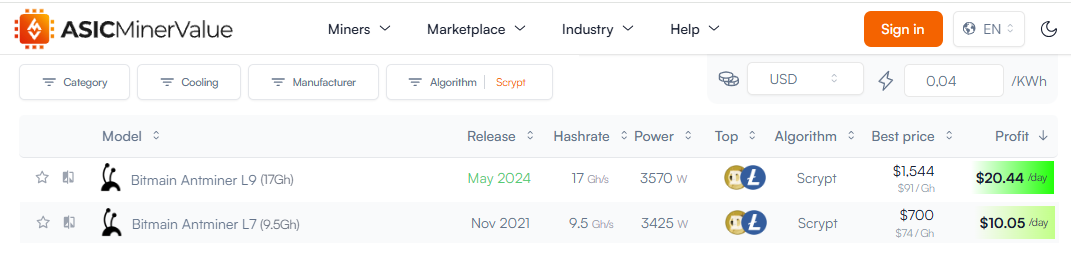
The hash rate and hash rate fluctuation of Bitcoin and altcoins are on completely different scales. Yet, these two "different worlds" coexist in the same reality, where the attractiveness of mining a particular asset is determined by real world profitability, operating costs, risks, and other factors. You might believe in Litecoin and mine it exclusively, or you might be a Bitcoin believer, considering any other form of mining a mere side gig.
Cooling technologies impact
Cooling efficiency directly determines the power consumption and lifespan of an ASIC. Air cooling is the simplest and cheapest cooling solution, but it is noisy and the least efficient, which limits equipment placement density.
Water (liquid) cooling based on coolers or heat exchangers is significantly quieter and more productive, allowing for better energy efficiency (W/TH). However, it is more complex to install and maintain, requiring additional infrastructure.
Immersion cooling, where miners are submerged in a dielectric fluid, is the most advanced method. It provides maximum noise suppression, the highest heat dissipation efficiency, and enables record-high placement density. However, it is the most expensive and technologically complex option, requiring special fluids and sealed installations.
Thus, the choice of technology is a compromise between CAPEX/OPEX, target energy efficiency, and the scale of the mining farm.
Electricity costs by region
The cost of electricity is a critical factor for mining profit margin, directly impacting net profit and the break-even point (ROI). The profitability of mining depends very much on the data center location.
- USA: Average price is $0.07–0.12/kWh. Regions with cheap hydropower (Texas, Washington) offer the highest profitability (up to 40% ROI).
- EU/UK: One of the most expensive regions ($0.25–0.40/kWh). Mining with even high-performance equipment (>25 J/TH) is often unprofitable.
- UAE and Hong Kong: Prices are high ($0.08–0.15/kWh), but profit is possible due to low taxes and premium infrastructure for large investors.
- Russia/Kazakhstan: Low prices ($0.03–0.06/kWh) make this region one of the most attractive, despite regulatory risks.
- Latin America (Paraguay, Venezuela): Energy prices starting at $0.02/kWh allow for super-high profitability, but come with high operational and political risks.
In conclusion, cheap energy ($0.03–0.06/kWh) and access to modern ASIC miners (13–16 W/TH) remain the key drivers of revenue in 2026.
Mining pools and platform tools
Cuverse utilizes one of the largest and most reliable mining pools, F2Pool, in its operations. This allows our clients to earn stable income by combining computational power and reducing payout variance.
F2Pool Overview:
- Payout Method: PPS+ (Pay Per Share Plus). This pool distribution method guarantees payment for each accepted share, plus a reward for block fees. One of the most predictable and stable methods for miners, ensuring the payout of a fair block reward.
- Remote Management: provides a convenient web interface and mobile app for real-time monitoring of hash rate, device temperature, and viewing statistics and payment history.
- Key Features: low withdrawal threshold (0.001 BTC), detailed analytics, customizable alerts, support for multiple algorithms and cryptocurrencies, as well as high worker uptime and infrastructure resilience.
- New Features: every transaction fee in the Bitcoin network goes to the miners. New technologies can expand the use of the Bitcoin blockchain and give miners additional profits.
Using this mining pool is part of Cuverse's strategy to ensure maximum stability and transparency for mining investors.
Selection guide: Best ASIC for your needs
How do you choose an ASIC to maximize your earnings? Remember a simple rule: the higher the potential profit, the higher the investment risk. And the foundation of any long-term profit strategy is competent risk management. So, is chasing records really worth it?
Therefore, before entering the mining market, you need to develop your own strategy, which should address the following questions:
- What is your success timeline? In other words, when will you be able to tell yourself that the mining results are satisfactory, that you've passed the first stage and are ready to continue (or stop if more interesting projects emerge)?
- What is the lowest price you expect for the coin you're mining during your specified period? This doesn't mean this price must be set in stone, but you should have your own understanding of the market and its likely state.
- What is my maximum total budget to avoid a snowball effect? You need to define your maximum expenses upfront because not everything can be accounted for initially. There will always be additional costs (e.g., maintenance, repairs, and other unforeseen events). Exceeding your budget is a damaging event; you must stay within a predetermined figure.
By defining these three points, you will already be in a stronger position. This step will later fuel your confidence in what you are doing. Next comes the technical assessment: regional specifics, electricity costs, placement and maintenance logistics, manufacturer warranty, noise, cooling, security, etc.
Select equipment models that fit your strategy's parameters, and these will be the best ASICs for mining in your specific case.
If you lack a mining strategy, it might seem that the most profitable crypto miners are the best solution. In reality, as we've shown above, this is not true. Mining is influenced by numerous conditions. If you've considered the potential risks and weighed them against your capabilities and vision, you are far more prepared for mining than most others.
Once you have a shortlist of ASIC models, consider how you will service them, repair them, update firmware (as needed and possible), and even how and when you will sell them on the secondary market (if you plan to), and what their resale value may be. That is, what will the resale market value of the equipment be if you do not intend to use the miners until their ultimate end-of-life?
Think about how security will be organized at your facility. Mining equipment requires protection, constant supervision, fire safety, etc. You will need to ensure a backup power supply, a backup internet connection, video surveillance, and a reliable centralized cooling system. Miners in a facility are like a capricious living organism — they cannot be left alone. They require constant care.
Calculating real returns
Before starting mining, it's logical to figure out how to calculate mining profitability. Cuverse displays the projected profitability for its hosted miners directly on each product card. This is an approximation that allows you to estimate returns, all else being equal. The market may go up or down, and the final parameters will differ. Nevertheless, these figures provide a crucial starting point, as they are the only way to evaluate how each specific miner fits into your own strategy.
Thus, when you operate under a hosted mining agreement with miners located in major data centers, you won't need to perform complex calculations yourself. Everything is already calculated for you on the miner catalog page and updated daily. Consider another key fact: Cuverse freezes the electricity price for the entire contract term, which means that one of the major variable parameters is removed from this complex equation, significantly reducing your risks.
Bitcoin Mining ROI 2026: Realistic Outlook with Cuverse Data
Bitcoin mining is an industry, a philosophy, a business, and a global idea
Security and remote hosting benefits
Choosing miner hosting with Cuverse provides a complete range of benefits unavailable when setting up your own mining farm.
Key advantages:
- Security and Reliability: Your equipment is housed in professional data centers with security, video surveillance, backup power, and fire suppression systems.
- Financial Predictability: A fixed electricity cost for the entire contract term protects you from market volatility, allowing for accurate ROI forecasting.
- Convenient Management: An exclusive mobile app for any device offers superior analytics, remote monitoring, and full real-time control.
- Additional Privileges: A referral program, a bonus system, and individual terms for major clients.
Cuverse handles all technical, infrastructural, and security tasks, allowing you to focus solely on strategy and profit augmentation.
Market trends: halving & 2026 outlook
The upcoming Bitcoin halving in 2024 should lead, as it historically has, to a long-term price increase (within 12–18 months on average), but halves miner profitability in the short term. This intensifies competition and makes equipment energy efficiency (<18 W/TH) critically important.
Key factors for 2026:
- Regulation: Tightening regulations in the EU and the US may increase operational costs, shifting mining to regions with clear rules (UAE, Hong Kong, certain US states).
- Technology: A mass transition to immersion cooling and next-generation ASICs (e.g., Bitmain S21 Pro) to maintain profitability.
- Market: A steady trend towards institutionalization. The hash rate and the average BTC price are forecasted to rise to the range of $100–150K by the end of 2026, offsetting the halving effect for the most efficient operators.
Thus, the strategy for 2026 entails a focus on maximum efficiency and partnership with infrastructure giants capable of weathering low-margin periods.
FAQ
Is ASIC mining profitable?
Mining never stops for a second, which is why it continues in 2026 as well. The market structure and ASIC miners’ profitability are evolving. One generation of miners is replaced by another with better energy efficiency. The best miners are those that align with your strategy. Cuverse offers mining through a hosted model, using miners that operate in the company's data centers. By taking advantage of this offer, you can mine Bitcoin on a ready-made infrastructure with transparent terms. Join us, because with Cuverse, ASIC mining is always profitable.
What is the most efficient ASIC miner?
In a mining calculator, such as asicminervalue.com, you can specify the mining algorithm (SHA-256 for Bitcoin) and your electricity cost (e.g., $0.04/kWh). You will see a long list of miners sorted by profitability. However, you shouldn't assume that the most efficient crypto miner is at the very top. In mining, every detail matters. Therefore, when choosing equipment, you should start from a realistic understanding of how much you are willing to spend and how much you aim to earn. Cuverse recommends the Antminer S21 series as the most widely used lineup in the world today.
Antminer S19k PRO Review: Performance, Efficiency and Mining Profitability
Particularly effective as part of a diversified portfolio
Which crypto mining is most profitable?
Currently, the most profitable crypto miners boast an energy efficiency of 13-17 W/TH. These models are relatively inexpensive yet allow for substantial earnings, resulting in the fastest payback period. Furthermore, these models are expected to remain relevant even after the 2028 halving, meaning they can operate effectively for over three years. Considering Bitmain's service capabilities, the Antminer series stands as the most attractive option in today's market, whose stability remains highly uncertain. Cuverse recommends hosting S21 miners in a data center — this way, you are protected from practically all types of risks.
What's the life span of an ASIC miner?
It is commonly accepted that an ASIC miner's lifespan is approximately three years. A standard power supply unit lasts about the same amount of time. However, for each individual, it's their own personal story. If mining equipment is properly maintained, if market conditions remain highly favorable, and if a well-considered mining policy is applied in your jurisdiction, success is highly likely. Modern popular ASICs, such as the Antminer S21, are capable of operating for 3 years or more, generating profit for you even after the 2028 halving.
Cuverse offers the most relevant lineup of miners on a hosting basis, allowing you to start mining without delving deeply into the technical complexities. Cuverse ensures high mining reliability and provides expertise in all matters related to Bitcoin mining.


