What hardware will define Bitcoin mining in 2026? Fierce competition in this sector is driving a relentless race for technological supremacy, with a singular focus on achieving record-breaking energy efficiency. However, this cutting-edge performance comes at a premium, inflating both the upfront cost and the projected payback period. Consequently, investors are faced with a critical balancing act, weighing immediate capital outlay against the promise of long-term, sustainable profitability.
This guide is designed to navigate the complex landscape of selecting the optimal mining hardware, providing a strategic framework for a calculated and successful market entry.
What’s the best Bitcoin miner in 2026?
High performance is a miner's key to maintaining efficiency across different market cycles. Cuverse offers cutting-edge hardware suitable for various mining strategies. By combining different equipment, you can build a balanced mining portfolio positioned for success in any market environment.
The most critical metrics for any miner are its hash rate and energy efficiency. These two figures alone provide deep insight into performance, projected payback period, potential profitability, and overall viability.
Comparative Overview of Leading Models (Data as of Dec 15, 2025)

A clear trend emerges: superior energy efficiency commands a higher price, which in turn extends the calculated payback period. However, as discussed, the payback period is not the sole decisive factor. Market conditions can shift rapidly, potentially rendering less efficient, ostensibly "faster-to-payback" models completely unprofitable.
Investing in premium, energy-efficient hardware provides a crucial safety margin. This resilience allows mining to remain profitable even during severe market downturns. While cheaper, less efficient units would need to be powered off—effectively pausing and potentially invalidating their payback clock—the more advanced equipment continues to operate, steadily progressing toward and beyond its break-even point. This strategic durability is what defines the best bitcoin mining hardware for the long term.
Antminer S19k PRO Review: Performance, Efficiency and Mining Profitability
Particularly effective as part of a diversified portfolio
Who is the leading manufacturer in 2026?
Several companies manufacture Bitcoin mining hardware, with a few clear technological frontrunners. Intense competition among them drives a relentless pace of new model releases, each generation pushing the boundaries of performance.
The key players in BTC mining machines are Bitmain, MicroBT, Canaan, Goldshell, and Innosilicon. The undisputed leaders are Bitmain and MicroBT.
Bitmain (Antminer series) is distinguished by its vast product lineup, high build quality, extensive global dealer network, and a premium price tag that reflects its status as the industry's leading brand.
MicroBT (Whatsminer series) excels by offering the best price-to-performance ratio. While its product range and dealer network are narrower than Bitmain's, Whatsminer represents an outstanding value proposition, particularly in a declining market.
Canaan (Avalon series) offers solid, though not the most cutting-edge, mining machines. Slightly trailing in the tech race with a more conservative design, it presents a reliable mid-market option appealing to miners focused on risk averaging.
Goldshell primarily targets the niche of trendy altcoins that use algorithms other than Bitcoin's SHA-256. Innosilicon, while attracting buyers with aggressive pricing, has developed a reputation for product instability and a lack of ongoing firmware support for its aging models.
Ultimately, the choice of manufacturer depends entirely on your specific mining strategy and risk tolerance.
How to pick a Bitcoin mining machine?
Choosing the most profitable ASIC isn't just a numbers game. It's a matter of strategy and risk management. While an Antminer S21 XP will have a payback period roughly 1.36 times longer than an Antminer S19k PRO (based on a ratio of $5.22 / $3.85 daily net profit), the Bitcoin market is inherently volatile, characterized by both explosive rallies and severe corrections. Your mining strategy must account for this reality.
Every Bitcoin mining machine operates with a specific profitability threshold — a Bitcoin price level below which mining becomes unprofitable. Naturally, this threshold is higher for the less efficient S19k PRO than for the highly efficient S21 XP. Imagine a significant market downturn that pushes the price below the S19k PRO's threshold. Its payback clock stops indefinitely; you must power it down to avoid burning cash on electricity. Meanwhile, the S21 XP remains online, continuing to generate profit and progress toward its ROI.
This illustrates the core strategic divide. Large corporations can afford to invest in the most advanced and expensive Bitcoin mining machines because their model prioritizes high capital expenditure to achieve the lowest possible operational cost (and thus the lowest Bitcoin production cost). Those with limited capital are forced to seek a compromise between a machine's upfront price and its long-term energy efficiency.
Price
Naturally, a more advanced miner commands a higher price, as it unlocks greater earning potential. However, a significant brand premium is also factored into the cost. For instance, Bitmain hardware is consistently more expensive than comparable alternatives. This premium is partially justified by the corporation's extensive global dealer network, consistent firmware updates to optimize performance, and readily available spare parts, among other advantages.
Selecting a miner is ultimately a compromise between two poles: expensive but durable versus cheap but risky. A wide spectrum of viable options exists between these two extremes.
There is no universally "correct" choice, just as there is no absolute truth in investing. Your selection is a direct result of your strategic goals. Formulating such a strategy requires a personal forecast of the market's trajectory during your mining operation. Where is Bitcoin headed? The accuracy of your prediction is less critical than having a coherent plan. With a defined strategy, you will maintain clarity and confidence in your decisions and navigate even the most challenging market conditions with purpose.
Mining rig efficiency
Mining Bitcoin is an exceptionally energy-intensive endeavor. Opening a mining calculator like asicminervalue.com reveals stark differences between miners, including their power consumption.
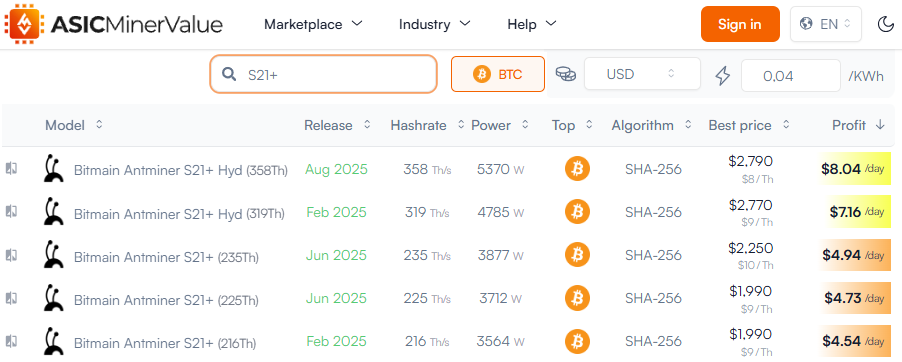
For instance, the Bitmain Antminer S21+ series at the end of 2025 comprised five distinct models, each with different hash rate and energy efficiency specifications. While the calculator doesn't display efficiency directly, it is easily derived by dividing power draw (W) by hash rate (TH).
Power consumption alone is an insufficient metric for decision-making. High power draw coupled with low hash rate signifies poor efficiency. Therefore, power must always be analyzed in conjunction with the hash rate it produces.
Within this specific S21+ lineup, the first two models boast an efficiency of 15 W/TH, with the following models slightly less efficient. In this case, higher power correlated with better efficiency, but this is not a universal rule, especially when comparing hardware across different manufacturers.
When evaluating any mining rig, prioritize energy efficiency (W/TH)—the power consumed per unit of computational work — over raw power consumption. This ratio is the true indicator of operational cost and long-term viability.
Hash rate
Every ASIC miner possesses its own unique hash rate, or computational power. We've previously touched upon the differences between miners in terms of their hash rate and energy efficiency. Fundamentally, the hash rate of an ASIC miner is its capacity to repeatedly calculate the same cryptographic function — to perform the same specific operation at maximum speed. This makes an ASIC miner a highly specialized device. Unlike a general-purpose computer, a CPU, or a graphics card (GPU), it is incapable of performing any other tasks besides mining.
A miner's hash rate is measured in TH/s (terahashes per second), a unit that speaks for itself: it represents the ability to compute one trillion hash values every single second. Within the Bitcoin blockchain, these hashes are computed in a race to find the single, specific hash value that meets the target set by the Bitcoin network. The miner who successfully calculates this valid hash earns the right to add the next block to the blockchain. This process involves assembling the block by selecting pending transactions from the mempool, collecting all associated transaction fees, and receiving the block reward. This, in essence, captures the core mechanism of generating earnings in cryptocurrency mining.
Noise
The noise level generated by a mining device is significantly high. Operating a miner in a residential apartment is impractical, as the noise would make the space uninhabitable. Some high-performance miners can produce noise levels of up to 90 dB. Common models typically operate at around 75 dB. While lower levels, approximately 50 dB, may be tolerable to the ear, they are still unsuitable for constant, close proximity.
This is precisely why miners are housed in dedicated technical spaces. These facilities are equipped with enhanced ventilation, security systems, fire suppression, and other necessary infrastructure. The idea of a modern, full-scale ASIC miner operating in a standard home is essentially a non-starter.
However, if you are determined to experiment with a single unit to see if you can coexist with the noise, your best approach is to select the quietest models available. You can do this using the same mining profitability calculator mentioned earlier. On the specifications page for any miner manufacturer's website, the noise level measured in decibels is a mandatory listing, allowing you to easily identify and choose the model with the lowest acoustic footprint.
Algorithm
To identify which mining algorithms are currently the most popular (December 2025), let's turn to the mining profitability calculator at asicminervalue.com without applying any internal filters. You will get a sample, automatically sorted by daily income in descending order. Let's see which miners and with which mining algorithms appear there:
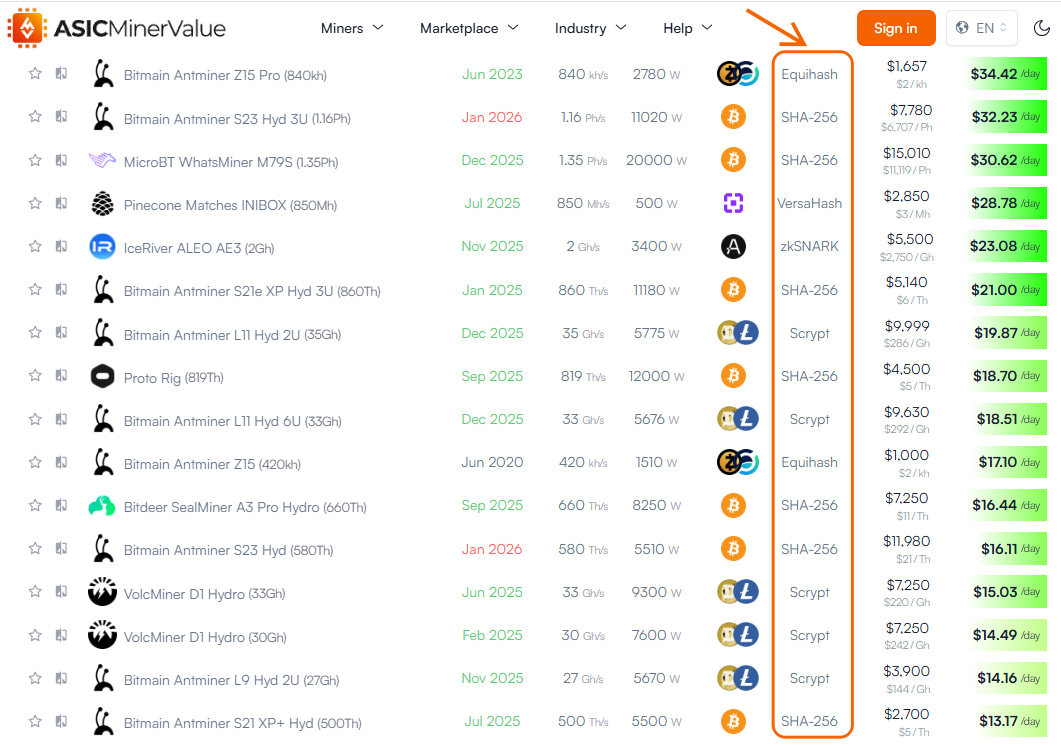
The top position is occupied by the Equihash mining algorithm, used for mining coins like Zcash (ZEC), Komodo (KMD), and Bitcoin Gold (BTG). It's evident that ZCash is the main focus of interest here, as interest in privacy-focused coins has significantly increased in the second half of 2025, with ZCash surging more than tenfold from September to November. This also highlights that its leadership is likely situational rather than long-term.
Following that is the SHA-256 algorithm, corresponding to the mining of Bitcoin and Bitcoin Cash. This is, by far, the most dominant algorithm. Bitcoin mining alone accounts for over 99% of the total mining landscape. SHA-256 is celebrated for its high level of security and is the cornerstone upon which Bitcoin's trustless system is built.
The selection also includes VersaHash, which is used for mining InitVerse (INI) on the IniChain network. This remains an exotic choice, of interest primarily to enthusiasts who follow niche projects.
Scrypt is another major algorithm, powering popular cryptocurrencies like Litecoin (LTC) and Dogecoin (DOGE). Originally designed to be more memory-intensive than SHA-256, Scrypt was intended to be ASIC-resistant, though specialized miners for it are now common.
We should also add the kHeavyHash algorithm, used for mining Kaspa (KAS), which was fairly popular relatively recently. This example, along with the case of Kadena (KDA), is indicative of a common trend in altcoin mining. These projects can experience meteoric rises and attract significant mining hardware from companies like Bitmain, only to later face a decline, loss of coin support, and delisting from exchanges.
In conclusion, SHA-256 and Bitcoin mining represent the top tier and carry the lowest long-term risk among all other mining opportunities. Its unparalleled network security, established ecosystem, and massive global hash rate make it the most stable foundation in the volatile world of cryptocurrency mining.
Factors that affect mining profitability - deeper dive
In addition to the obvious impact of the Bitcoin exchange rate on mining profitability, there are a number of secondary but equally important nuances. For example, the cost of electricity can change depending on the time of day, meaning you don't always earn the same amount. During market downturns, a situation may arise where you incur losses during peak hours (when electricity is most expensive) but make a profit at night. In such cases, it is logical to operate the mining rig only during profitable periods, reducing overall revenue but increasing average profitability.
Systematic equipment maintenance, cleaning dirt and dust from air ducts, etc., is also crucial. If a miner overheats due to contamination, it will fail prematurely, resulting in lost profit. Imagine a miner that, according to your plan, should work for three years, but breaks down after just two, barely having paid for itself, and all because it was poorly maintained. This is a serious blow to the project's overall profitability.
You can monitor the release of new firmware for miners (typically for Bitmain) to promptly "overclock" the devices. This slightly reduces their lifespan but generally increases the profitability of each re-flashed unit.
Hardware cost
Every ASIC miner possesses a set of characteristics that unequivocally determine its place in the modern mining landscape. The (human) miner's dilemma is as follows: mining hardware can be highly energy-efficient, meaning it ensures maximum Bitcoin mining profitability, but then it comes with a fairly high price. We either choose a cheaper miner and earn less, or we take the most expensive one, earn more, but have a longer payback period. What to choose?
You must have noticed that the Cuverse catalog features a wide variety of models — from extremely cheap to expensive ones. For example, the Bitmain Antminer S19k PRO 120 TH/s; 23.1 W/TH costs only $999, while the Bitmain Antminer S21 XP 270 TH/s; 13.5 W/TH costs $5,222. The difference is more than fivefold; why is that the case?
Let's try to understand. The hash rate, i.e., the computational power of the S21 XP, is 2.25 times higher than that of the S19k PRO. This means you will earn 2.25 times more every day (a directly proportional relationship). The energy efficiency of the S21 XP is 1.71 times better (lower) than that of the S19k PRO. Here, an inversely proportional relationship applies. This means you will earn 1.71 times more with the Antminer S21 XP. Total: 2.25 x 1.71 = 3.85: your daily mining rewards with the Bitmain Antminer S21 XP machine will be 3.85 times greater than with the Bitmain Antminer S19k PRO machine.
So why is the price difference still more than fivefold? This is a premium for the brand, for an extensive dealer network, for timely firmware updates, service, spare parts, etc. The result of working with Bitmain is presumed to be profit maximization. Sounds like your goal? Work with Bitmain.
Electricity costs
A deviation in the cost of electricity of just 1 cent per kilowatt-hour leads to a significant increase in the cost of mining. Therefore, if there is a parameter to start reducing costs from, it is undoubtedly the price of electricity. In practice, you yourself cannot reduce anything because the electricity tariff is a given fact set for you by the energy supply company.
Your task is to choose a strategy that does not contradict the energy tariff. This means that the energy efficiency of mining equipment is your top priority and can only be limited by its price. Choose the upper price bracket — thereby, you minimize the risk of losing profitability.
The price of electricity for an individual is always higher. Large companies purchase electricity directly; it is always cheaper for them. Thus, placing your miners in a hosting facility is the most reasonable approach today because tariffs in large data centers are low, and the level of service is very high. It is highly likely that with hosting, you will earn significantly more than trying to set up your own mining infrastructure.
Mining revenues
Bitcoin mining is a fascinating business, but it would have never been so fascinating if not for the potential for super-profits. However, when it comes to revenue, there are nuances. Revenue is gross profit, not net profit. You could mine a pile of Bitcoin and spend even more on electricity. That’s not the kind of mining we need.
It's necessary to find a point of balance where you are earning. When electricity prices fluctuate, you shouldn't keep mining until you drop. Mine only during the hours with the lowest electricity cost—you'll get lower revenue but higher net profit. Why would you unnecessarily heat the air? Others will manage that without you.
Time to break even
The break-even period for a mining device depends on two key factors: its energy efficiency and its purchase price. Using the same mining profitability calculator website, you can input your local electricity cost and select the models you are interested in. The results will display a column showing the estimated net daily profit for each device. To get a rough estimate of the payback time, simply divide the initial cost of the miner by this daily profit figure.
It's important to recognize that this calculation provides a very superficial estimate. The primary reason is that daily mining revenue is highly volatile and can fluctuate significantly from one day to the next due to changes in cryptocurrency prices, network difficulty, and transaction fees. Despite this inherent volatility, this method is excellent for comparing different miner models against each other and for quickly identifying which hardware looks most attractive under the current market conditions.
When evaluating the return on investment, it's crucial not to focus solely on the number of days to break even. Sophisticated, long-term mining strategies must include a margin of safety for profitability. This concept is key: a more expensive miner with a longer projected payback time might ultimately be a more effective strategic investment. Its higher efficiency could allow it to remain operational and profitable during a severe market downturn, while less efficient models would have to be powered down entirely. Therefore, resilience during low-profitability periods is a critical factor that a simple days-to-break-even calculation does not capture.
Hydro-cooling, air-cooling, or immersion?
Air-cooling of operating miners seems the simplest and most accessible option. This implies it has hidden drawbacks, where relative affordability masks the risks of more significant costs to cover long-term effects. The miners' fans and supply/exhaust ventilation are relatively straightforward. However, the hidden effect of such a system is the overheating of the premises, especially during summer. This will necessitate the installation of an air conditioning system.
Some miners have a built-in hydro-cooling system, which affects their price. Heat from the chips is dissipated in much the same way as from an internal combustion engine in cooling circuits with antifreeze. Here, the issue of large capital expenditures comes to the fore. Mostly, only large corporations operating on a very long horizon can afford such expensive miners. In general, miner manufacturers are adhering to the trend of hydro-cooling, which will lead to a reduction in prices for this type of miner over time.
Immersion cooling involves completely submerging the equipment in liquid. Here, the primary concerns are technological complexity and safety (corrosion, leaks, maintenance difficulty), which leads to an increase in the total cost of the entire facility.
One way or another, based on your strategy, you are unlikely to have to make a choice based on equipment cooling methods – first and foremost, you will be guided by price and energy efficiency. However, if your capabilities allow you to consider many parameters, think about which type of cooling will lead to a reduction in costs in the long term in your case.
Why profitability matters in Bitcoin mining
The reality is that you can't choose the most profitable ASIC based on numbers alone. Strategy and risk management are paramount here. By including models like the Antminer S21 XP in your fleet, your payback period will be longer compared to the Antminer S19k PRO — approximately 1.36 times longer (5.22 / 3.85). However, the Bitcoin market is volatile, experiencing both periods of explosive growth and significant downturns. This volatility must be factored into your mining strategy.
Bitcoin mining has a specific profitability threshold — a Bitcoin price level below which mining becomes unprofitable. Naturally, for the S19k PRO, this threshold is higher than for the more efficient S21 XP. Imagine a significant market drop to levels where mining with the S19k PRO becomes unprofitable. Its payback time extends indefinitely until better market conditions return, forcing you to power it down to avoid losses from electricity costs. Meanwhile, the S21 XP remains operational and continues to generate profit.
Large corporations can afford to invest in the most modern and expensive mining equipment because their strategy is based on high capital expenditure and minimal operational costs (the lowest possible Bitcoin production cost). Those with limited capital are forced to find a compromise between the price and the energy efficiency of the hardware.
What is mining profitability?
Mining profitability is the most crucial parameter, indicating how profitable your operation is. If your income exceeds your expenses, you are profitable. If not, you are unprofitable. The generalized profitability formula is simple: (Profit / Cost) * 100%. No profit means no profitability (negative zone).
Bitcoin mining is a long-term business, and you can temporarily become unprofitable if the market crashes. Such events must be factored into your strategy by modeling various possible outcomes. However, mining profitability must remain positive overall; otherwise, there is no point in starting operations.
How to calculate mining profitability?
ROI (Return on Investment) is a key indicator of your investment's profitability, expressed as a percentage. It shows the profit (or loss) you receive relative to the funds invested. Calculating ROI in mining requires considering several variables. Here is a step-by-step checklist.
Example of a simplified annual ROI: A miner costs $5,000, net annual profit is $1,800.
ROI = (1800 / 5000) * 100% = 36% per annum.
Let's take the Bitmain Antminer S21+ (216 TH/s, 3,564 W) costing $3,307. Under current conditions, it generates $4.88 in gross daily income.

1. Cheap electricity: Texas (USA), Kazakhstan (~$0.04/kWh)
- Electricity costs: 3.564 kW * 24 h * $0.04 = $3.42/day.
- Net profit: $4.88/день.
- Annual net profit: $4.88 * 365 = $1,781.2
- ROI: (1,781.2 / 3,307) * 100% ≈ 53.8% per annum.
- Payback period: ~ 1 year and 10 months.
2. Average electricity: UAE, Canada (~$0.07/kWh)
- Electricity costs: 3.564 kW * 24 h * $0.07 = $5.99/day.
- Net profit: $2.31/день.
- Annual net profit: $2.31 * 365 = $843.15.
- ROI: (843.15 / 3,307) * 100% ≈ 25% per annum.
- Payback period: over 3 years.
Simplified formula for quick assessment:
ROI (%) ≈ ( (Daily income - Daily electricity costs) * 365 / Equipment cost ) * 100%
Conclusion: Positive Mining profitability ROI is only possible with a combination of three factors: cheap electricity, energy-efficient equipment, and a rising/stable BTC exchange rate. For a private investor, calculating their own ROI often shows the inexpediency of building a farm "from scratch," making professional hosting services a more economically justified solution.
Bitcoin Mining ROI 2026: Realistic Outlook with Cuverse Data
Bitcoin mining is an industry, a philosophy, a business, and a global idea
Bottom line
To succeed in Bitcoin mining, you need to procure mining hardware that aligns with your business strategy.
If you have substantial capital and are pursuing a long-term mining and Bitcoin accumulation strategy, the most expensive and energy-efficient equipment from Bitmain or MicroBT is suitable. Such miners will have a longer payback period, but they will allow you to remain operational even during a significantly depressed market — you will stay profitable while many others are forced to switch off their miners due to losses.
You can take a different path, excluding the risk of major drawdowns. In this case, you can purchase less expensive miners and achieve a faster payback, provided the market does not experience a steep downturn. The risk is higher, but the initial costs are lower and the potential profit is greater.
You can also employ a combined strategy by filling your mining portfolio with a variety of equipment types. This is a very sober approach that mitigates some risks and allows for a faster return on investment than a maximalist, all-in strategy.
FAQs
Are Bitcoin miners worth it?
Yes, they are worth it, because it's cool to mine Bitcoin! However, one person alone cannot win the battle, especially nowadays when mining is dominated by big business. Join Cuverse to mine under hosting conditions. Don't reinvent the wheel; mine with miners that operate in top-notch data centers and are taken care of by awesome professionals.
How much money do Bitcoin miners make?
Simply put, you can make a lot of money because when Bitcoin grows, you generate super-profits. You also need to understand that there are periods of lulls and downturns in the markets. This must be factored into your strategy—you can't earn all the money. It's like in football: "You'll have half an hour to decide this match in your favor," but that will be the most important half-hour in your mining life! In other words, by earning a little during the quiet times, you only do so to hit the jackpot when the right moment arrives.
Which is better: air-cooling, hydro-cooling, or immersion?
Don't start thinking about Bitcoin mining from the perspective of choosing miner cooling systems. It's not worth it at all. You have a financial model. You have a strategy. You have a budget. You know how much your miners should cost. You know how much each W/TH of their energy efficiency should be worth. So what does cooling have to do with it? Forget this question.
What makes a Bitcoin miner profitable?
If you're asking this question, it means you're looking at the root of it. Bitcoin is a phenomenon, and what makes it so is the phenomenal resilience of its code, the phenomenal idea, and the resulting level of trust in the entire system, from which, in turn, stems Bitcoin's value as an asset. This partly resembles the US dollar, the trust in which stems from the stability of the US economy and the idea embedded within it.
Bitcoin is not just a digital asset, but a technological symbol that cannot be broken by any means available in this world. Think, what else in the world has become so deeply ingrained in it in just 15 years?
How do I calculate mining profitability?
If you are taking your first steps in mining, you might be surprised by the perspective that you actually determine for yourself what mining profitability you need. Why do you want to dedicate yourself to this business? Do you want to be satisfied with numbers on paper? Or do you think in terms of the actual money you want to earn?
Decide how much money you want to make, and then, after reading this article, calculate the profitability of the miners you'd like to work with. If it turns out to be less than you wanted, ask yourself if it's worth starting at all. If it's more — don't even think twice, get to work!
Bitcoin Mining ROI 2026: Realistic Outlook with Cuverse Data
Bitcoin mining is an industry, a philosophy, a business, and a global idea


