
Bitcoin halving dates and the next halving in 2028: full schedule and price outlook
Much has been said about the Bitcoin halving chart. Perhaps everyone knows that every four years, the mining reward is cut in half. Technically, this means a twofold drop in miners' profitability.
This raises a question: what happens in production if the rate of output (or, say, oil extraction) suddenly, or even according to a known schedule, drops by half while costs remain the same? On one hand, it's a catastrophe. On the other—if we remember that product quantity is strictly limited to 21 million units—there is no reason to panic. Did you mine half as much gold as last month? Sad, but you won't stop, because you are mining gold and you know what that entails.
It's worth noting that miners' share of Bitcoin ownership is decreasing as its price rises (according to CryptoQuant). In other words, miners are increasingly losing their ability to influence the BTC price. But is this really important?
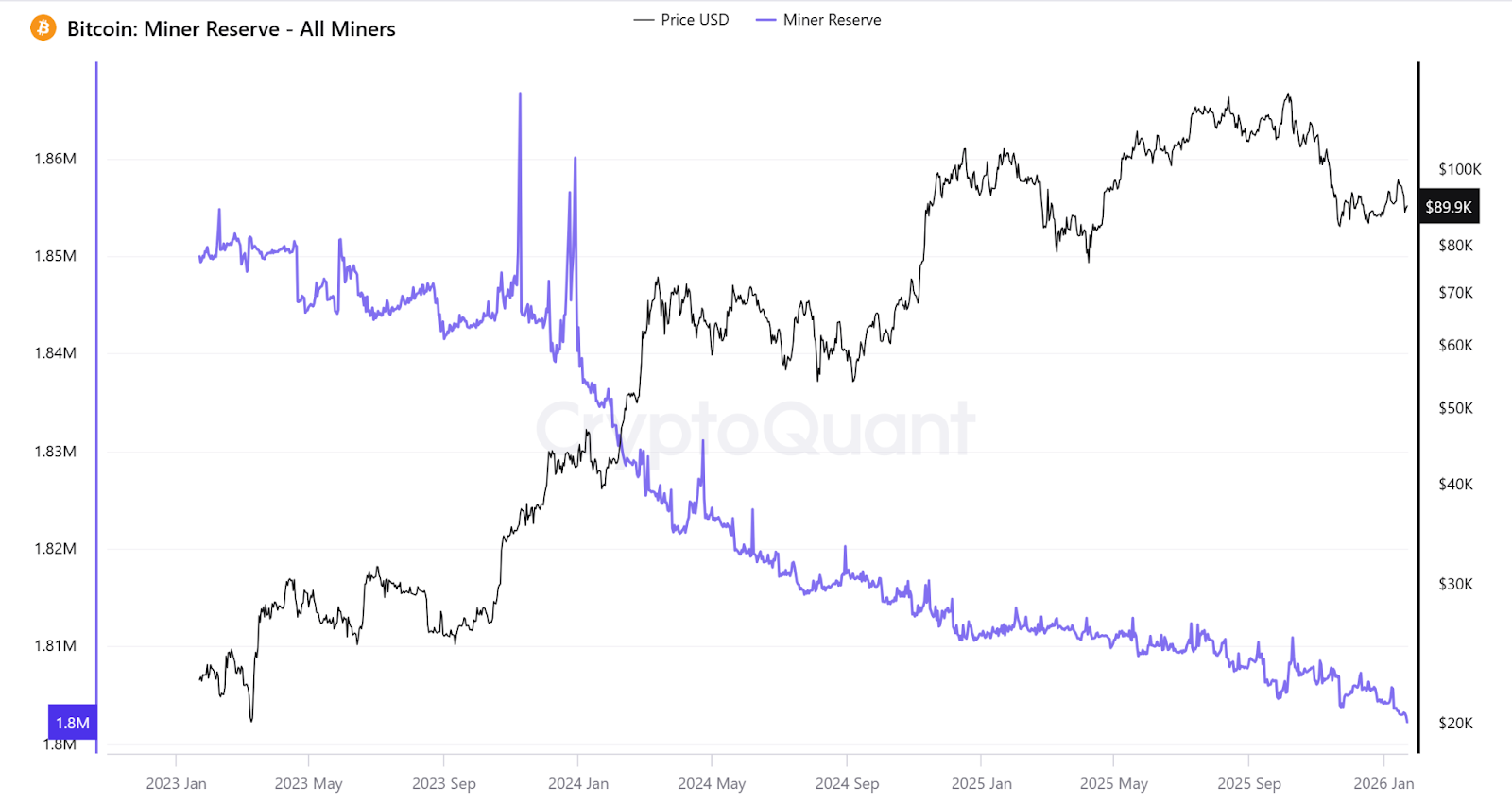
The Bitcoin price is influenced most by the movement of risk capital (indirectly tied to the Fed's interest rate), while miners merely draw an imaginary profitability threshold line, following in the wake of market trends. However, this state of affairs does not mean miners are somehow deprived — after all, an entire industry of mining hardware manufacturers works for them. These manufacturers would be the first to falter if they sensed trouble (as was the case with Kadena mining equipment).
As we can see, the system operates on its own, and no one is interested in its collapse. Therefore, although Bitcoin halving is a traumatic event, everyone will do all they can to survive, which means the price of BTC will rise. That’s partly why the exact timing of the next Bitcoin halving is not critically important, though everyone keeps in mind that it is scheduled for early 2028. The 3 ⅛ BTC per block will turn into 1 9/16 BTC per block rather than into a pumpkin. This signifies nothing more than a new phase of long shadows and wicks on daily candles, which, after burning out, will return us to a state of new stability and new expectations.
Bitcoin halving 2028 date and chart are below.
What is Bitcoin halving and why does it happen?
Every 210,000 blocks, the miner reward is cut in half. The last time the great divider visited the BTC blockchain was in the spring of '24, turning 6 1⁄4 BTC into 3 1⁄8. The executioner leaves no room for mocking the hardworking miners. In the spring of '28, he will appear again and do the same, leaving them with half the profit once more. The halving is not about an exact date because the Bitcoin network's difficulty adjusts the mining speed every two weeks, inevitably causing acceleration or deceleration.
This is relatively clear so far except for one single question: why did Satoshi Nakamoto, whoever he was, choose an initial reward of 50 BTC per block rather than 64 BTC? Did he not believe Bitcoin would endure through so many halvings, or was he simply uninterested in the magic of binary numbers? Today, the reward would be 4 BTC/block, and in 2028, it would be 2 BTC/block.
On the other hand, he earned enough when the network reward was 50 BTC, likely thinking, "après moi, le déluge" (after me, the flood), implying that halvings are a matter for successors, not founders, to deal with. At the same time, he reasoned that 21 million coins were sufficient to create supply scarcity. So the question is: which came first in Nakamoto's mind — total emission size or block reward?
When is the next Bitcoin halving in 2028?
A Bitcoin halving occurs every 210,000 blocks, approximately once every four years, as a block is mined roughly every 10 minutes. Therefore, the fifth halving is expected around March-April 2028, at block #1,050,000 (the previous halving occurred in April 2024 at block #840,000).
The common question of when is the next halving is, generally speaking, of limited significance, as the BTC mining industry does not live for halving alone. Although the upcoming Bitcoin halving will cut mining profitability in half, most importantly, it will raise the entry barrier for newcomers to BTC mining. Meanwhile, established players have already learned to adapt, and the entire industry constantly pushes for adaptation by offering increasingly energy-efficient equipment.
Bitcoin halving history: all halving dates at a glance
Before the fifth Bitcoin halving arrives, let's look back at history and observe how the Bitcoin price changed relative to the Bitcoin halving dates. Literally on the eve of 2013, the first reward halving occurred in the Bitcoin network. By that time, all early whales had already earned enough, the legendary pizza had been purchased for 10k BTC, and the entire enlightened geek community could essentially hang up their boots.
Bitcoin halvings by year
|
Halving # |
1 |
2 |
3 |
4 |
5 |
|
Date |
28.12.2012 |
09.07.2016 |
11.05.2020 |
20.04.2024 |
Q1-Q2 2028 |
|
Block Height |
210,000 |
420,000 |
630,000 |
840,000 |
1,050,000 |
|
Reward Before |
50 BTC |
25 BTC |
12 ½ BTC |
6 ¼ BTC |
3 ⅛ BTC |
|
Reward After |
25 BTC |
12 ½ BTC |
6 ¼ BTC |
3 ⅛ BTC |
1 9/16 BTC |
|
BTC Price |
$12.5 |
$655 |
$9,315 |
$63,846 |
? |
|
BTC Mined |
10,500,000 |
15,750,000 |
18,375,000 |
19,687,500 |
20,343,750 |
|
BTC Left to Mine |
10,500,000 |
5,250,000 |
2,625,000 |
1,312,500 |
656,250 |
It's curious to imagine what awaits us in 2028 — what the price will be, what the market sentiment will be like, and what average energy efficiency will allow miners to continue profiting in this increasingly complex market. Often, to understand the present, it's worth assessing the extreme scenario: what would happen if all the Bitcoins were already mined? What is the value of a "Byzantine consensus system" that has operated flawlessly for 20 years? As Arthur Hayes rightly notes, “This alone guarantees that Bitcoin’s value is greater than zero”.
Bitcoin halving chart: rewards, supply and emission over time
Do Bitcoin halving dates hold any significance today? How substantial is the influence of halvings on BTC's market prospects, and should we view the Bitcoin halving schedule as a kind of calendar for cryptocurrency market cycles?
Bitcoin halving chart:
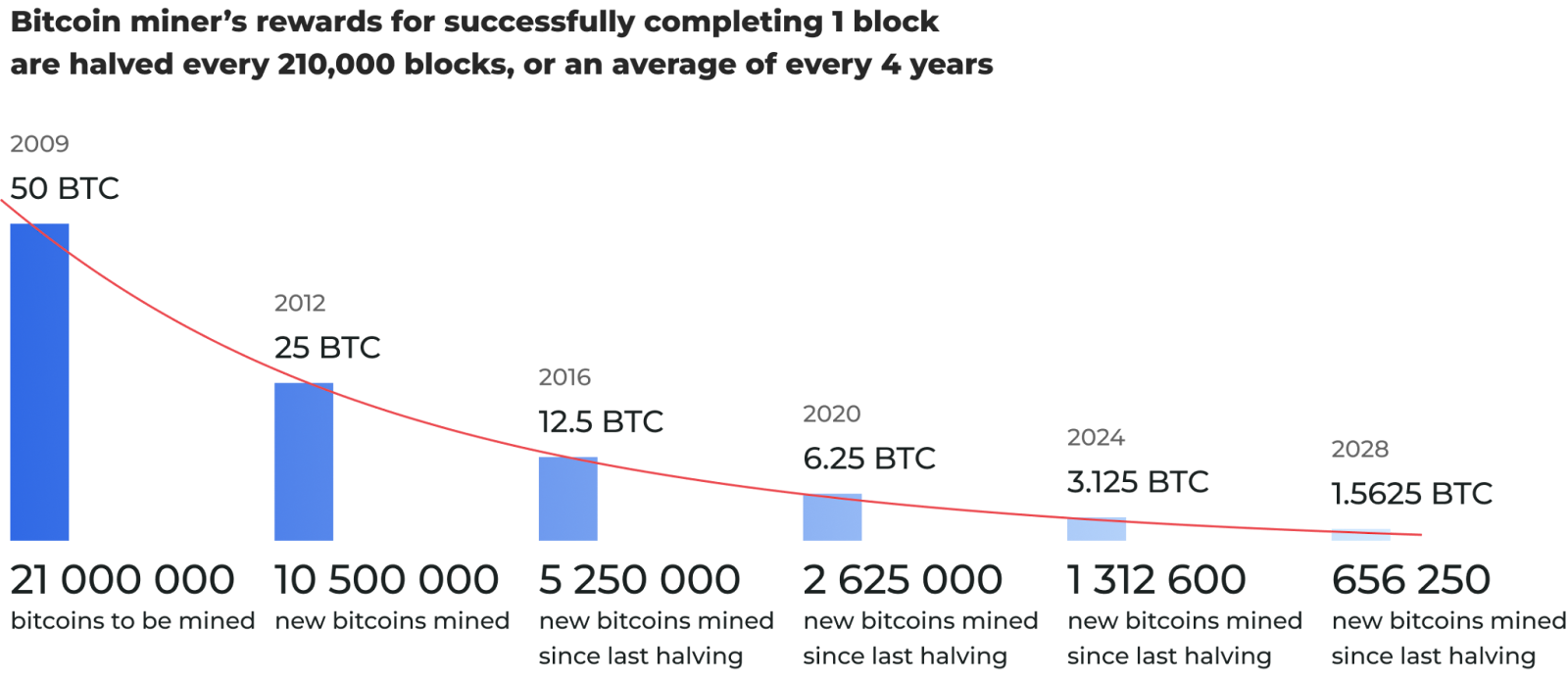
If we look at the halving phenomenon objectively, the only ones who truly feel its impact are the miners, as they directly absorb the blow of a halving in profitability. However, it's not the miners who dictate the market price of BTC. A scenario where, due to the actions of whales, the Bitcoin price falls to a level where mining becomes unprofitable for anyone, is entirely possible. Yet, the Bitcoin network will adjust its difficulty in such a way that profitability will eventually be restored. The market will be cleansed of weak miners and a new cycle will begin. In this sense, the periodicity of market cycles has already become decoupled from halvings and now depends on whale sentiment (the movement of market capital and overall market sentiment).
How Bitcoin halving impacts price, miners and inflation
Thus, taking into account the above, the impact of the halving on the Bitcoin price is becoming increasingly indirect, more akin to a habit of market participants stirring up activity every four years. Miners themselves have other priorities — maintaining profitability is paramount.
For miners, a bitcoin halving 2028 date estimate is very important, as after this date, all inefficient equipment will have to be shut down. However, this will trigger a difficulty recalculation, after which some of that equipment will become operational again.
The Bitcoin halving event is a kind of survival experiment, where miners are essentially shown their place in the ecosystem and expected to survive however they can in plain sight. Survival is facilitated by the evolution of mining hardware. The constant improvement in its energy efficiency encourages long-term planning among those determined to continue mining. In essence, miners are forced to constantly anticipate the next halving and take measures to ensure it isn't their last. This is aided by major mining hardware manufacturers who are coming up with ever more efficient equipment.. It's as if each winter is colder, but the logs burn hotter each next season, preventing anyone from freezing.
The halving itself is no longer capable of directly influencing the Bitcoin price. However, from the perspective of market cycles, it is quite capable of amplifying attention to Bitcoin, repeatedly proving to everyone that the system works, offers earning opportunities, and attracts new players. This is where HODL, FOMO, and greed tightly interwoven with fear come into play. Once you start with Bitcoin, it doesn't easily let go.
FAQ about Bitcoin halving
In this article, we have adopted a philosophical approach to the issue of Bitcoin halving and its impact on the industry. Experts often attempt to make bitcoin price predictions for the 2028 halving, but these are merely extrapolated expectations. There are only facts and their interpretation. For example: mining profitability halves every four years. U.S. elections are held every four years. The solar activity cycle is 12 years. Lunar phases... And so on. Everyone is free to consult their own internal interpreter to analyze this, but heaven forbid analyzing the chart trends.
When was the last Bitcoin halving and what changed?
The fourth, and so far the last, Bitcoin halving occurred on April 20, 2024.
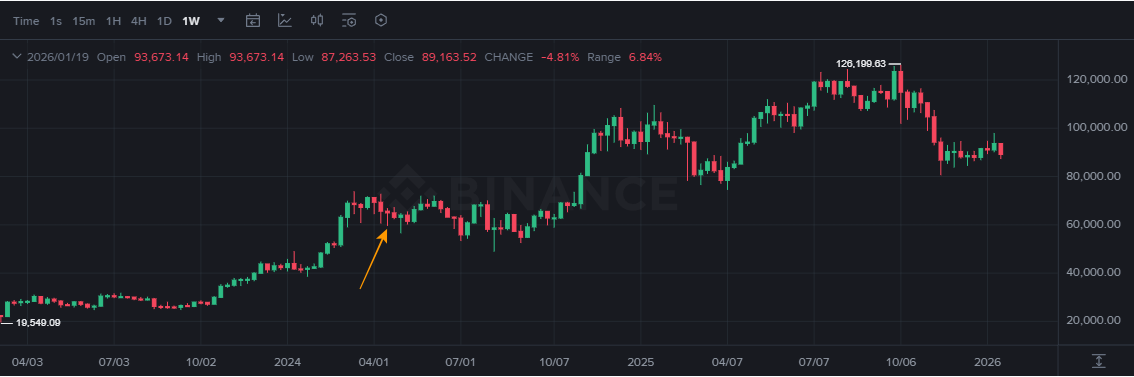
On Bitcoin's weekly chart, the halving resembles a dim star in the night sky, one among thousands, with nothing indicating the event's momentous nature. Yet, the gears of the Bitcoin mechanism seem to begin turning differently afterward, and the flywheel of history spins more fiercely with each passing week after a halving.
In any case, Bitcoin's halving cycle coincides with the U.S. presidential election cycle. Therefore, it's quite possible that what matters is not so much when the last Bitcoin halving was, but rather when the last U.S. presidential election took place and what policy shifts followed.
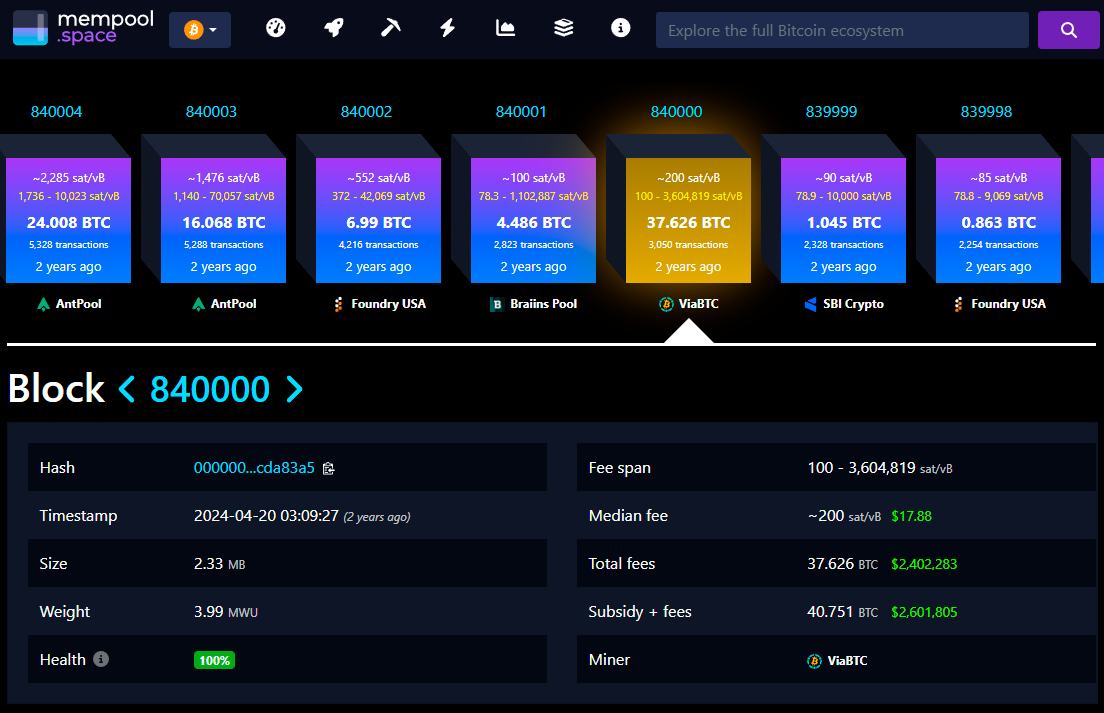
If you look into the Bitcoin network at the moment of the halving, passions are certainly ablaze. At block #840,000, a miner earned over 37 BTC in fees, while the block reward itself was only 3 ⅛ BTC. Long live the ViaBTC pool!
What is the Bitcoin halving schedule and how many halvings are left?
A Bitcoin halving occurs every four years. There have been four so far, with a total of 32 planned. Bitcoin halvings are exerting less and less influence on the market every time, but they serve as a kind of marker for miners' viability in the new "halved" reality. A twofold loss in mining profitability is a challenge that demands constant hardware upgrades, and miners have managed this so far thanks to the evolution of ASIC manufacturers.
How to prepare for the 2028 Bitcoin halving as an investor
The easiest way to find out when the next Bitcoin halving is to use one of the many online countdown timers. The exact date of the next Bitcoin halving cannot be pinpointed because block mining speed is not constant. If the difficulty increases, the speed also increases, so each block takes less than 10 minutes to mine, and vice versa. The halving date is known with an accuracy of 1-2 months, which is sufficient.
The day of the halving itself is no different from any other day, so it may or may not carry buy signals. To buy Bitcoin, one should be guided by their own strategy regarding BTC's market prospects and the local market conditions. Bitcoin halving dates are important for miners but hold little significance for those not directly involved in mining and those who employ long-term investment strategies.


