Bitcoin mining ASICs in 2026: Efficiency and profitability explained
This article is intended to help you understand the resources required to earn income through Bitcoin or other crypto mining. Bitcoin mining ASICs — what are they, how does mining work, what obstacles stand in the way of receiving daily mining rewards, where to start, and how to maintain an ASIC’s efficiency and profitability? There are many questions, but it boils down to this: today, earning through mining on your own is not feasible. However, everyone has a chance to earn with the right strategy!
How ASIC Bitcoin miners work (simple explanation)
Let's clarify what an ASIC is and how ASIC miners work. An ASIC, or Application-Specific Integrated Circuit, is a specialized chip — a bitcoin mining machine. Typically for soulless machines ASICs don't spread their efforts; they solve one specific task: to guess, by means of an exhaustive search, a long 64-digit hexadecimal number of a given difficulty (called a "hash"). Why? To become the Chosen One and receive the reward. That's how Satoshi Nakamoto, whoever he was, designed this blockchain. Previously, this specific task was unspecific enough to be solved using non-specific means, i.e., computers and graphics cards (GPUs). Alas, as the song goes — those days are gone.
Today, approximately 1,000 EH/s of computational power is dedicated to solving this task. An exahash — clearly, that's a lot, but what is this word "exa"? We know "kilo," "mega," maybe "giga," but not anything beyond that. But it’s there that everything related to Bitcoin begins—"tera": a terahash equals a trillion hashes. 1 TH/s = 10¹² hashes per second. Petahash: 1 PH/s = 10¹⁵ hash/sec. And say hello to the exahash: 1 EH/s = 10¹⁸ hash/s = 10⁶ TH/s. So, all the mining hardware in the world brute-forces a thousand exahashes every second to win the prize. That is, a billion terahashes are processed every second to make money — relentlessly burning endless kilowatts to get a hit of euphoria worth 3⅛ BTC every 10 minutes.
This may seem like a harsh trial, but in all fairness — ten billion people on the planet are striving for roughly the same thing in order to survive. But somewhere in this Maslow's pyramid are the lucky ones who can afford not only to play with Bitcoin but also to multiply it through mining. Let's talk about it.
Key performance metrics: hash rate, power consumption, efficiency
There are literally only a few parameters around which everything revolves at the core of Bitcoin mining. When we think about mining hardware, what comes to mind are hash rate, power consumption, and efficiency. Yes, of course, price is also factored in, but let's assume we're at that romantic stage where our decisions are governed purely by logical and technical considerations.
So, hash rate is a measure of computational power. Essentially, the higher a miner's hash rate, the more hash-finding operations it can perform per second. For example, the hashrate is 270 TH/s. That says it all. However, with an increase in hash rate comes an increase in power consumption. Miners are power-hungry creatures. Let's say we're talking about the Bitmain Antminer S21 XP whose power consumption is 3,645 W. That's substantial! Such a device cannot simply run in your kitchen like a regular electric kettle. It's a kettle that ferociously boils water around the clock, as if possessed.
And here's the main trick — efficiency. It turns out that the same 270 TH/s can consume power differently. In the case of the S21 XP, it's 13.5 W/TH. That means the device consumes 13.5 watts per 1 terahash per second. The same device with, say, an efficiency of 27 W/TH would cost twice as much to operate!
Efficiency is often written as J/TH - joules per terahash, which is equivalent to watts per terahash. There are several different notations, but the essence is the same. The better the energy efficiency, the greater the chances that the miner will pay for itself and earn money in this volatile world.
Is Bitcoin mining with ASICs still profitable in 2026?
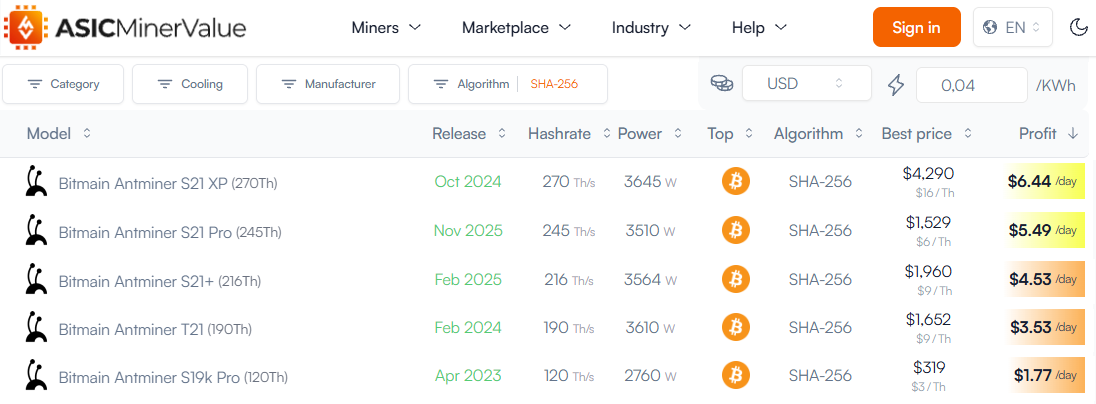
On the grim day of January 30, 2026, after BTC fell to $81k, this screenshot was taken from the AsicMinerValue mining calculator (on a website with the same name). The list of miners is not random—these are top-tier mid-class models, whose combined power (along with similar models) accounts for over 20% of all operating equipment. These miners are part of Cuverse's arsenal and are offered for hosting. On the left is the ASIC used for mining, on the right is the ASIC mining profit — it's that simple. Is bitcoin mining profitable?
Mining income heavily depends on the price of electricity and the equipment's energy efficiency. Let's evaluate how a miner's daily earnings change if the electricity price shifts by just one cent.
Let's evaluate bitcoin mining profitability 2026 if the electricity price is $0.04/kWh and Bitcoin price is around $82.5k:
Daily profit at the electricity price of $0.05/kWh:
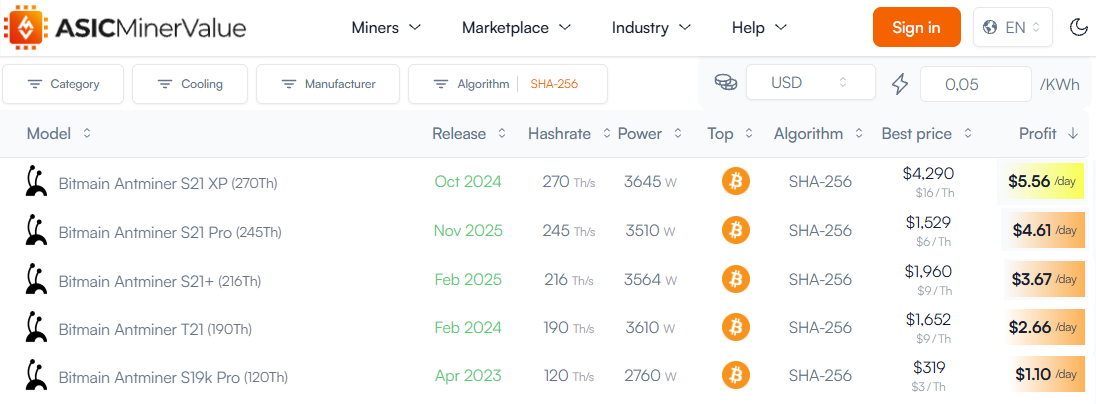
As evident from the two tables, the difference is significant. This is why access to cheap electricity is so crucial for engaging in Bitcoin mining.
A miner's energy efficiency is calculated as Power / Hashrate (from this table). S21 XP boasts the best energy efficiency of 3,645 W / 270 TH/s = 13.5 W/TH. This number shows how many watts of electricity the miner consumes per terahash per second. The worse the efficiency, the lower the miner's profit. Add to this the important fact that a miner's efficiency naturally degrades over time, especially if poorly maintained (dust clogs the cooling system, chips overheat and their performance declines).
Other expenses will undoubtedly reduce your profit, and this is also crucial to remember to avoid viewing the world through rose-colored glasses. Mining pool fees, taxes, salaries — there are numerous cost items. Even if everything is calculated, the Bitcoin network's difficulty can increase, proportionally reducing mining rewards. It feels like there's a catch everywhere. But it works both ways — with a favorable wind, mining profit can more than compensate for all the pain of your expenses and efforts.
How to calculate ASIC mining profitability step by step
How to calculate ASIC mining profitability? We have shown how this is done using a mining profitability calculator. This calculation doesn't require much effort. But you can also do it yourself, and here is the formula:
First, calculate your mining reward:
REWARD = (Your Hashrate / Network Hashrate) × (Block Reward) × (Number of Blocks per Day).
There are many variables here, as the mining pool you connect to doesn't mine all the world's blocks, and the network hashrate is constantly changing.
Now, let's calculate ASIC mining profitability using the daily profit formula:
Daily Profit = (REWARD × BTC Price) – (Your Power in kW × 24 hours × Your Electricity Tariff) - (Fees and Other Expenses)
Obviously, Bitcoin price and electricity cost are the main components of successful mining. However, in a borderline market situation, all components become important. For example, the mining pool fee, internet costs, maintenance, rent, etc. Small expenses multiply and turn into a snowball when things are far from ideal. Miners have to operate not only in favorable conditions but also endure tough times when maintaining profitability becomes the primary concern.
To evaluate mining as a whole, ROI is used: ROI = (Revenue - Expenses) / Capital Costs × 100%
By offering miners on a hosting basis, Cuverse demonstrates by example how to build a mining business correctly. This is, first and foremost, an infrastructural investment in a long-term business. Such a strategy involves timely equipment upgrades to ensure its energy efficiency never comes into conflict with market realities.
Realistic ROI and payback scenarios for ASIC miners
The most interesting aspect when you buy an ASIC for mining is its payback period. Payback is a more important parameter than price or even ROI because it already encompasses both price and energy efficiency. However, you cannot rely solely on payback if you have big plans. The thing is, if you happen to buy complete junk for next to nothing, but it can still mine, earn, and pay back quickly — that's just luck. When it comes to strategy, good energy efficiency is what will allow you to earn consistently over the long term in any market situation, even if such a project's payback period is far from ideal. The market is changing: today it's gloomy, tomorrow it could skyrocket so fast you won’t be able to catch up. Therefore, energy-efficient equipment is like having the ultimate weapon hidden in the bushes: you can both threaten with it before the fight, and when needed — fire fiercely with all barrels until complete victory.
PAYBACK PERIOD = PRICE / Daily Profit
The payback formula is simple. Any investment in mining has a price, which is essentially a constant. The daily profit is more complex. Initially, it's calculated in bitcoins but it fluctuates based on network difficulty, hashrate, unforeseen expenses, pool fees, etc. And if you convert it to USD, it also depends on the BTC price. Therefore, you cannot calculate the payback period precisely — it will only be an approximation. The same applies to ROI. It's one thing today, another tomorrow.
Let's take, for example, the Antminer S21 XP from the list above at a price of $0.04/kWh. Its price in the Cuverse catalog is $5,204, and the calculator promises $6.44/day. According to the formula, we divide the price by the profit, and what do we see? Payback = 800 days, which is over two years! It might seem like a disastrously bad result, and it would be better to grab some cheap junk that will pay for itself in about a year and a half. But that's a dead-end path, as the S21 XP will withstand deeper market dips, and in an uptrending market, it will pay back sooner and earn a lot more money. Meanwhile, the junk simply won't live to see that wonderful day. So, extend your strategic horizons, and then your equipment will bring you not only joy but also good money!
Factors that affect efficiency and profitability of ASIC mining
The relevance of ASIC mining persists even in tough market times because for every market downturn, there is a miner whose efficiency allows it to remain profitable. Bitcoin mining is a self-regulating competition where the one with the longest-term vision wins. Equipment must be upgraded, and its efficiency improved. The upgrade schedule is your primary strategic asset.
At Cuverse, this approach has been perfected. In a large company, you cannot leave equipment to its own fate; it must have a specific operational lifespan and earn its designated amount. Only then will success be long-term and sustainable. If you ever stop, cut back on upgrade costs, and resign to fate, that success will be your last, and you will eventually have to shut down. Cuverse works for the future.
As we've noted before — BTC price and electricity cost are the primary success factors in mining. But even if these are favorable, there are secondary parameters whose importance should not be underestimated: your total hashrate and its operating mode. In some cases, if different electricity tariffs apply within a single day, you can focus on the most efficient mining during the most favorable hours, while the 24/7 model can be reserved for periods of market growth. Not every instance of equipment idleness means lost profit!
Furthermore, it’s crucial to upgrade equipment in a timely manner — reputable manufacturers periodically offer new firmware that can make miners operate more efficiently.
How to choose the right ASIC miner for your budget and power price
Choosing an ASIC miner is a task that requires calculation. Here are the key steps:
- Define your goal. Choose the coin you want to mine (e.g., Bitcoin, SHA-256 algorithm). However, since we've been focusing solely on Bitcoin mining in this article, this point, while necessary, falls somewhat outside its scope due to its universal nature.
- Select a miner from all available ASIC models based on price, payback period, and energy efficiency. It should fit your budget, pay back within a reasonable timeframe, and be efficient enough to remain profitable at every minor market downturn. For this step, it's wise to use the calculator mentioned above.
- Consider how you will service equipment from this manufacturer. Who provides service support? Where will you get spare parts? How will you update the firmware, and is it even available?
- Re-evaluate everything, taking into account all the costs you'll incur — and that's not just electricity. The device needs to operate in a well-cooled space, its noise shouldn't bother you, and you must maintain it in the best possible way to prevent its energy efficiency from degrading over time. Top-tier industrial ASICs require a dedicated room!
- Scale your mining farm gradually as you generate income. This could be done with identical models or more energy-efficient ones. Do not allow your total fleet efficiency to drop without a significant reason (such as a very attractive price).
Common risks and mistakes in ASIC Bitcoin mining
A beginner's primary mistake is chasing the fastest possible payback period based on current market conditions. Remember, the one with the most energy-efficient equipment wins. Whether the market falls or rises, such equipment always generates profit and earns the maximum.
It is also dangerous to underestimate the cost of electricity — the tariff should be precise and transparent, or better yet, fixed (as offered by Cuverse). As we demonstrated above, even a one-cent change in the tariff leads to a significant drop in profit!
Mining calculators show a momentary snapshot. Today it looks one way, but tomorrow it can change drastically. Approximations based on calculators don't work. Stress tests do — imagine what will happen if the price drops to level X. What is your strategy, what market scenario does it allow for?
Imagine that legislation in your jurisdiction has changed abruptly. What will you do? How will you act? Where will you move your miners?
Imagine that the noise level from your miners has become a problem. How will you solve it?
The best antidote to rose-colored glasses is a thorough examination of all "what if…" scenarios.
Who should (and shouldn’t) invest in ASIC Bitcoin mining
The relevance of mining any cryptocurrency is not an empty phrase.When evaluating mining, a private investor always considers which market phase is more advantageous for entering this business. Typically, the worse the market sentiment, the cheaper the equipment—that's precisely when you should buy it! The profit will come later. Profitability will increase when the market turns upward. But the equipment price will be optimal only when everyone is in despair and has stopped dreaming. If you approach this financial instrument this way, it will undoubtedly yield good returns.
An owner of premises with cheap electricity holds almost all the cards. They can afford a wide range of miners with a good spread in energy efficiency. Cheap electricity is the key to success because, in our competitive world, not everyone starts with such advantages. If you have a cheap power outlet—you were born for mining; use your edge!
The next category is those seeking passive income. For such investors, the best option is equipment hosting in a large data center. This is precisely what Cuverse offers to its clients. The company immerses the user in an environment where no specialized knowledge or technical details are required. You buy the equipment and maintain it like a magnificent beast in the world's finest zoo, where it is fed, washed, petted, and its golden fleece is combed. All that's left for you is to watch the mined gold accumulate in your account. Just don’t forget to buy an electric comb.
FAQ
A lot of questions are usually asked about ASICs for mining. How to choose an ASIC? How to calculate profitability? What should the payback period be? And is mining even relevant today? We answer these questions impartially and systematically. For us, mining is always relevant because Cuverse is a major mining company with developed mining infrastructure. The energy efficiency of our miners allows for successful Bitcoin mining even in the most challenging market conditions and, moreover, enables us to invite private investors to collaborate through miner hosting.
The main benefit of such a partnership is that you don't need to build your own farm — it already exists. All you need to do is select the parameters of this farm, pay for the equipment, and remember to cover the electricity costs. You will be monitoring not the process, but the dynamics of your BTC account balance.
Can I mine Bitcoin without an ASIC miner?
Today, there is only one viable tool for profitable mining, and that is an ASIC. No super-duper processor or even a graphics card can withstand competition with a purpose-built chip. The industry has decided this for you — all of us are currently in the clutches of manufacturers of useless specialized equipment.
Is it better to buy Bitcoin or invest in ASIC mining hardware?
This is a question of strategy. You can buy gold, or you can buy shares in gold mining companies. You can also mine gold yourself (if you can). Or you can invest in gold mining equipment. There are many options; which one resonates with you more? Mining Bitcoin and buying Bitcoin (never mind cloud mining) are two different temperaments, two different horizons and you should discover which is best in your case. Choose mining if you have superpowers (see above), or do it together with Cuverse.
How long do ASIC miners usually stay profitable?
An ASIC miner is a miner with profitability above the market average that can withstand negative market trends longer than others, even when the Bitcoin price drops sharply, as happened on January 30, 2026, when this screenshot was taken. The relationship between mining income and the BTC price is directly proportional. Bitcoin is a risky asset. When the Fed hesitates on cutting rates, mining profitability declines. The market needs an influx of cheap money.

However, the mining system has a counterbalance — the Bitcoin network's difficulty. If mining becomes unprofitable, some equipment is shut down, leading to a drop in difficulty: this has been happening since November 2025. The relationship between mining income and difficulty is inversely proportional.
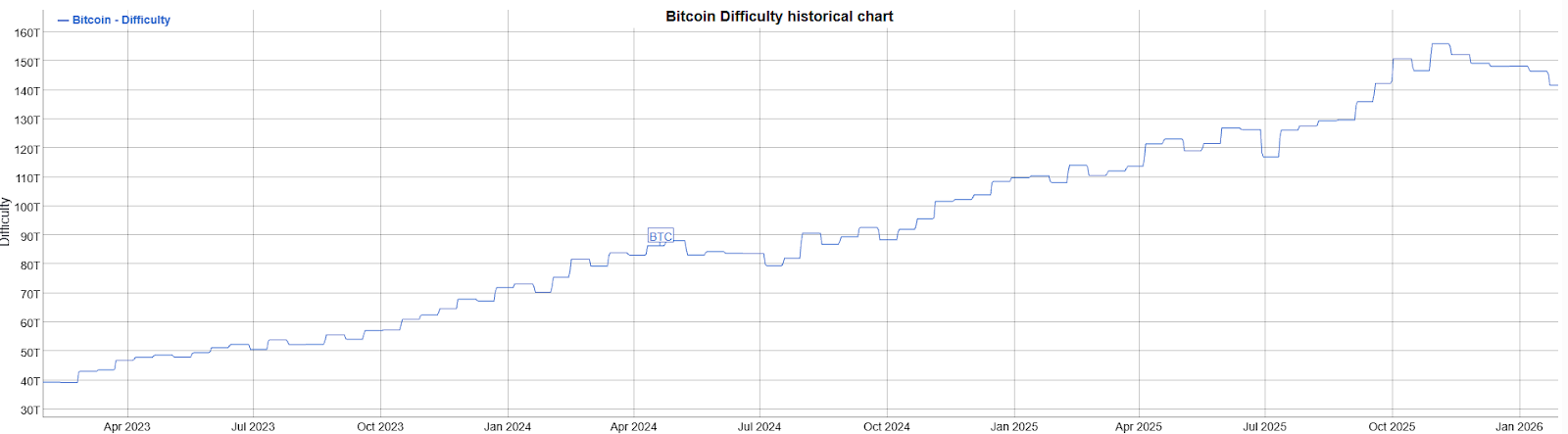
Thus, the Bitcoin price cannot simply be dropped with impunity — ASICs mining parameters will adjust in such a way that the strongest miners survive and become even stronger. The market will be cleansed of weaker miners, and a new growth cycle will begin. The key is not to be among those who couldn't withstand the pressure. By joining Cuverse, you'll be among the stronger players, simply because your miners are efficient and your electricity cost is among the best.


