
How much does mining yield in 2026? Is bitcoin mining profitable? What factors affect mining profitability of such production? Can one expect to succeed? When calculating in dollar terms, the Bitcoin exchange rate affects ROI most significantly. In addition to this direct proportional impact, mining profitability is also influenced by the Bitcoin network difficulty — if it increases, then, all else being equal, the size of daily mining rewards proportionally decreases.
The Bitcoin network difficulty is recalculated approximately every two weeks and is designed to balance the block discovery rate, which changes due to decreases or increases in total computational power (hashrate). The higher the difficulty, the smaller the mining reward earned by a miner, all else being equal (an inversely proportional relationship). In 2025, the difficulty grew from 110 T to 148 T, i.e., by a factor of 1.35. This means that mining profitability decreased 1.35-fold.
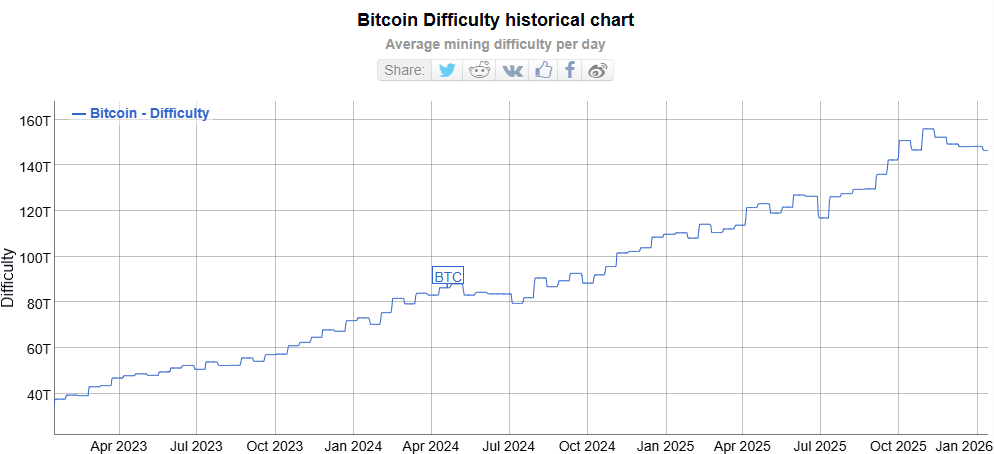
Analysts often alarm the public with apocalyptic forecasts like a twofold drop in Bitcoin price. However, it's essential to understand that the Bitcoin system will regulate itself. It can be assumed that in such a case, the Bitcoin network difficulty would drop by 70-80%, and only then begin to rise as capitulated miners return. This would initially fully compensate for the price drop and then clear the market of weaker participants. Each player would be free to make their own decision — to continue or not — but strong players never capitulate because mining remains profitable due to their chosen strategy.
The Bitcoin halving occurs approximately every four years. Each such event cuts mining rewards in half. That is, mining profitability instantly drops twofold, and one must live with and accept this.
Thus, mining is constantly changing but remains extremely profitable with the right strategy and the correct choice of initial conditions.
What is Bitcoin mining and how profitability is calculated
Mining is the process of earning Proof-of-Work (PoW) cryptocurrency. It involves receiving rewards for performing energy-intensive computations in a competitive environment. The electricity costs incurred secure the network, since compromising it would require even greater expenditures, outweighing any potential benefit for malicious actors.
Bitcoin mining is a computational process carried out by ASICs (Application-Specific Integrated Circuits). Approximately every 10 minutes, this hardware finds a required hash (a 64-digit hexadecimal number) whose difficulty is set by the Bitcoin network. The successful miner receives a block reward and transaction fees for the transactions included in that block. Bitcoin's issuance consists precisely of these block rewards, which are halved roughly every four years in an event known as "halving."
Thus, the revenue stream in Bitcoin mining comes from block rewards + transaction fees included in the block. The cost side comprises capital expenditures on equipment and infrastructure, electricity, mining pool fees, and other operational expenses.
To assess bitcoin mining profitability and ROI (Return on Investment), it is necessary to account for all expenses in your crypto business and correctly estimate the payback period and, consequently, the amortization of capital costs.
ROI = (Revenue - Expenses) / Capital Costs * 100%
ROI is typically considered on an annual basis, but it can be calculated for a month or any other period if you need to compare it with other ROI metrics (e.g., the weekly ROI of different machines or even another business).
Bitcoin Mining: How It Works & How to get started in 2025-2026
How to mine Bitcoins every day in a mature market?
Block reward, fees, hashrate and difficulty
The Bitcoin halving instantly halves mining rewards, reducing the profitability of BTC mining by half. In addition to block rewards, miners earn transaction fees on the Bitcoin network. The example of block #840,000 (the block before the most recent 2024 halving) illustrates how dramatically network fees can surge during peak activity. The total amount earned by the ViaBTC mining pool for mining that block was over $2.6M, while the block reward itself was approximately $200k—the rest were fees!
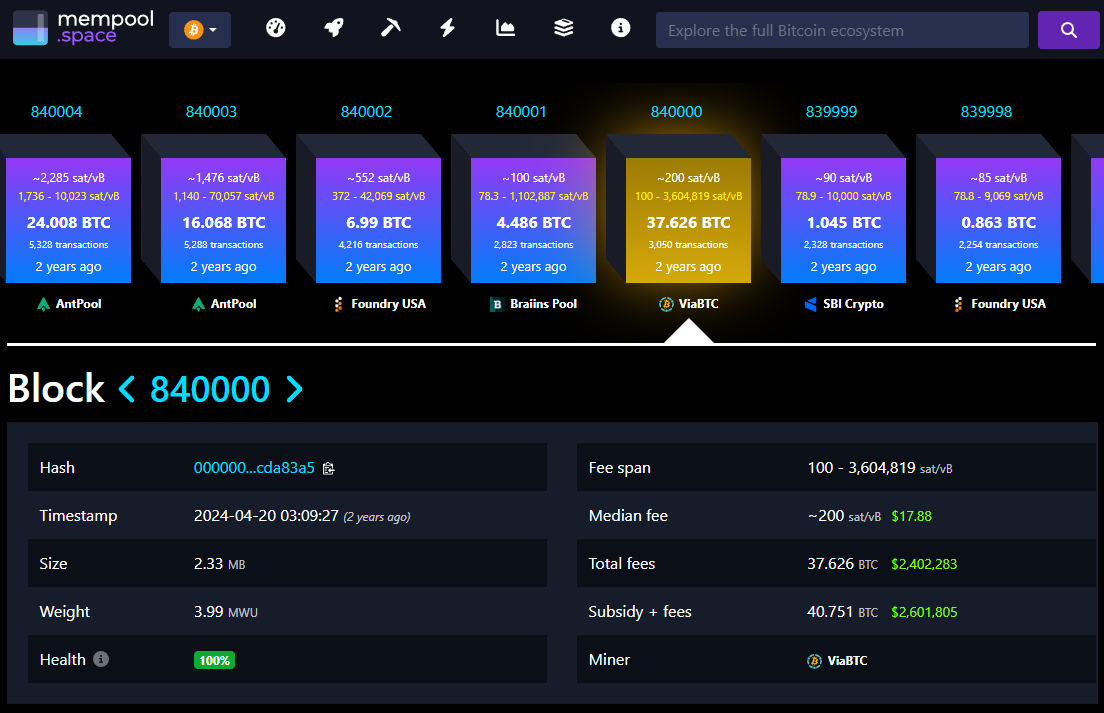
As mining profitability decreases due to halvings, the role of transaction fees will become increasingly important. At the same time, the total network hashrate and difficulty continue to significantly impact rewards. The higher the hashrate (computational power), the faster blocks are found. The Bitcoin network automatically recalculates its difficulty approximately every two weeks (every 2016 blocks) to maintain the target block discovery time of 10 minutes. As the hashrate increases, the difficulty inevitably rises, as the graph in the first chapter shows.
Bitcoin network difficulty has an inverse proportional effect on the reward size. When calculating mining profitability, it's essential to account for the dynamics of all these components to achieve the most accurate estimate.
Key factors affecting Bitcoin mining profitability in 2026
Is mining bitcoin profitable? In summary, Bitcoin mining profitability is primarily influenced by the BTC exchange rate, electricity cost (the main operational expense), the pace of hardware upgrades, the quality of technical maintenance, Bitcoin network difficulty, and other expenses (mining pool fees, infrastructure costs, etc.).
In 2025, mining went through both exciting growth periods and downturns. Is bitcoin mining still profitable? Absolutely! With the right strategy, 2026 has every chance of being even more exciting!
Mining hardware efficiency and equipment costs
The Cuverse catalog offers miners for hosting under any strategy. The evolution of hardware helps us evaluate its characteristics (as of early 2026).
The April 2023 release, the Antminer S19k PRO, had an excellent energy efficiency of 23.1 W/TH for its time. Today, this miner costs just over $500, offering less than $1 in daily net profit and a corresponding payback period of around two years. Such a miner is suitable for trying out mining without significant investment. Three years after its release, it appears outdated.
The Antminer S21+ model, a February 2025 release, boasts 16.5 W/TH energy efficiency and about $3.5 in daily net profit. Its payback period is comparable to the S19k PRO, but its profitability margin far exceeds it, meaning this miner will operate much longer and generate more profit.
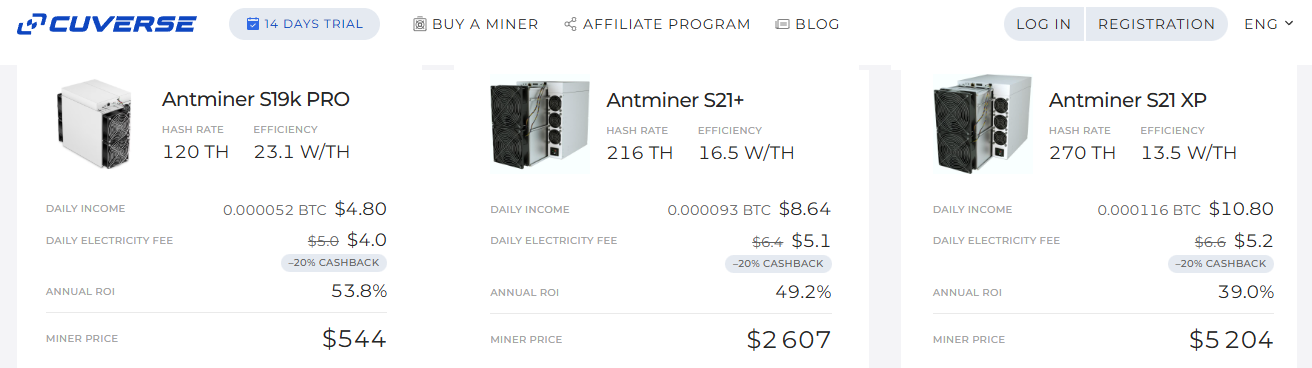
The Antminer S21 XP model boasts 13.5 W/TH energy efficiency and offers over $5 in daily net profit. This miner is well-positioned to remain profitable even after the 2028 halving and continue generating earnings.
Thus, the risk with cheaper models lies in their obsolescence and the nearing end of their operational lifespan. Expensive models require larger investments but offer a significant reduction in long-term risks.
Energy prices and power consumption
The price of the Bitmain Antminer S21 XP in the Cuverse catalog as of mid-January 2026 is $5,204. It will earn us 0.000116 BTC per day with daily electricity expenses of $5.2. You can also select a comparable Whatsminer model for the calculation.
This means we will receive 0.00348 BTC per month, spending $156 on electricity and other costs. Assuming the average monthly Bitcoin price is $95,000, we would earn $330.
Let's calculate the monthly ROI for our ASIC miner:
($330 - $156) / $5,204 × 100% = 3.34%
Now, let's examine the contribution of electricity cost and the S21 XP's performance to this ROI formula.
Electricity costs are based on the price of $0.04 per kWh. The Antminer S21 XP's power consumption is 3,645 W. Let's calculate the net monthly electricity expenses:
3.645 kW × 24 hours × 30 days × $0.04/kWh = $105.
We are left with $51 in other expenses, which we will keep constant.
Let’s assume the electricity price increases by one cent (from $0.04 to $0.05/kWh), i.e., by a factor of 1.25. Now, we are paying $131.3 per month for electricity instead of $105, and total expenses rise to $131.3 + $51 = $182.3.
Let's change the values in our formula:
ROI (monthly) = ($330 - $182.3) / $5,204 × 100% = 2.84%
With just a one-cent increase in electricity cost, the monthly ROI dropped from 3.34% to 2.84%, a decrease by a factor of 1.176. The annual ROI in this case would fall from 40% to 34.1%. This is highly significant.
Now imagine that due to wear and changes in the thermal environment, the miner's energy efficiency deteriorates by a factor of 1.2 from the specified 13.5 W/TH to 16.2 W/TH. This means that monthly profit will drop by the same factor:
ROI (monthly) = ($330/1.2 - $156) / $5,204 × 100% = 2.29%
Thus, with a 1.2-fold decrease in revenue, the ROI decreased by a factor of 1.46!
Therefore, an increase in electricity tariffs and/or a drop in operating equipment’s energy efficiency can deliver a crushing blow to mining profitability. The best path to high returns is a combination of energy-efficient ASICs and low-cost electricity.
Regulatory environment and market volatility
Today, Bitcoin mining is a long-term business. Simply buying a mining machine is not enough; you need to build an entire infrastructure where this equipment can operate, be maintained, and eventually replaced with newer models. In the event of a significant drop in Bitcoin's price, mining can become unprofitable. As we demonstrated earlier, miners would need to be temporarily shut down during the day or for an extended period until conditions improve.
In addition to market risks, there is also regulatory risk. For instance, China's 2021 mining ban set the most significant regulatory precedent, leading to an almost twofold decrease in Bitcoin's network difficulty (from 25 T to 13.7 T) over two months. Just imagine your mining income doubling over eight weeks solely due to a change in network parameters. This is equivalent to a twofold increase in Bitcoin's price or a free upgrade of all your equipment to a new model with twice the energy efficiency! But what if you were one of those miners in China?
Thus, regulation is a serious matter. Today, mining has become more familiar to regulators, making an instantaneous, widespread ban difficult to imagine. However, tax legislation is evolving and could significantly impact your revenue. Furthermore, governments might mandate the use of only renewable energy sources or impose other restrictions on the activities currently considered legal.
Yet, the most challenging aspect of mining is maintaining the energy efficiency of operational equipment over an extended period. A clear upgrade strategy is crucial here; without it, mining operations will stagnate until they eventually become unprofitable. The effort and time required to compensate for this downward trend may at some point become insurmountable.
Ways to mine Bitcoin in 2026
Mining hardware and electricity costs are the two key components for successful Bitcoin mining. Today, home mining is no longer viable. The most rational path is to join the mining ecosystem through equipment hosting in large-scale data centers. In this case, the technical burden is entirely carried by the service provider.
Cuverse offers the following miners at the beginning of 2026:
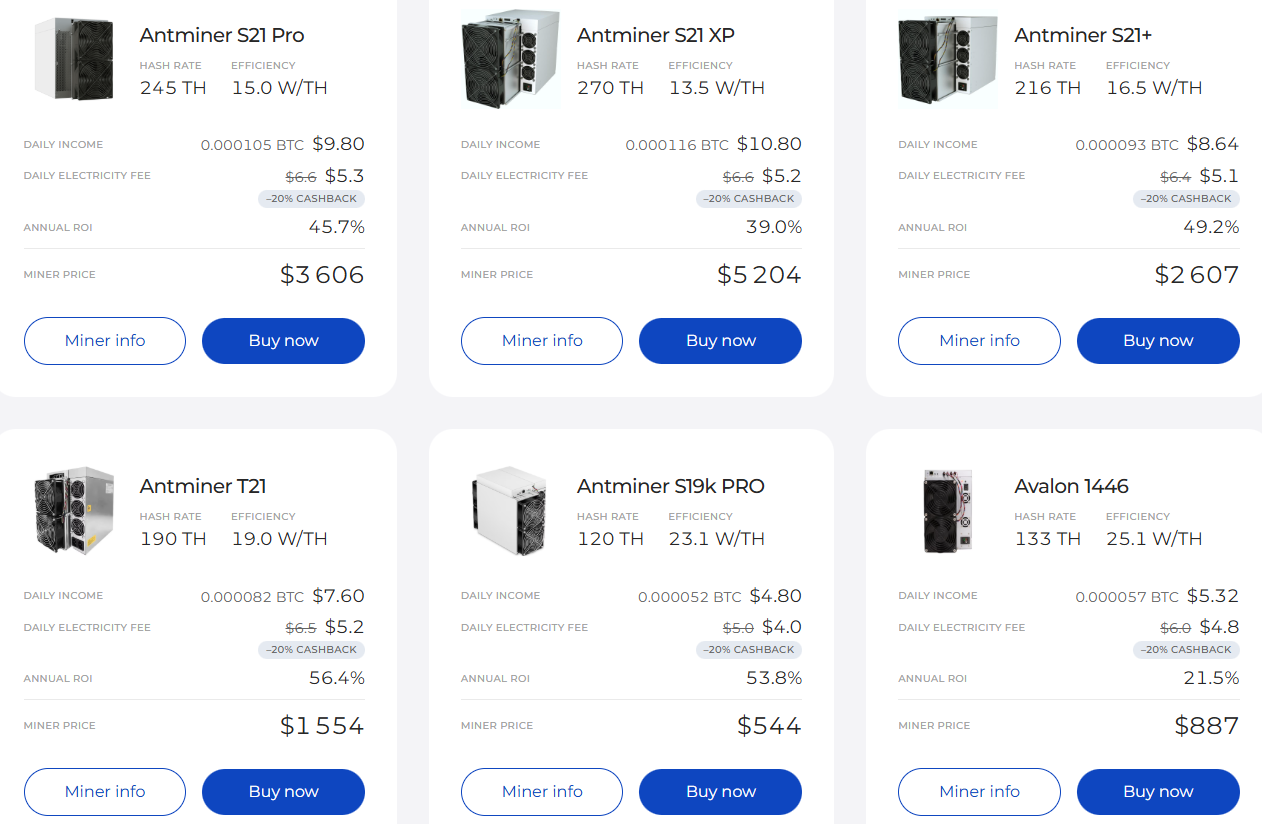
These are models designed for any strategy. The variety allows you to build a diversified mining portfolio and hedge against market risks, though a focused strategy may utilize just one specific type of hardware.
The nuance of evaluating mining potential is evident in this example: You could buy ten S19k PRO miners or one S21 XP miner. In the first case, you would earn about $8/day; in the second, about $5.6/day. Which is better? The first option may seem more profitable, but it is also significantly riskier because older models have a lower profitability cushion.
In other words, the newer the model, the longer it can operate and the better it can withstand negative market shifts. The older the model, the less potential it has to survive until the next halving and remain profitable afterward.
Pick your strategy and choose your miners based on your market outlook.
Self-mining vs Hosting vs Cloud mining
Self-mining today is catastrophically irrelevant due to significant costs and high risks. In the past, you could build a GPU farm at home and make a profit. Now, you need an entire data center packed with modern equipment to have any meaningful potential to earn over a three-year or longer horizon.
The optimal mining solution for a private enthusiast is hosting in a large data center. Here, you are insured against technical failures and the general need to manage an entire infrastructure. You operate within your strategy, controlling the mining process through an app. It's a partnership where both sides win.
Cloud mining — once an attractive option — has discredited itself due to the abundance of scams. Online mining certainly had its place, but the actual existence and ownership of the computing power were always major questions in this murky business. Hosting has outcompeted cloud mining in the long run simply because mining on your own equipment is always more reliable than on hypothetical virtual resources.
How to calculate Bitcoin mining profitability (ROI and break-even)
To calculate mining profitability, there is a wide array of suitable tools available online. For example, the WhatToMine calculator. Let’s explore the vital question: how profitable is bitcoin mining?:
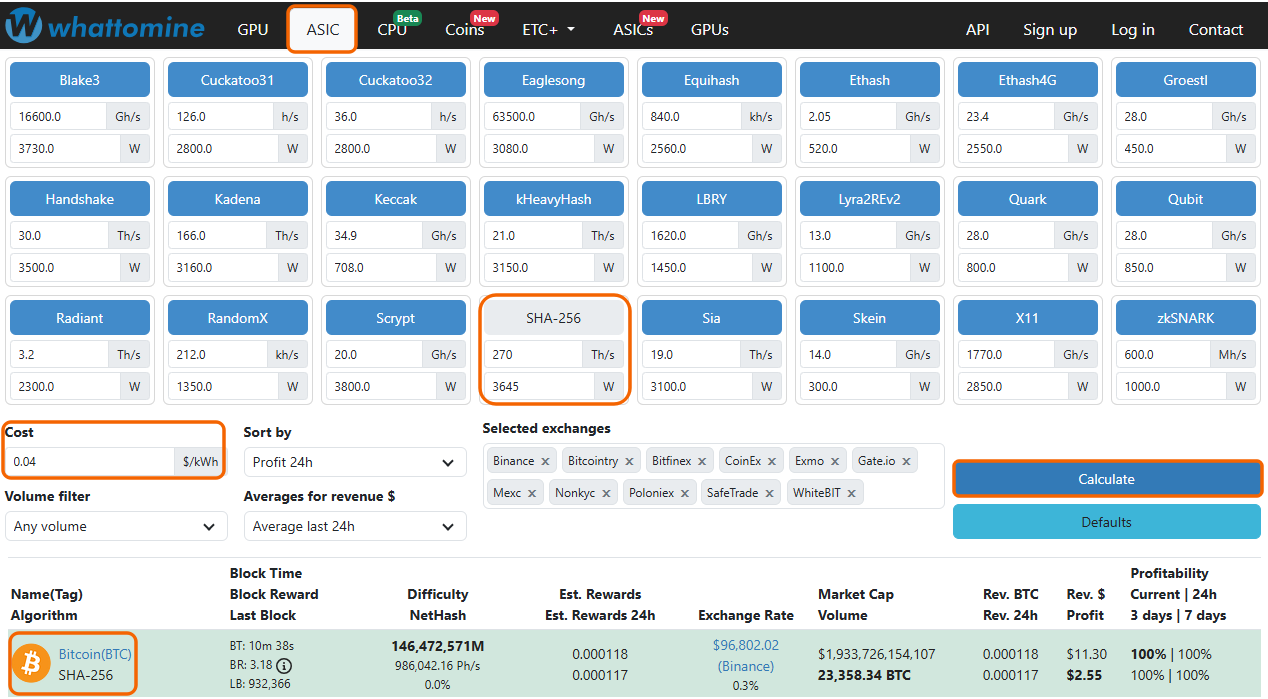
Here, to estimate the profitability of an Antminer S21 XP, you need to navigate to the ASIC tab, select the Bitcoin hashing algorithm SHA-256, and enter the miner's specifications (in our case, the S21 XP): a hash rate of 270 TH/s and a power consumption of 3,645 W. Then, select the electricity price (we used $0.04 / kWh).
Next, click the Calculate button to get a breakdown for various cryptocurrencies. In the screenshot, we provide the line pertaining to Bitcoin. It shows network parameters and an estimate of daily payouts: 0.000118 BTC. Based on this data, you can calculate the ROI, as we did in the previous section.
The same can be done on the AsicMinerValue service by setting the required parameters and selecting the desired miner:
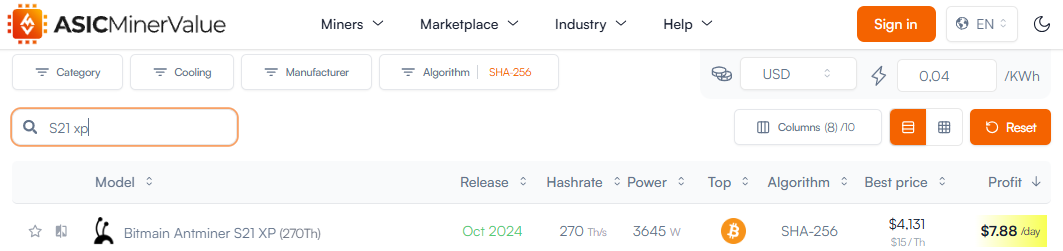
This service is simpler and more intuitive, with a greater focus on searching by model and comparing different miners.
Any mining calculator also allows you to estimate the break-even point, i.e., the moment when profit becomes zero. To push this point as far into the future as possible, it is necessary to reduce costs, improve energy efficiency, and leverage favorable market conditions to increase profit in dollar terms.
Mining revenue, pool fees, and taxes
The mining pool you work with will always take 1-3% of the profit. This is normal, but it must always be factored into your profitability calculation. Additionally, part of the revenue will go toward taxes — depending on the jurisdiction, this can be either a significant expense or a minor one. Often, if you are a private miner and do not sell the mined bitcoins, there may be no taxes, but it's still essential to clarify your status.
Beginners often miscalculate potential mining profitability simply because they don't fully grasp the cost side. Incorrect profit expectations can justify a flawed strategy, where an enthusiast becomes a hostage to their own groundless hopes.
Remember, everything looks simple on paper, but as you dive deeper into the business, you risk facing a snowball effect of problems and additional expenses. It's more rational to partner with those who have already walked the entire path and offer a ready-made infrastructure solution. We are talking about Cuverse and hosting mining equipment in large data centers. You pay for electricity, and Cuverse handles the technical issues, pays pool fees and taxes.
Strategies to maximize Bitcoin mining profits in 2026
Electrical energy is the primary operational cost in mining. Electricity prices are set by generating companies or even governments and cannot be changed by miners. However, a technology called "smart mining" can be applied in situations where electricity prices are variable and depend on grid load.
Peak energy consumption typically occurs during morning and evening hours. During the day and especially at night, grid load decreases. In some regions, this leads to lower electricity tariffs. If your mining becomes unprofitable during peak hours, you can mine exclusively during low-tariff periods. In this case, while revenue may decrease, net profit will increase.
A significant impact on mining efficiency comes from the equipment upgrade strategy (policy). Manufacturers constantly offer new, more energy-efficient miner models, and this opportunity should be leveraged. Optimizing hashrate requires increasing capital expenditure but allows for timely improvement of mining profitability.
Furthermore, it is crucial to monitor other expenses, such as internet costs, mining pool fees, infrastructure maintenance costs, and equipment servicing. All miner downtime translates to lost money. Therefore, scheduled maintenance must be performed promptly and professionally to ensure that even inexpensive miners operate as long as possible while maintaining their performance level.
Efficient ASIC hardware and cheap electricity
Which mining strategy is the most successful today? It is obvious that mining is a long-term business. If you invest in mining, you should have a plan for three years or more — otherwise, what's the point? To justify these investments, one should aim for maximum energy efficiency (profitability) and the lowest possible cost of electricity (expenses). This is the fundamental rule. The payback period for the equipment, which will be expensive with this approach, becomes less critical here because you are investing in a powerful asset capable of operating for 5 or more years.
As we have already shown above, even a 1-cent difference in electricity price can reduce ROI by a factor of 1.2. This is significant, so you should give it some thought. Electricity is a daily reality that cannot be overcome by mere expectations of Bitcoin's price growth; it is what you will have to pay for day after day, in both the best and the worst of times. The potential of mining is enormous, but the priority is to limit risks in order to survive a couple of market downturns.
ASIC Miner profitability ranking - Top ASICs by Cuverse Analysts
The best ASIC is not always the most expensive or the most powerful one
Choosing reliable mining pools and long-term holding
Cuverse works with F2Pool — one of the largest mining pools that has proven its reliability. The pool's payout method and its fees are important; however, increasing ROI requires a different approach. You mine bitcoins but pay for electricity in fiat currency. Your goal is to profit from Bitcoin’s long-term price appreciation by holding it in the long-term as a reserve asset.
When large mining companies begin selling off their BTC reserves to cover operational expenses, it is a special sign indicating the start of "miner capitulation." Small-scale miners have usually already shut down their operations by that point. Typically, this is when the market reverses and turns bullish again. Your task is not to capitulate but to accumulate bitcoins until your capital costs are fully amortized, or perhaps even longer. This is the only way you can achieve record ROI, regardless of the specifics of your strategy!
Is Bitcoin mining worth it in 2026? Final verdict
Bitcoin mining is an industry, a philosophy, a business, and a global concept: you cannot succeed in something you don't believe in. If you don't believe in Bitcoin, there is no point in mining. "Miner capitulation" is a common term signifying a breakdown in market sentiment. During capitulation, miners turn off their equipment and sell their bitcoins to cover the costs. However, miner capitulation is typically the last failure before a trend reversal. In other words, miners are the last to surrender.
So, those were a few words about a mining crisis. Let's allocate 20% of our emotions to it and not return to this topic. In reality, Bitcoin mining is one of humanity's greatest achievements, which has yet to fully reveal its potential. The capabilities of the Bitcoin blockchain as an impressively reliable ledger for storing information are still underutilized. In this sense, the prospect of rising transaction fees, as seen with Ordinals or Runes, remains just as relevant.
The Bitcoin blockchain contains more than is currently being used. Every transaction on the Bitcoin network can become a significant source of profit for miners. This means that sooner or later, the halving will cease to be a traumatic event for miners, as the reward from transaction fees will substantially exceed the block subsidy. This is just one positive scenario for the growth of BTC mining profitability.
Even without considering "white swans," Bitcoin mining today is more relevant and profitable than ever. Of course, today mining is, first and foremost, a serious investment in infrastructure, and many things must align for the venture to be successful — in particular, proximity to a cheap power source is one of the key conditions for long-term success, meaning systematic profit generation.
Major mining companies today earn significant profits thanks to their ability to reduce costs in ways unavailable to private enthusiasts. Cuverse offers miner hosting because a chasm has already formed between individual miners and large-scale operations in the industry. Mutual benefit lies somewhere in the middle of this chasm, so now is the time to start bridging it. Join Cuverse and see for yourself that this partnership is far more productive than going it alone!
Is Bitcoin Mining Still Profitable?
Strategy and risk management will lead you to success
Conclusion
Mining profitability is influenced by the following factors:
- Electricity cost
- Bitcoin exchange rate (directly proportional)
- Bitcoin network difficulty (inversely proportional)
- Equipment hash rate (TH/s)
- Equipment energy efficiency (W/TH)
- Quality of maintenance (downtime and loss of efficiency)
- Equipment upgrade strategy
- Facility security
- Regulatory environment within the jurisdiction
Each of the points listed above represents a specific type of risk. Successfully managing these risks determines the success of a Bitcoin mining operation.
Today, mining enables significant earnings for those with long-term goals, the strength, and the means to achieve them. Never stopping, looking ahead, and believing in Bitcoin are the essential components of success in this complex yet incredibly inspiring endeavor — Bitcoin mining!


