
Bitcoin mining investment is the process of earning rewards on the Bitcoin network using specialized computing hardware (ASIC miners). Miners solve a mathematical problem of a given difficulty level to encrypt information about Bitcoin network transactions into the blockchain. Miners earn rewards for adding new blocks to the blockchain as well as fees for each transaction.
Investing in mining can take various forms — from building your own mining farm to obtaining a share in large mining companies. Cuverse offers a rational solution for private investors by inviting them to utilize its energy-efficient mining infrastructure.
Host your equipment in a large Cuverse data center under professional hosting terms with a fixed electricity rate as part of a three-year Bitcoin mining contract!
It’s profitable and does not require setting up your own mining enterprise.
What is Bitcoin mining and how does it work?
Bitcoin mining is a competition of computational hardware for a mining reward, which is paid out approximately every 10 minutes. The reward amount is halved roughly every four years through an event known as Bitcoin halving. The current reward (2024-2028) is 3.125 BTC.
The Bitcoin network is a blockchain (ledger) made up of blocks that record information about payment transactions on the network. Miners compete to solve the problem of finding the so-called block hash. The winner receives the mining reward, populates the mined block with transactions, and also collects fees from each transaction.
The blocks in the blockchain are stored in such a way that each subsequent block contains cryptographically encrypted information about the previous blocks. Therefore, to retroactively alter information in a specific block, one would have to change all subsequent blocks, which is completely unfeasible from the energy cost perspective.
Calculating the block hash requires significant energy resources due to the complexity of the task. These costs serve as a security measure for the blockchain, as any attempt to hack it would require even greater energy expenditure, making any malicious attack pointless.
Bitcoin Mining: How It Works & How to get started in 2025-2026
How to mine Bitcoins every day in a mature market?
The Hash
In the Bitcoin network, a hash is a unique 64-character alphanumeric code produced by the SHA-256 cryptographic algorithm. For instance, the hash of block #925,101 (25.11.2025) is 0000000000000000000158caeebf0f98f9c7d0a445d461bfa08a1ded94fcaf5f.
At its core, the mining process is a computational race to discover a specific hash value that satisfies the prevailing network difficulty. The first miner to arrive at the correct hash secures the block reward. This validation event is programmed to occur approximately every 10 minutes. An increase in the number of miners raises the collective hash rate, increasing the likelihood of finding a block faster. To counter this, the network recalibrates its difficulty level every 2,016 blocks, ensuring the average block time remains steady.
This continuous hash generation cycle is immensely power-consuming, underpinning the Proof-of-Work (PoW) model that secures Bitcoin and other cryptocurrencies like Litecoin. Miners validate transactions and protect the blockchain by converting electrical energy into computational proof. Each block's hash is intrinsically linked to its predecessor, forming a secure and tamper-evident chain. Attempting to alter a historical transaction would require an attacker to recompute not only that block's hash but also all subsequent blocks—a task so energy-intensive it becomes practically impossible, thus ensuring the network's integrity.
Target Hash and Nonce
The Target Hash and Nonce are fundamental components of the cryptographic puzzle at the heart of Bitcoin mining. Miners engage in a massive computational trial-and-error process, testing countless Nonce values in the block header until they find one that produces a hash lower than or equal to the current Target Hash. Success in this endeavor grants them the right to add the new block to the blockchain and claim the reward.
The term "Nonce" stands for "Number Used Once," a randomly generated value that ensures the uniqueness of each hash attempt. The security of the entire operation relies on this uniqueness, making it computationally unfeasible to manipulate the blockchain.
The mining process involves incorporating a Nonce into the block's data and processing it through the SHA-256 hashing algorithm. If the resulting hash meets the stringent requirement of the Target Hash, the block is considered valid. This core Proof-of-Work mechanism is universal, though the specific hashing algorithm may differ — Bitcoin uses SHA-256, while cryptocurrencies like Litecoin utilize the Scrypt algorithm. These specifications are crucial and are always accounted for by mining profitability calculators such as asicminervalue.com.
Network difficulty, which defines how hard it is to find a valid hash, is dynamically adjusted approximately every two weeks (every 2016 blocks). This adjustment is based on the total network hash rate, ensuring that the average time to discover a new block remains consistently around 10 minutes, regardless of how much collective computational power is dedicated to mining.
Mining Difficulty and Block Rewards
Fluctuations in the Bitcoin network's difficulty are the network's response to the amount of computational power connected to it (network hash rate). The higher the hash rate, the faster a hash can be found, so the network increases its difficulty by demanding a more specific hash value as the solution. Miners are forced to iterate through a greater number of possibilities to receive the reward, spending more time on the process. The network adjusts its difficulty approximately every two weeks (every 2016 blocks) to ensure that block computation and the subsequent bitcoin mining payout occur roughly every 10 minutes.
Since the network's hash rate is almost always growing with minor pullbacks, the Bitcoin network's difficulty also increases. The difficulty chart can be viewed on many resources, including this one. The size of bitcoin mining payouts is inversely proportional to the difficulty, meaning it usually decreases slightly, all other factors being equal, thereby affecting mining profitability.
Transaction Verification
The Bitcoin blockchain is essentially a ledger maintained by miners in a specific way—through the creation of a sequence of blocks, each containing encrypted information about all its predecessors. Every transaction within the Bitcoin system must be verified by miners to prevent the same bitcoins from being spent twice (double-spending), to block transactions if a user has insufficient funds, and so forth.
All transactions on the Bitcoin network are sent to a so-called mempool, from which miners collect them to populate a candidate block. Each transaction must be verified by multiple miners. The miner who successfully finds the block's hash fills it with transactions, receiving not only the block reward but also all the associated transaction fees.
This process ensures the integrity of the blockchain in the sense that, through the decentralized verification of each transaction by miners, only valid information is included in the blocks. This information is then encrypted and permanently embedded into the blockchain.
Investment Methods
The primary methods of crypto mining investment include purchasing your own equipment, using cloud mining services, or opting for hosted solutions.
Mining with your own hardware has both advantages and disadvantages. You keep all the mining rewards but bear all the risks associated with owning miners — from the need for housing, maintenance, and repairs to the threat of total loss due to force majeure.
Cloud mining is a service for renting mining power, manageable through an online platform provided by the cloud operator. You only own the results of cloud mining — meaning the mining income transferred to you less the provider's fees. Cloud mining has often been used as a disguise for financial pyramids, which is why this format has lost popularity over time.
Cuverse offers an alternative approach that mitigates many user risks. As a large mining company with developed infrastructure and access to cheap electricity, Cuverse offers miners under hosting terms in large data centers through profitable contracts. With this approach, you mine bitcoin on your own equipment, purchased and hosted in Cuverse's data centers, while the provider company assumes all obligations for ensuring its continuous operation throughout the entire contract term.
Staking vs Mining: The Ultimate Guide
Two fundamentally different paths with their own philosophy, mechanics, and set of risks
Risks and Profits
Bitcoin mining is a complex business based on the superiority of one mining infrastructure over another. The winner is the one who has built the most energy-efficient mining data center. Smaller players are quicker to lose crypto mining profitability amid Bitcoin price fluctuations, its network difficulty, and electricity costs. They either become easy targets for larger players or simply go bankrupt if their equipment is hopelessly outdated and they lack the funds to upgrade it.
Imagine a mining operation that lacks the funds to upgrade its miners, where old miners constantly break down with no replacements available, and which is located in a jurisdiction with vague, poorly regulated industry laws. Both small and large mining companies bear these risks; however, the former often cannot withstand the competition and, for one reason or another — and there are clearly many — cease their operations.
Today, only large enterprises like Cuverse can ensure continuous Bitcoin mining while simultaneously executing planned replacements of outdated equipment with new, more energy-efficient models. Hosting your equipment with Cuverse is your opportunity to engage in real Bitcoin mining and earn regardless of market conditions, as Cuverse ensures high bitcoin mining profitability and minimizes the cost of producing 1 BTC through innovative technologies and a strategic approach to developing the mining business.
What makes crypto mining profitable and how do you figure it out?
The question of investing in mining leads us to a more specific question: how to invest in Bitcoin and achieve high bitcoin mining profitability. An analogy with gold and gold mining is appropriate here. You can simply buy gold hoping that its price will rise, or you can invest in gold mining companies, similar to investing in mining corporations, whose value often grows significantly faster than the asset itself during a bull market.
Investing in mining is suitable for those who clearly understand the nature and prospects of digital gold (Bitcoin) and recognize that the mining business is about constant scaling and development of mining infrastructure. If a mining company can sustain this relentless growth and renewal of computational power, then it is an excellent investment target because you will earn more as it expands.
A mining enterprise can also be compared to a manufacturing plant that pays out dividends every day. If you have experience in the stock market and find mining intriguing, it's obvious to you that a business based on mining real bitcoins is far more dynamic than any traditional business, even one traded on NASDAQ.
How much can you earn?
How much can you make mining bitcoin? As of the beginning of November 2025, Cuverse offered the following mining profitability figures for its different miner models.
| Miner | Hash Rate | Energy Efficiency | Price (November, 2025) | Net profit per day (20.11.2025) | Payback period, days |
| Avalon 1446 | 133 | 25.1 | $915 | $5 | 183 |
| Antminer S19k PRO | 120 | 23.1 | $999 | $4.51 | 221 |
| Antminer T21 | 190 | 19 | $2,399 | $7.15 | 335 |
| Antminer S21+ | 216 | 16.5 | $3,307 | $8.13 | 407 |
| Antminer S21 Pro | 245 | 15 | $4,058 | $9.22 | 440 |
| Antminer S21 XP | 270 | 13.5 | $5,222 | $10.16 | 514 |
Mining profitability depends almost entirely on the cost of the miners and electricity expenses. The Cuverse miner lineup includes models from various price groups with different hash rate and energy efficiency parameters.
Any shift in market conditions leads to a decrease or increase in mining returns, especially in dollar terms, since the Bitcoin exchange rate is the most volatile parameter proportionally affecting mining revenue.
How long does it take to make a profit off crypto mining?
In the table above, the payback period for each miner model is calculated as follows: the cost of the miner must be divided by the daily net profit. The result is the number of days required for the total net profit to equal the amount spent on the miner.
For example, for an Antminer S21 XP costing $5,222 with a daily net profit of $10.16, it would take $5,222/$10.16 = 514 days (approximately 1 year and 5 months) to break even. When calculating the payback period, it is crucial to understand that the daily profit is a highly volatile figure, especially when converted to USD. If the Bitcoin price rises, the profit will increase proportionally; if it falls, the profit will decrease. Therefore, the payback period can only be estimated conditionally, based on your own view of future market dynamics.
Bitcoin Mining ROI 2026: Realistic Outlook with Cuverse Data
Bitcoin mining is an industry, a philosophy, a business, and a global idea
What is required for Bitcoin mining?
To engage in independent mining, you need to purchase, deliver, install, and connect mining equipment; install and configure software; connect to a mining pool; and set up wallets to store the mined bitcoin.
When purchasing equipment, you must be guided by your own views of market dynamics and the miners’ payback parameters. It is crucial to understand the total cost of the equipment after delivery to your location, the price you will pay for electricity, how to configure the software, which mining pool to join to minimize fees, and how to secure your wallets to avoid losing the mined bitcoin.
All these issues are quite complex for beginners, making equipment hosting with Cuverse a less risky form of mining. Here, you entrust all risks and equipment care to a large data center, while you manage the mining remotely, earning bitcoin on your chosen hardware.
How to Mine Cryptocurrency
To start mining cryptocurrency, first select the coin you want to mine, such as Bitcoin, Litecoin, or Dogecoin — though Bitcoin mining remains the most prominent option. Next, you need to purchase and receive the corresponding mining hardware, install the software, and connect to a mining pool, since solo mining is essentially a lottery you cannot win. Create a crypto wallet to store your mined bitcoin, ensuring you follow all security best practices. Never take screenshots of your seed phrase, and never store or send it via messaging apps.
Installing the software requires specific technical skills. You can use popular programs like HiveOS, NiceHash, or CGMiner. This software will manage the mining process, connecting your hardware to the blockchain.
Once your equipment is connected to a mining pool, you will start receiving mining rewards proportional to your share of the pool's hash rate, minus the pool's fees. Your daily earnings will be small, but this approach eliminates the risk of earning nothing at all, which is a likely outcome if you mine outside of a pool.
Types of cryptocurrency mining
When Bitcoin mining first emerged, it was possible to mine bitcoins even using a computer's central processing unit (CPU). This was soon followed by the rapid development of more powerful mining on graphics cards (GPUs). However, over time, GPU mining also became unprofitable. Today, mining is only feasible on specialized devices — ASICs (Application-Specific Integrated Circuits) — designed exclusively for mining a specific cryptocurrency.
ASIC miners are hardware suitable exclusively for mining; therefore, their purchase represents a targeted investment in mining with no option for any other use. The higher a miner's hash rate (computational power) and the better its energy efficiency (electricity consumption per unit of computation), the more profit the chosen model will generate. However, this also means a higher price and, consequently, a longer payback period. Investing in more expensive models helps mitigate market risks associated with mining, as such miners remain profitable for a much longer time, even under significantly worse market conditions.
What do I need to invest in Crypto Mining?
If you decide to invest in bitcoin mining, you can attempt to build your own operation, select a cloud service, or host your equipment in a large data center — the business model of a mining enterprise.
For independent mining, you will need not only capital but also knowledge, software skills, the ability to maintain computing hardware, and the discipline and patience to troubleshoot, repair, and overcome the inevitable challenges that arise.
If you choose a cloud service, scrutinize its profitability and transparency. If a service promises unrealistically high returns, lacks transparency, has unclear affiliations with mining pools, and provides no public information about its operations, it is unlikely to deliver the desired benefits and, in the worst case, could lead to losses.
To invest in bitcoin mining successfully, it's crucial to verify that the enterprise you intend to partner with possesses real computational power and is genuinely mining bitcoin or other cryptocurrencies. Cuverse offers miners for ownership under hosting terms with professional maintenance in its data centers and invites investors to collaborate. By investing with Cuverse, you are funding a real, energy-efficient mining infrastructure capable of generating profit even under the most challenging market conditions. Build your mining farm by selecting from the range of miner models available in Cuverse's data centers.
Disadvantages of mining
When mining independently, an enthusiast can face a vast array of challenges. High electricity costs can become a decisive negative factor, especially during market downturns. Mining hardware must be sufficiently energy-efficient to have a safety margin in case of a significant drop in the Bitcoin price.
To maintain profitability, miners need to be periodically upgraded to more advanced models with better computational power and energy efficiency. Furthermore, miners require constant maintenance and repairs, leading to potential downtime and lost profit. All of this can result in additional costs and unrealized earnings, which can be an overwhelming burden for a mining enthusiast operating on the edge of profitability.
The best solution for an individual is to host equipment in a large data center. This approach eliminates all the aforementioned risks, allowing them to earn bitcoin rewards on equipment maintained by a large mining company like Cuverse.
How is crypto mining taxed?
Bitcoin mining is a regulated activity, and participants are generally required to pay taxes on their earnings. However, the specific tax treatment varies significantly across different jurisdictions.
- United States: The IRS treats mined bitcoin as taxable income at its fair market value upon receipt. When the bitcoin is later sold, a capital gains tax applies to any profit. Income tax rates can range from 10% to 37%, while capital gains rates depend on the holding period.
- United Kingdom: Mining income is subject to Income Tax (ranging from 0% to 45%) if it's a hobby or side activity, or Corporation Tax if conducted as a registered business. Selling bitcoin also incurs a Capital Gains Tax.
- United Arab Emirates (UAE): A highly attractive jurisdiction with a 0% personal income tax rate, which makes mining and trading profits tax-free for individuals.
- Hong Kong: Profits from mining conducted as a trade or business are subject to a Profits Tax. However, private, casual mining by individuals is typically not taxed.
- Germany: If mining is a commercial activity, it is subject to trade tax. A key benefit is that private sales of bitcoin are tax-free if the coins were held for more than one year.
- Switzerland: Known for its crypto-friendly approach, Switzerland does not levy capital gains tax on crypto assets for private individuals. For professional mining operations, taxes are applied at the cantonal (state) level, with rates varying by location.
How long will crypto mining last?
Bitcoin mining is a long-term process that typically requires at least three years to become profitable and reach its full earning potential. The halving cycle occurs approximately every four years, creating a certain periodicity in market fluctuations linked to these events and the establishment of new Bitcoin all-time highs (ATHs). However, any cyclical patterns can be disrupted over time.
Every four years, the block reward is cut in half, which implies a halving of mining profitability. This is analogous to a transition to extracting hard-to-reach reserves of a commodity, which drives the asset's price upward. Nevertheless, market downturns do occur, cleansing the market of weaker players. To avoid being one of them, a meticulously calculated financial model of the mining operation, one that accounts for potential volatility and other risks, is essential.
Large companies like Cuverse possess a much greater safety margin than smaller outfits or, even more so, individual miners. Therefore, the most rational approach to investing in mining appears to be hosting equipment in large data centers. Cuverse offers a wide range of miners. By operating them under their hosting terms, you earn bitcoin, while Cuverse assumes responsibility for all technical aspects.
What's the future of bitcoin mining?
Today, Bitcoin mining is evolving towards the refinement of mining hardware. Leading global manufacturers are offering increasingly energy-efficient equipment, enabling the mining of bitcoin at a progressively lower cost. However, this advanced hardware is significantly more expensive than simpler models and has longer payback periods. Large corporations utilize precisely this type of equipment and gain a competitive edge, as they achieve greater operational resilience and superior profitability despite the higher capital expenditures.
The increasing Bitcoin network difficulty and the halving events continually weed out weaker and smaller players from the market. This sector will continue to consolidate and become increasingly high-tech, while halvings are expected to drive the price of bitcoin upward.
How many bitcoins can be mined?
The total number of bitcoins that can be mined is capped at 21 million. By 2025, approximately 95% of the total possible supply had already been issued, with the emission rate slowing down at an exponential rate defined by the halvings (occurring every four years). The finite nature of the emission is a significant factor influencing the price, as an asset with a limited supply inherently holds substantial value.
However, miners earn not only block rewards for finding a block but also fees from each transaction included in it. In the long run, when the block reward becomes negligible, it is expected that miners will operate solely on transaction fees. This implies that fees on the Bitcoin network will have to rise to compensate miners for their electricity costs; otherwise, mining will cease to be economically viable for anyone.
Today, during periods of high market activity, only transactions with very high fees (set by users) are included in blocks. It is likely that in the future, all transaction fees will be significantly higher than they are today to ensure the continued operation and security of the Bitcoin blockchain.
Сonclusion
How to make money with Bitcoin? Bitcoin mining can be approached in different ways. For instance, you could buy a miner and attempt to mine bitcoin at home. However, under current conditions, that would be quite senseless from a profitability standpoint. Furthermore, miners operate very noisily, require constant attention, maintenance, cleaning, and sometimes repairs. In short, such an endeavor would be highly vulnerable. Additionally, it is crucial for the miner to be connected to a cheap electricity source — a requirement that is often unattainable for a private mining enthusiast.
To generate earnings, you would need to connect to a mining pool; only then is there a chance for the operation to become profitable. Otherwise, you cannot compete with the global computational power and will quickly become disillusioned with mining as a means of enrichment.
Another option is to use a cloud mining service, which eliminates the need for you to own hardware. However, this type of service has been largely discredited, and those that remain in business are often less than fully transparent and carry significant risks for users. The profitability figures advertised by cloud mining services are sometimes above market rates, yet it is impossible to verify the actual existence of the claimed computational resources and correlate them with the expected mining rewards.
Mining with Cuverse is an example of the third, and the most rational, path for a private investor in mining. It provides the opportunity to mine bitcoin using real hardware housed in the company's data centers with professional maintenance. The Cuverse mobile app is available on Google Play and the App Store, allowing you to manage your mining operations from anywhere in the world and access all essential statistics in real-time.
FAQ
Should I invest in crypto mining?
Bitcoin mining is a long-term project that requires several years to become profitable and generate earnings. It also demands knowledge and skills in software configuration, maintenance and repair of computing hardware, an understanding of financial market dynamics, and more. If you are new to this field, investing in independent mining will most likely not be successful.
However, there is a solution: engaging in Bitcoin mining through equipment hosting in a large data center. Cuverse offers profitable contracts for various miner models, which will be maintained by professionals, while you cover the electricity costs and earn bitcoin. This approach is both profitable and secure, as the risks are assumed by a large company.
Is bitcoin mining profitable?
Bitcoin mining profit and overall mining profitability depend on the energy efficiency of your equipment, electricity costs, the Bitcoin exchange rate, and numerous other factors. Today, only large corporations operating the most advanced hardware can ensure long-term profitability. These companies can afford to pay a premium for equipment upfront, subsequently maximizing their bitcoin mining profit regardless of market conditions and even remaining profitable during significant downturns.
Private miners cannot sustain such investments and are therefore consistently at a disadvantage. If you are serious about earning, join Cuverse and operate miners under hosting terms in professionally maintained data centers.
Is cryptocurrency mining worth it?
Bitcoin is still justifiably considered a high-risk asset, and therefore, Bitcoin mining is a risky venture. All high-risk assets are subject to the same market tendencies—they attract "cheap money." When the Federal Reserve's policy changes (raising interest rates, thus making money more expensive), high-risk assets often falter. Conversely, during favorable market conditions with low rates and prospects for further cuts, capital flows into risky assets, including the crypto industry. This drives asset prices up, making Bitcoin mining increasingly profitable.
Mining is a continuous process. After investing in equipment, you must recoup the costs and maximize earnings, which is only achievable during a favorable market period. By carefully monitoring the Fed's policy, interest rate trends, and the state of the stock and currency markets, you can make an informed decision about the optimal point of entry into mining. At the same time, by joining Cuverse and mining under their hosting terms, you can significantly reduce your operational risks. This approach allows you to earn substantial profits thanks to the centralized maintenance of your miners and the company's advantageous range of equipment contracts.
Is It Illegal to Mine Bitcoin?
The legal status of Bitcoin mining varies significantly worldwide, as many countries are still developing specific regulatory frameworks for this emerging industry. While some nations have embraced it, others have imposed strict bans or restrictions.
Notable Jurisdictions:
- China: Once the global leader in Bitcoin mining, China implemented a comprehensive ban on all cryptocurrency mining activities in 2021. This led to a major, albeit temporary, drop in the network's computational power (hashrate) as operators relocated to other countries.
- Restrictive Regions: Mining is prohibited or heavily restricted in several countries; frequently cited reasons include concerns over excessive energy consumption, financial stability, or the use of cryptocurrencies for illicit activities. The specific list of such countries keeps changing, so checking current local regulations is crucial.
- Pro-Mining Nations: In contrast, countries like El Salvador and Bhutan have adopted mining as a state-level strategy. They are leveraging their renewable energy resources (geothermal and hydroelectric power, respectively) to mine bitcoin for national reserves.
- Favorable Climates: The United Arab Emirates (UAE), particularly Dubai, has established itself as a highly attractive hub with clear, supportive regulations and a 0% tax rate on cryptocurrency income for individuals.
Key Takeaway:
Bitcoin mining is not universally legal. Before investing, it is essential to research the local laws concerning energy use, business licensing, and taxation in your specific country or region.
How long does it take to mine one Bitcoin?
The Bitcoin network generates new coins by issuing a reward for each successfully mined block, with new blocks slated to be found approximately every ten minutes. In today's competitive landscape, these rewards are almost exclusively earned by large mining pools, which then distribute the proceeds to their participants based on each member's share of the pool's total computational power.
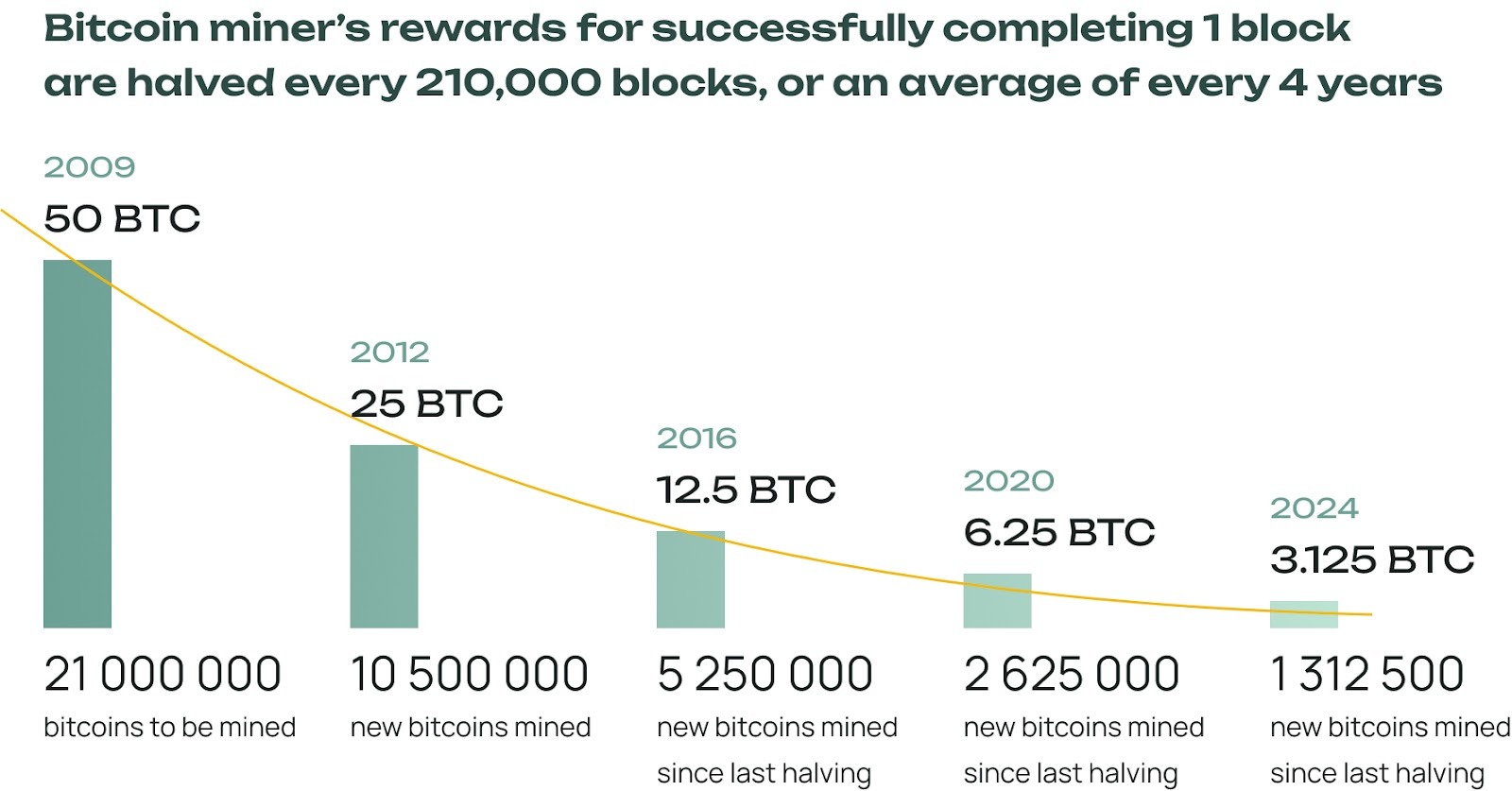
Following the most recent halving event in 2024, the fixed block reward stands at 3.125 BTC. It is programmed to halve again in 2028 to 1.5625 BTC, with this pattern continuing until the maximum supply of 21 million bitcoins is reached.
While the network collectively emits 3.125 BTC every 10 minutes, it is a common misconception for individual miners to calculate how long it would take them to earn a full bitcoin. The reality is that mining is a probabilistic process. Even the largest pools cannot mine every single block, and their payouts are averaged over time and shared among all contributors. For an individual miner operating alone or with minimal hash power, the prospect of mining an entire 1 BTC reward is virtually impossible, as their chances are directly proportional to their tiny fraction of the network's total hashing power.


