The profitability of Bitcoin mining is governed by a critical trio: equipment energy efficiency, electricity costs, and the BTC exchange rate. Therefore, building a successful mining operation requires a forward-looking investment strategy designed to navigate various market conditions. This article explores the tangible benefits and potential returns of engaging in BTC mining.
What is Bitcoin mining?
What do you really need to know to succeed as a Bitcoin miner? Focus on this: mining can be profitable, and your key task is to ensure that profitability. Ask yourself the core questions: What is the price of a reliable bitcoin miner? What is your electricity rate? How long do you have before your hardware becomes obsolete? Where will you house the miners, and who will maintain them? The answers depend entirely on your budget, dedication, and problem-solving skills. Mining is a long-term commitment—plan for a horizon of at least three years, ideally five to seven.
At its core, Bitcoin mining involves performing energy-intensive computations on specialized hardware in exchange for rewards paid in BTC. You are essentially converting electricity into new units of digital gold while simultaneously securing the Bitcoin network. The immense energy cost required to power this process is precisely what makes the network resilient; any potential attacker would face prohibitive expenses. This is why miners are the cornerstone of stability and functionality for the world's largest blockchain.
Bitcoin Mining: How It Works & How to get started in 2025-2026
How to mine Bitcoins every day in a mature market?
How do Bitcoin miners calculate their earnings?
To evaluate the impact of electricity costs, you can use a mining calculator like asicminervalue.com. This service allows you to select the mining algorithm (SHA-256 for Bitcoin), the manufacturer, and the specific miner model (for instance, the Whatsminer M63S 390 TH/s from MicroBT), and then input your power cost.
Once you've chosen a model, check how fluctuations in electricity price affect daily profit. Consider a scenario where the power cost for your mining farm increases from $0.04/kWh to $0.05/kWh.


With electricity priced at $0.04/kWh, as of December 10, 2025, a single miner would generate approximately $8.53 per day.
If the cost were just one cent higher at $0.05/kWh, the miner's daily earnings would drop to about $6.80, a decrease of $1.73 per day. Now, imagine a farm with 10 such miners operating for a full year (365 days). The annual income would be $31,135 at the lower rate versus $24,820 at the higher rate — a difference of $6,315.
A mere one-cent difference in your power rate can lead to substantial financial loss, wiping out roughly 20% of your potential revenue!
Mining revenue
In the previous chapter, we demonstrated the potential profitability of mining Bitcoin using the Whatsminer M63S 390 TH/s. To compare this result with the mining of other cryptocurrencies, let's select a similarly priced unit and analyze its performance using the same calculator.
The M63S is valued at approximately $5,000 according to asicminervalue.com. What equipment can we acquire at this price to mine KASPA?

A suitable option would be a mini-farm consisting of two devices: a Bitmain KS7 (40 TH/s) for $3,780 and a Bitmain KS5 Pro (21 TH/s) for $990. Their combined cost is roughly equivalent to that of the M63S. The projected daily earnings for this KASPA mining setup are about $9.32 at an electricity cost of $0.04/kWh, slightly higher than the $8.53/day from Bitcoin mining.
However, it's crucial to understand that KASPA mining carries significantly higher risk than Bitcoin mining. This is due to the greater volatility of altcoins and the relative instability of their underlying projects. Short-term gains are possible, but the long-term outlook involves considerably more uncertainty.
Now, let's examine Ethereum Classic (ETC):

Here, various versions of the Bitmain Antminer E11 yield a similar result — up to $5/day. While ETC is a less risky asset than KASPA, its mining profitability is nearly half that of Bitcoin.
You can analyze any coin in this manner to get a daily snapshot of potential earnings. However, always weigh these results against the associated risk. Remember, higher yields in altcoins include a built-in "risk premium." Therefore, from a long-term investment perspective, such mining is generally less attractive than the more stable and established process of Bitcoin mining.
What is a block reward?
The block reward is the mining incentive paid out roughly every ten minutes for successfully calculating a block's hash — a cryptographic puzzle whose complexity is set by the Bitcoin network and adjusted approximately every two weeks.
The image below shows a blockchain segment (from December 11, 2025) on mempool.space. Miners earn not only the block reward but also fees from all transactions included in that block. This total is prominently displayed. For example, for mining block #927,390, the Foundry USA pool earned not only the 3.125 BTC reward but also an additional 0.005 BTC in transaction fees from the 4,008 transactions processed in that block.
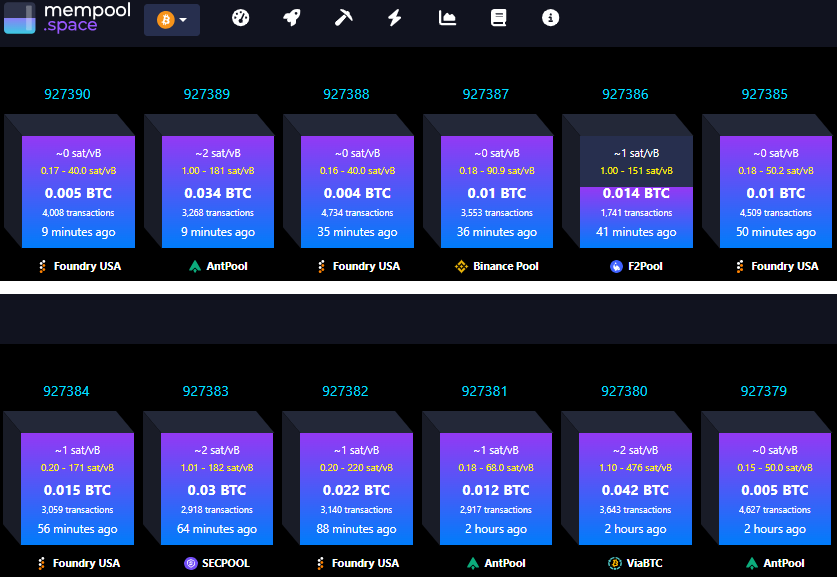
Depending on market activity and network congestion, this fee amount can multiply significantly. For instance, in blocks mined close to the 2024 halving, transaction fees reached up to 37 BTC (as seen in block #840,000).
What about transaction fees?
While the Bitcoin network facilitates mining, its primary function is that of a payment system. At its core, it is an immutable transaction ledger built on blockchain technology. Any payment system requires a record of its transactions, and Bitcoin documents them through a cryptographically secured chain of blocks. This structure makes retroactive alterations practically impossible, as the cost of such an attack would far exceed any potential gain.
Transaction fees are an integral part of this system. Their size can spike dramatically during periods of high market activity. When transaction volume surges, pending transfers accumulate in the mempool. Miners prioritize including transactions with higher attached fees in the next block, creating an economic incentive for faster processing. Consequently, transactions with lower fees may experience significant delays during network congestion.
Although the network typically suggests a standard fee, users have the option to manually increase it to expedite confirmation and ensure their transaction is processed promptly.
Taxes on Bitcoin mining profits
To operate a Bitcoin mining venture legally, your first step is verifying that your plans comply with local regulations. In most jurisdictions, mining is permitted but comes with mandatory reporting requirements. If you are generating Bitcoin mining profits and want to shield yourself from government scrutiny without delving into legal intricacies—simply ensuring the activity is allowed—prioritize these key areas:
- Documentation proving the legitimate purchase of your mining hardware.
- Evidence that the electricity used for mining comes from legal sources.
- A complete and detailed ledger of all cryptocurrency transactions.
- Accurate daily mining statistics (hashrate, power consumption, earnings) for audit trails.
By diligently gathering and organizing this information, you will be equipped to present it in any reporting format required by your tax authority.
How do you know if you can profit from Bitcoin mining?
By 2026, Bitcoin mining has become a far more demanding endeavor for miners. According to data from Hashrate Index, mining profitability has declined tenfold over the past four years — observe the 'hashprice' chart, which shows the average daily earnings per 1,000 TH/s of computing power.
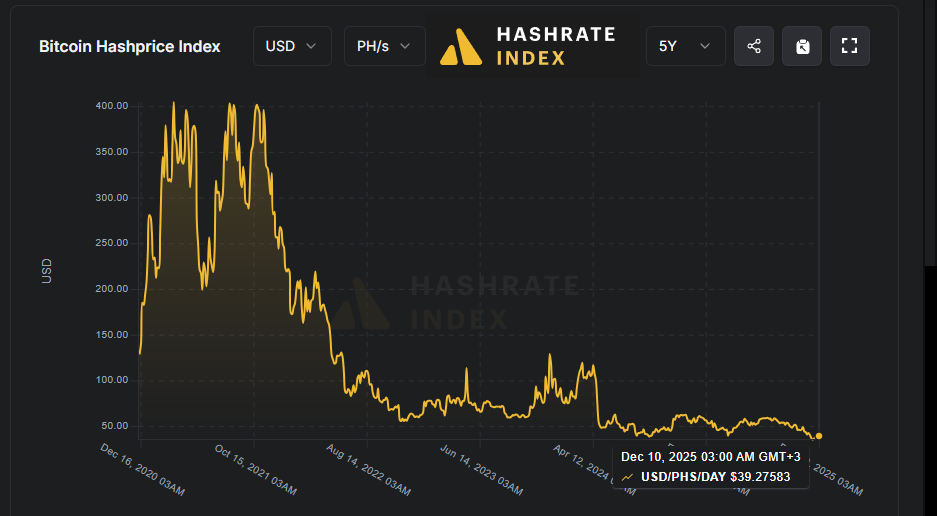
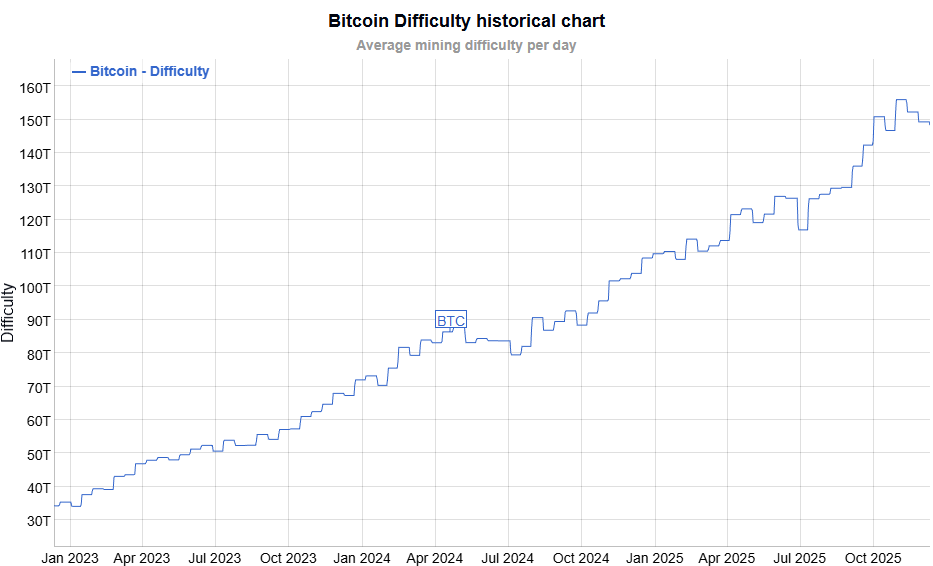
Over the same four-year period, the Bitcoin network's difficulty has increased tenfold, reaching 150 T. This means that, all other factors being equal, mining profitability has dropped by a factor of ten solely due to the rise in difficulty!
In contrast, leading hardware manufacturers continue to release increasingly sophisticated machines. For 2026, releases of miners with energy efficiency below 10 W/TH have already been announced! Just years ago, such figures seemed impossible.
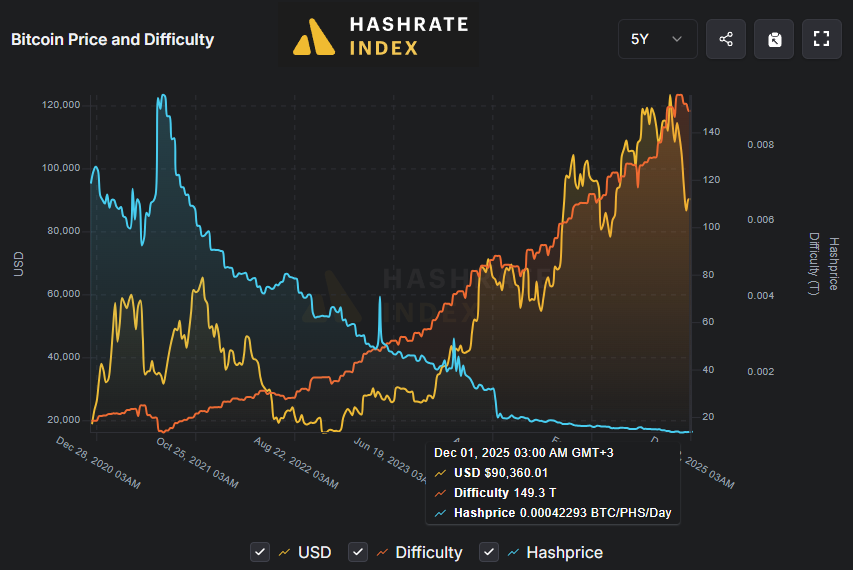
Now, looking at the chart of the price of bitcoin (in yellow), let's imagine how it would look if the price hadn't quintupled in recent years. Perhaps all these charts would look different, and mining profitability would have remained the same. This is a philosophical question, but it's evident that the rising price of Bitcoin complicates mining and makes it a more expensive pursuit. The inverse is also true.
Bitcoin Mining ROI 2026: Realistic Outlook with Cuverse Data
Bitcoin mining is an industry, a philosophy, a business, and a global idea
Efficient hardware
If you've decided to start mining Bitcoin and purchase an ASIC miner, your choice should be based on the following criteria:
- Final Cost
- Hash Rate
- Energy Efficiency
You can order an ASIC miner directly from the manufacturer, handle shipping and customs clearance, and then set it up and run it yourself, spending considerable time and money in the process. The final cost of the miner might surprise you if you manage everything independently.
Alternatively, you can purchase a miner through Cuverse under hosting terms. In this case, the final cost is transparent and listed on the website upfront. The miner is already housed in a data center and can be activated by you with a click of a button within 24 hours. Within 48 hours, you'll start earning bitcoin.
This approach simplifies everything: decide on your budget and desired specifications, pay for the miner and electricity, and you're up and running! iIn the Cuverse catalog, you can always select a capable mining hardware, such as the Bitmain Antminer S19k Pro (120 TH/s; 23.1 W/TH) or the Bitmain Antminer S21 Pro (245 TH/s; 15 W/TH).
Cheap electricity
In mining, electricity costs are the primary factor determining profitability, as they typically constitute 80-90% of operational expenses. However, it's crucial to look beyond residential utility rates—large-scale mining operations negotiate industrial tariffs, which are far more competitive.
The global leader in hash rate, the United States, illustrates this point perfectly, as power prices vary dramatically by state. For instance, mining in Texas can cost as little as $0.04-$0.07 per kWh, while in California, rates of $0.12-$0.20 per kWh make industrial mining largely unviable.
Similarly competitive rates for large-scale operations can be found in Canada, Paraguay, and the UAE, where the mining industry is actively growing. There is, however, a major caveat in the UAE: despite having access to cheap, subsidized power, you’ll also incur significant additional expenses for equipment cooling due to the extremely hot climate, which is inherently challenging for mining.
For a private investor, gaining access to genuinely cheap industrial electricity is exceptionally difficult. A more viable path is to partner directly with those who already have it — large mining corporations whose data centers profitably mine bitcoin thanks to superior infrastructure.
Cuverse offers equipment hosting in its own data centers. By mining with Cuverse, you bypass the arduous search for a "cheap power outlet," eliminate complex technical challenges, and avoid the constant struggle to maintain mining profitability.
Reliable mining pool
If you've decided to engage in Bitcoin mining independently, you will need to select a mining pool to join and earn a stable income. Otherwise, you are doomed to fail—competing with large pools is pointless, even if luck smiles upon you once or twice.
How do you choose a mining pool? Start with reputation. Referring to the image in the chapter about block rewards, you'll notice that practically all blocks are mined by the largest mining pools. These pools have the best reputations, otherwise, who would contribute their computing power to them? The simplest and most effective advice is to choose a pool from the top five or ten, such as Foundry USA, Antpool, F2Pool, or ViaBTC. Incidentally, Cuverse works with F2Pool.
With a large pool, reward payouts are stable, and all information is public and available at any time.
There are some differences in payout methods among pools. The most common is FPPS (Full Pay-Per-Share)—payment for so-called "shares" plus a share of transaction fees. Some pools do not distribute fees, while others only reward participants who contributed to mining the most recent blocks. In the latter case, income will fluctuate more, but the overall benefit is questionable.
Therefore, universal advice is to use the largest pool from the top five. However, if independent mining seems excessively complex to you, and searching for a mining pool is outside your interests, turn to Cuverse and start mining with hosted equipment. This option is significantly simpler, more stable, and more predictable.
Fees when selling bitcoin
When you sell bitcoin or other cryptocurrencies and tokens on exchanges, the platform will inevitably charge you a fee. In our overview of block rewards, we already touched on the topic of fees. You can revisit that segment, but at this point, let’s view it from a bitcoin seller’s perspective rather than that of a miner.
Selling bitcoin is a transaction. Once you initiate it, your transaction enters the very same mempool from which a miner will retrieve it, include it in a block, and earn a fee for doing so.
During periods of market frenzy, fees on the Bitcoin network can multiply significantly. As you may recall, in block #840,000 at the peak of halving excitement, the total transaction fees amounted to roughly 37 BTC! This leads to another universal piece of advice: avoid participating in the hype and execute your transactions during calmer market periods. Then, you simply won't notice the fees charged by the exchange for any transaction.
For example, if you decide to invest in bitcoin, do it when the market is in a lull — your fees will be minimal. If you decide to sell bitcoin, you might do so during a euphoric rally; fees will be higher then, but that's precisely the moment you stand to profit the most from a timely sale.
It's crucial to understand that the fee amount is not the primary factor determining the quality of a trade. It is a secondary consideration that should be taken into account, but nothing more. When you execute a trade, you profit from the asset's appreciation, not from saving on fees.
Market volatility
Bitcoin is a volatile, high-risk asset that is quite challenging to manage — unless you are a professional investor. However, if you are a miner, Bitcoin is the product you generate. This means the success of your venture is determined by a simple ratio: the cost of producing it versus the price at which you can sell it. Your goal is to mine bitcoin at the lowest possible cost and sell it at the highest possible price.
The HODL strategy does not involve selling bitcoin; instead, it focuses on accumulation. This strategy is based on the idea that Bitcoin will continuously appreciate due to its capped supply. However, as a miner, you will likely need to sell some of your bitcoin periodically to cover mining expenses. The key is to build a financial safety net and sell bitcoin only after significant price rallies. This way, you can be a successful miner and a successful investor at once, effectively doubling your potential earnings.
Is crypto mining passive income?
You can certainly transform mining into a strategy for generating passive income. What does it take?
At its core, mining is a complex manufacturing process. You build a factory (a mining farm), invest in equipment, maintain computing power, and are constantly involved in ensuring your factory operates continuously at peak performance. It's hard to call this passive income — it's a business that demands vigilant oversight.
Passive income implies you don't spend time earning it. This means you need a large-scale partner who will handle all technical aspects, while you pay for their services. Hosting miners is precisely what we're talking about.
You purchase miners that operate within large data centers, where concerns like energy efficiency and the optimal operational mode for each miner are already addressed. Furthermore, a major mining company always has access to cheap electricity. Consequently, your miners will operate in the best possible environment, ensuring mining profitability that is consistently higher than if you managed everything yourself.
Cuverse has been professionally hosting miners, locking in the electricity cost for the entire contract duration.
Professionals vs Amateurs
The Bitcoin network's difficulty is an automatically adjusted parameter designed to keep the average block discovery time at approximately 10 minutes. The network recalibrates this difficulty roughly every two weeks, after every 2,016 blocks.
As more miners join the Bitcoin network, the total computational power dedicated to solving blocks for rewards increases. This naturally accelerates the mining process.
The network counteracts this acceleration by increasing the complexity of the computational puzzle. Observing the difficulty chart reveals a clear, long-term upward trend with only minor corrections. This enduring pattern means that, all other factors being equal, mining rewards proportionally decrease as the network's difficulty rises.
Mining is still profitable
So why does Bitcoin mining remain profitable despite the constant increase in difficulty? The key is that the market perpetually seeks equilibrium between price and production cost. While extended periods of euphoria or pessimism can occur, the market inevitably stabilizes, driven by calm capital free from fear or greed and content with steadiness. This dynamic is especially pronounced in Bitcoin as a risk asset, which helps explain why it is still profitable.
What does this mean for miners? Simply that their earnings will fluctuate—sometimes lower, sometimes higher—as long as their operation remains state-of-the-art. Those unable to maintain this competitive edge are unlikely to survive the ongoing computational race, as its rules grow increasingly demanding.
A perfect example is the 2021 Chinese mining ban. Network difficulty plunged by 28%, the largest single drop in Bitcoin's history. This instantly made mining 1.38 times more profitable for those who remained operational. The lesson is clear: market swings are unpredictable, but equilibrium always reasserts itself, reinforcing that well-managed mining is still profitable.
Profit maximization strategies
Now is the time to figure out which Bitcoin mining strategy will not only ensure survival but also maximize earnings. We have established that weaker players exit the market because the gap between the strong and the weak is widening. Any significant market movement purges unprofitable hardware. Strong players grow larger and more energy-efficient, while older operations are either absorbed by stronger ones or wither away like autumn leaves.
To meet today's mining standards and achieve long-term success, you must have access to cheap electricity (we have shown how critical even a one-cent price change can be for a miner). Additionally, you need the capital to continuously upgrade equipment and enhance its energy efficiency as newer, more advanced models enter the market.
Furthermore, you must constantly improve your entire mining infrastructure (data centers) to keep all operational costs at a minimum. This holistic approach is the only way to achieve payback and turn a profit in today's competitive Bitcoin mining landscape. This is precisely the strategy employed by the large-scale businesses that now dominate this sector.
Conclusions
In this article, we have explored the profitability of Bitcoin mining. So, should a private enthusiast engage in mining? The answer is an unequivocal yes. However, the approach today must differ from the past. There's no need to attempt doing everything yourself, just as there's no need to invent a TV set from scratch. Others have already built more efficient and cost-effective infrastructure .
To succeed in mining today, you must leverage ready-made, centrally maintained computing power. This model is known as equipment hosting. You purchase miners that are already operational within a large data center. You pay for their electricity consumption and earn all the bitcoin they mine, every single day.
Cuverse offers precisely this partnership format, and its proposition is genuinely worthy of attention as it creates value for all parties involved. You are, in essence, buying a ready-made "TV set" that produces the final product for you with minimal overhead. Don't reinvent the wheel — utilize the already invented one that’s proven to work effectively!
FAQ
How long does it take to mine 1 Bitcoin?
In the chapter “How do Bitcoin miners calculate their earnings?” we examined the case of mining with a Whatsminer M63S (390 TH/s).
Let's now see how long it would need to operate to earn $90k (the value of 1 BTC as of December 10, 2025): the result is slightly over 100 days. However, it's crucial to understand that mining difficulty is almost constantly increasing, meaning revenue will decline over time. Therefore, this approximation is quite superficial, yet it provides a rough estimate achievable with a calculator like asicminervalue.com.
How much profit do Bitcoin miners make?
Each miner has specific characteristics. The approximate profitability of any hardware can be estimated using a mining calculator. Above, we showed the potential earnings of the MicroBT M63S miner. You can independently assess the profit of any miner based on its hash rate, energy efficiency, and electricity cost.
Can you make money from Bitcoin mining?
Absolutely. Bitcoin mining is the process of generating profit through complex computations. By using modern miners, you can consistently earn income and accumulate bitcoin in your cryptocurrency wallet. This article provides a detailed answer to the question of what your potential earnings might be and which strategy to employ to remain successful over the long term.
Contact Cuverse to make your mining process extremely simple and stable.


