
Best crypto to mine in 2026: Top coins and How to pick the right one
At the beginning of the year, it is wise to figure out the best crypto to mine in 2026. While the choice of cryptocurrency for mining largely depends on your strategy and market outlook, it is helpful to examine the full range of Proof-of-Work cryptocurrencies and understand their mining specifics and the latest trends in mining hardware.
The profitability of PoW mining, even in the case of the best crypto to mine, depends on the quality of capital expenditures (energy efficiency of the equipment and the quality of the entire mining infrastructure), as well as on operational expenses, the main component of which is electricity price.
In this article, we will try to determine the most rational path in mining for an independent investor and answer the main questions related to investing in mining and finding the best crypto to mine — 2026 holds enormous potential for PoW mining.
Is crypto mining still worth it in 2026?
Mining and staking are two distinct methods of investing in the cryptocurrency industry. Investing in mining is essentially building your own production facility. Investing in staking, on the other hand, is akin to opening a bank deposit. There is a qualitative difference in the effort required to initiate the profit-generating process.
Mineable cryptocurrencies are "Proof-of-Work" coins. This means that to earn rewards (in the form of new coin issuance), one must perform energy-intensive work in a competitive environment. Stakable cryptocurrencies (Proof-of-Stake) provide passive income by locking up funds within the protocol. Staking does not incur electricity costs, which are ultimately "burned" for the sake of issuance, but it does require capital lockup. This, in its own way, resembles capital expenditures, as the "Return on Investment" (ROI) is far from immediate.
In mining, profitability is influenced by numerous factors. In essence, the only feature in common with staking is the price of the cryptocurrency, which most clearly impacts returns. Beyond that, key factors include the energy efficiency of the hardware, electricity costs, network difficulty, the quality of equipment maintenance, and the strategy for hardware upgrades.
The complexity of these factors draws a stark line between the capabilities of solo enthusiasts and large companies. Mining is increasingly becoming a high-tech industry dominated by major corporations, leaving little room for small players. In this sense, cryptocurrency mining today is more relevant than ever for companies with high-quality infrastructure and proximity to cheap electricity sources. However, this very fact allows such companies to create compelling offerings for retail clients — after all, opportunity abhors a vacuum.
How to choose the best crypto to mine: key factors
To begin exploring the market in terms of mining profitability, let's open the asicminervalue.com calculator and see what's at the top:
As of the end of January 2026 the picture is as follows:
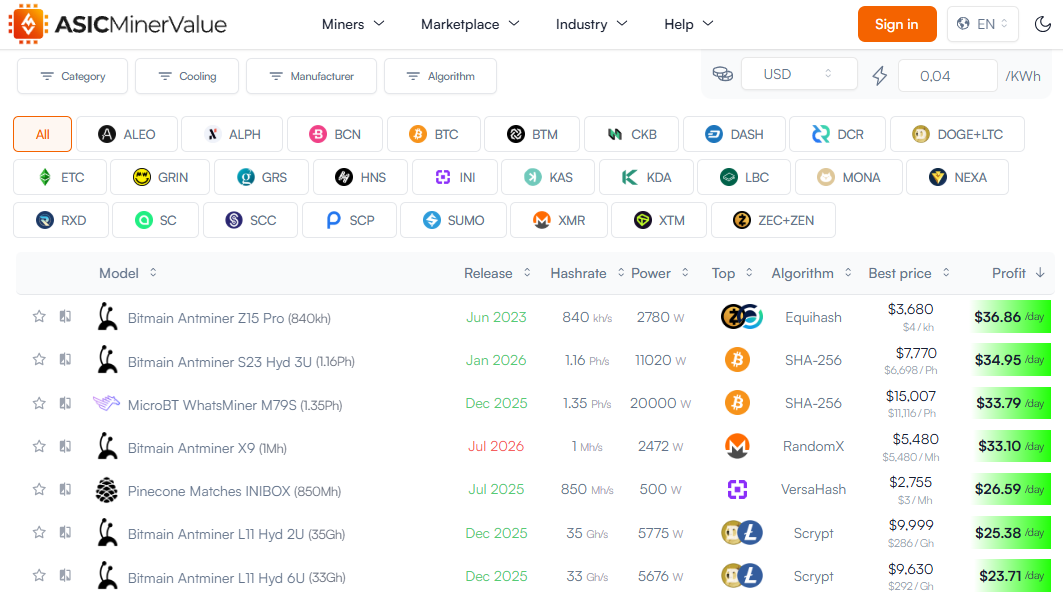
This seemingly endless ranking contains all PoW cryptocurrencies, mining algorithms, miner models — essentially all the information needed to understand which coin is more profitable to mine.
However, the key nuance is that the best cryptocurrency for mining is not necessarily the one at the very top of the list, because this list is merely a snapshot in time. Mining is a long-term business, so the calculator can only provide part of the information. The rest must be figured out independently with regard to the following factors:
- The coin: its market history and current market phase.
- Liquidity: the coin's liquidity and its presence on exchanges.
- Hardware: manufacturers, repairability, availability of service and firmware.
- Costs: capital costs (equipment) and power consumption.
- Depreciation: equipment amortization and residual value.
- Pools: working with mining pools—convenience and fee size.
- Network difficulty: the current state of energy efficiency.
- Tax regime: applicable tax regulations.
Keep this list of factors in mind when determining the profitability of mining a particular cryptocurrency. Only then will your conclusions be accurate.
Types of mining and what you can actually mine in 2026
When choosing a cryptocurrency to mine in 2026, the equipment remains the key factor. Let's examine the three main types of mining, their characteristics, and try to find the best way to mine crypto - 2026 holds enormous potential for mining.
CPU Mining (Processor).
- How it works: using a computer's central processing unit.
- Pros: low entry barrier, suitable for testing.
- Cons: extremely low profitability.
- Here you can find the best crypto to mine at home in 2026: primarily privacy-focused projects or those using ASIC-resistant algorithms, such as Monero (XMR).
GPU Mining (Graphics Card).
- How it works: utilizing the power of graphics processing units.
- Pros: flexibility (possibility of switching between different algorithms), relatively good equipment liquidity.
- Cons: high initial costs, dependence on electricity prices.
- Here you can choose the best way to mine crypto in 2026: currently, this can method can be used for Ethereum Classic (ETC), Ravencoin (RVN), as well as many newer projects on the Ethash algorithm, and others.
ASIC Mining (Specialized Device).
- How it works: using devices created for mining with a specific algorithm.
- Pros: maximum performance and energy efficiency for their niche.
- Cons: high price, noise, rapid model obsolescence, lack of flexibility.
- Here you can find the best mineable crypto: Bitcoin (BTC), Litecoin (LTC), Kaspa (KAS).
Thus, when determining which coins you can mine in 2026, first select the equipment type by analyzing your budget and risks. The strong trend toward energy efficiency continues this year.
Top mineable cryptos in 2026
Below are the best crypto coins to mine based on profitability calculator data. We have also considered the offerings from mining hardware manufacturers, as mining success is based primarily on the quality and energy efficiency of miners, their repairability, ease of maintenance, residual market value, operational lifespan, and similar factors.
In addition to technical aspects, it's important to find the best crypto to mine today based on your success strategy. In other words, choose the best crypto coin to mine based on the project's goals, the team's background, the development roadmap, and other criteria. Now let's finally open this black box.
Bitcoin (BTC): the king of ASIC mining
Bitcoin's share of the hashrate exceeds 99% of the total computational power dedicated to PoW cryptocurrency ASIC-mining. At the same time, "niche" projects always have their own audience and objective reasons for attracting investor attention. Bitcoin is ideal for mining because hardware manufacturers offer a vast number of miner models to suit any preference. Bitcoin is widely accepted, possesses the highest value among all cryptocurrencies (as confirmed by its market capitalization), and is the original cryptocurrency, digital gold, and the primary benchmark that all others follow.
BTC is the best cryptocurrency for mining because it offers the broadest opportunities for risk management when investing in mining. This is achieved through diversification of equipment, mining pools, investment approaches (e.g., through hosting), and so on.
Bitcoin's enormous network hashrate and high difficulty are reflections of demand, not obstacles. Furthermore, the volatility of its price offers a chance to find the optimal market entry point, as there is a deep correlation between the BTC price and the cost of equipment (especially on the secondary market).
Today, profitable Bitcoin mining is only possible and affordable when several factors align: proximity to a source of cheap renewable electricity, the availability of suitable infrastructure, and access to long-term capital. The alternative path is to leverage these same factors indirectly by hosting equipment within the infrastructure of a major player (such as the service offered by Cuverse).
Monero (XMR): a privacy coin you can mine with a CPU
Monero stands out among cryptocurrencies suitable for mining due to its two key features: mandatory privacy of all transactions and the RandomX algorithm, specifically optimized for CPUs. This makes XMR one of the few projects where CPU mining is not only possible but also sensible. Some enthusiasts believe that XMR is the best crypto to mine at home in 2026.
The main advantage is the extremely low entry barrier. You can start mining on almost any modern processor, making it ideal for testing the technology. However, you should expect modest profitability, which is offset by the low initial costs. This fact makes Monero the best crypto to mine for beginners who are understandably not inclined toward large investments.
An important nuance for a miner is the regulatory risks inherent to privacy coins. Some exchanges may restrict XMR trading, which can potentially impact its liquidity. Monero should be considered a niche, technologically unique option for decentralized mining, and XMR mining should be viewed as an opportunity to try out or diversify your mining activities without significant investment.
Litecoin (LTC): a classic altcoin on Scrypt
Litecoin is the best crypto to mine for profit on the Scrypt algorithm. Its key features are fast block times (2.5 minutes) and its time-tested reputation as "digital silver" (Ethereum had previously claimed this title but lost its ambition after switching to the popular Proof-of-Stake algorithm — staking cannot be considered an analogue of producing "digital metal").
Litecoin mining is particularly attractive for those seeking an alternative to Bitcoin. For instance, it can be more profitable due to lower global competition and the availability of specialized Scrypt-ASIC devices, which are cheaper to purchase and operate than their BTC counterparts. This lowers the entry barrier for beginners. LTC is worth consideration for miners focused on a stable, predictable asset with established infrastructure.
Litecoin often decouples from Bitcoin, providing LTC miners with additional income opportunities. However, Litecoin is not a benchmark coin and most of the time follows in Bitcoin's wake, experiencing deeper drawdowns and recovering more slowly after sell-off waves, which significantly impacts Litecoin mining profitability. In fact, this is a common trait of all mineable altcoins.
Dogecoin (DOGE): a meme coin with real mining rewards
Dogecoin is a coin whose success perfectly illustrates the concept of "survivorship bias." In other words, Dogecoin's success cannot be used to judge the overall success of meme coins, of which there are millions, while only a handful succeed. For some reason, Elon Musk chose DOGE to periodically stir up the market, but it’s something to work with — Dogecoin's volatility, stemming from all of the above, allows it not only to "trade itself," which is attractive to a certain cohort of traders, but also to "mine itself," which may be of interest to a certain cohort of miners. Have you ever heard of "mining volatility"?
The speculative nature of the DOGE cryptocurrency adds unpredictability to the market picture. However, it should not be forgotten that this is a solid project with a substantial market capitalization. There is big money and high stakes involved, and as long as this sun shines, it is quite reasonable to bask in its rays and get your share of warmth from the humming mining equipment nearby. A factory producing a volatile asset is both a risk and great opportunity in one bottle.
Ethereum Classic (ETC): a smart-contract chain that’s still PoW
Following the hack of Ethereum in 2016 and the forced blockchain "rollback," not everyone accepted it as a necessary reality. A part of the community rejected this turn of events—thus, an Ethereum fork emerged under the logical name Ethereum Classic, inheriting the Proof-of-Work mining algorithm, which remains unchanged to this day.
For miners, this means that ETC remains one of the few major mineable cryptocurrencies on the Ethash algorithm, accessible for mining with both GPUs and specialized ASICs.
The main advantage of mining ETC is significantly lower competition compared to networks like Bitcoin, which theoretically lowers the entry barrier. However, the key risk is the coin's more modest liquidity and volatility relative to market leaders.
Thus, ETC represents a niche but viable option for miners looking to utilize familiar Ethash infrastructure. It suits those willing to balance between potential opportunities, including smart-contracts and the asset's heightened market specificity.
Ravencoin (RVN) and Vertcoin (VTC): GPU-friendly alternatives
For beginners looking for the best crypto to mine, Ravencoin (RVN) and Vertcoin (VTC) are excellent examples of GPU-friendly projects. Both are built on ASIC-resistant algorithms — KawPow and Verthash respectively—ensuring a level playing field for individual miners with graphics cards. RVN runs on the KawPow algorithm, designed for sustainable GPU mining and ASIC resistance. Its appeal lies in its strong community and clear focus on asset creation, which keeps the network in demand.
Their core philosophy is a commitment to decentralized, fair GPU mining, which translates to a relatively low entry barrier. You can start with a single modern video card.
It's crucial to understand that their mining profitability is highly volatile, directly tied to the coin's market price and, most importantly, your electricity costs. They represent a solid entry point into mining, prioritizing network ideals over guaranteed high returns.
Zcash (ZEC) or Grin (GRIN): privacy projects with their own risks
For miners interested in supporting confidential transactions, Zcash and Grin are notable examples of privacy coin mining. Both are considered best mineable crypto for GPU rigs, with Zcash also having ASIC options. Their main appeal is the strong technology focus on privacy, attracting a dedicated community. Zcash (ZEC) uses the Equihash algorithm and is mined on powerful GPUs or specialized ASICs. Its key feature is enhanced privacy functions combined with the possibility of transparent transactions.
However, Zcash and Grin mining carries specific risks beyond standard market volatility. Increased regulatory scrutiny can lead to exchange delistings, which directly impacts liquidity and price stability. This makes them a more speculative, niche choice suitable for miners who understand and accept these potential market dynamics.
How to calculate mining profitability in 2026
To figure out which coin is best to mine right now, use mining profitability calculator services. A mining calculator allows you to estimate the profitability of a particular coin based on objective reality. Take the WhatToMine service, for example. In the screenshot, the fields to be filled in by the user are highlighted with orange borders. You can select GPU, CPU, or ASIC as your mining hardware, choose the mining algorithm, and specify your electricity cost. The screenshot shows a Bitcoin miner with a hashrate of 270 TH/s and power consumption of 3,645 W, which corresponds to an Antminer S21 XP (Energy efficiency: 3,645 W / 270 TH/s = 13.5 W/TH).
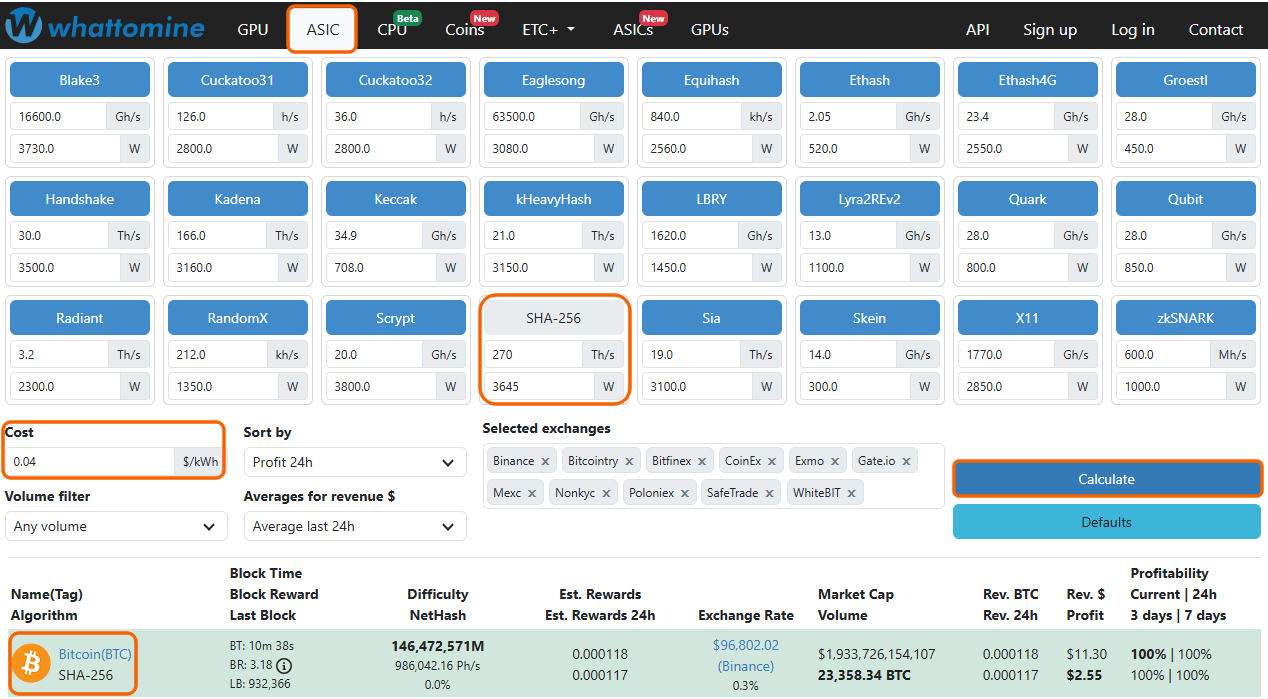
After clicking the "Calculate" button, a selection of all possible coins and options based on the entire dataset will appear at the bottom, making it easier to determine which coin is more profitable to mine. In this case, we limited ourselves to Bitcoin, resulting in a daily income of 0.000117 BTC and the corresponding USD conversion based on the current rate. This approach is valid for any mining algorithm, cryptocurrency, and hardware—any initial conditions.
You can also calculate mining profitability using the AsicMinerValue service — it's simpler to understand, especially when filtering by mining algorithm. You'll get a long list of relevant hardware models for mining all available coins using that algorithm. For example, select the Scrypt algorithm, and you'll receive a comprehensive list of equipment for mining LTC and DOGE, sorted by profitability.
It's also crucial to understand, as mentioned above, that this is an instant snapshot that should not be your basis for long-term conclusions. However, this information allows you to compare various options that fit your strategy and make a more objective choice.
Which coin fits your hardware and budget best?
Choosing a cryptocurrency to mine directly depends on your hardware and starting capital. Here are a few typical scenarios to help determine which coins to mine:
Scenario 1: low budget, only a PC (not a phone, at least a laptop!).
You have a regular computer. Your option is CPU mining of privacy coins like Monero (XMR). The income is symbolic, but it's a way to start from scratch.
Scenario 2: you have one or more graphics cards (GPUs).
This is the most flexible path. You can switch between different altcoins for mining (e.g., Ravencoin, Ethereum Classic), choosing the most profitable algorithm. Profitability depends on the power of your cards and the cost of electricity.
Scenario 3: investment in ASICs.
You purchase a device for a specific algorithm (e.g., SHA-256 for Bitcoin or Scrypt for Litecoin). Your coin choice is strictly limited, but mining efficiency is maximized.
To make the final decision on the best coin to mine, match your equipment with current profitability data in an online calculator, specifying your electricity costs.
Main risks of mining in 2026 and when it’s easier to just buy crypto
Mining is a long-term business. As you mine, the market will inevitably experience both growth and decline phases. You must be prepared for any scenario and have a profitability buffer in addition to your expectations. The risks of mining are significant, which is why it’s so important to choose the best cryptocurrencies — those that fit your strategy for achieving success.
Deciding which cryptocurrency is best to mine is ultimately up to you, with regard to the following risks:
- A drop in the coin’s exchange price.
- An increase in electricity price.
- Regulatory restrictions, changes in tax regimes, or bans.
- An increase in the network difficulty of the mined cryptocurrency.
- Equipment obsolescence, natural wear and tear, downtime, inability to compensate for lost capacity.
- Force majeure expenses (security, etc.).
Take all these factors into account to be free from delusions, assess your resilience, and stress-test your scenario. However, remember: the higher the risk, the higher the potential profit.
FAQ
Below, we briefly answer the most common questions from beginners about the best crypto to mine. While mineable cryptocurrencies generally behave similarly, each has its own market nuances. What should you do, and is it worth starting to search for the best crypto to mine today? (Spoiler: it is).
What is the best crypto to mine for beginners in 2026?
With minimal investment, you can mine Monero, Ravencoin, Vertcoin, and other CPU/GPU coins. You can view this as a warm-up before entering a real business — you won't earn much money here. The only truly attractive business with solid potential is Bitcoin mining; everything else merely follows in its wake.
Bitcoin mining requires long-term commitment — it's no longer a mere hobby, as is often the case with altcoins. Weigh all the pros and cons when considering BTC mining. Contact Cuverse to figure out how to start with minimal upfront investment, leveraging Cuverse's equipment hosting, infrastructure and user-friendly app.
What is the best crypto to mine at home with a small setup?
For a typical home setup with 1-2 GPUs or a powerful CPU, the best crypto to mine right now will likely be one of the coins with lower network competition and equipment flexibility. A strong CPU supports Monero (XMR), while GPUs are ideal for Ravencoin (RVN) or Ethereum Classic (ETC).
Your electricity tariff is the critical factor. With higher residential rates, mining must be efficient to remain profitable. Proper cooling is also essential to maintain hardware performance and longevity in a confined space.
For maximum efficiency, consider using software or pools that allow automatic switching between different coins. This ensures that your small setup will always mine the most profitable coin after accounting for your specific electricity costs, making the most of limited resources.
Is there a single “best” crypto to mine for profit in 2026?
Don't waste time searching for the best crypto to mine for profit or a holy grail. Base your decision on your capabilities, not on potential fleeting gains — profit is a transient thing. What is profitable today may turn to dust tomorrow.
What is the best crypto currency to mine? The answer is actually extremely simple — the best cryptocurrency to mine is the one you not only believe in but also one that matches your capabilities. If we look at the mining market regardless of individual capabilities — the best coin to mine is, quite obviously, Bitcoin. After all, it has been chosen by over 99% of the global mining audience, and they can't all be wrong.


