Mining farms are facilities for cryptocurrency mining that house numerous computing devices, such as ASIC miners. In the past, mining with GPU graphics cards or CPU processors was popular. Today, Bitcoin mining using CPUs and GPUs is no longer profitable. In this article, we will take a detailed look at mining farms and determine which path to Bitcoin mining is the most rational and carries the least risk.
What is a mining farm?
A mining farm is a collection of multiple mining devices united for a single purpose — to mine cryptocurrency. A farm is characterized by its computational power (TH/s, PH/s = 1,000 TH/s — the number of computational operations per second) and its energy efficiency (W/TH — energy consumed per trillion computational operations). A mining farm can consist of two devices or more. Large-scale farms comprise hundreds or even thousands of ASIC miners and are housed in data centers with centralized systems for monitoring, cooling, security, and more.
The crypto industry is witnessing a battle not only among miners but also among mining hardware manufacturers such as Bitmain, Canaan, MicroBT, and others. The overall trend is that everyone strives to create the most energy-efficient machine, as it will mine bitcoin at the lowest possible cost. However, the more energy-efficient a miner is, the higher its price, and consequently, the longer its payback period. At the same time, advanced energy efficiency enables a mining farm composed of such devices to remain profitable for as long as possible, even during severe market downturns. In contrast, a cheaper farm will sooner fall into the loss zone and need to be shut down.
Bitcoin Mining Guide 2025-2026
Using a ready-made mining infrastructure allows you to start BTC mining with minimal risk
How do crypto mining farms work?
Today, Bitcoin mining is an extremely labor-intensive and energy-demanding computational process. Essentially, all bitcoins are mined by the largest mining pools, which unite the vast majority of mining farms of all sizes. After a pool receives a reward, the bitcoins are distributed among all pool participants according to a specific scheme. Typically, each participant's share of the earnings depends on the computational power they contribute. The mining pool charges a fee for its services. These fees can vary between pools.
No matter how energy-efficient a mining farm is, mining Bitcoin outside of a pool is pointless, as it becomes a lottery where winning is by no means guaranteed.
Working within a pool is a guarantee of earnings for any mining farm in today's reality, where mining has long ago ceased to be a mathematical toy for a handful of crypto enthusiasts and has transformed into a massive industry.
Examples of mining farms
Cuverse is a large-scale enterprise with data centers in many parts of the world. The company's mining infrastructure is built to ensure maximum long-term profitability in bitcoin mining, regardless of market sentiment.
Cuverse uses ASIC miners with various specifications, allowing you to choose any investment strategy when operating on the company's provided capacity.
On the main page of the Cuverse website, you will find a video from our data center in Northern Europe. It allows you to examine the mining rigs, cooling systems, and endless cables in detail, and appreciate the scale of the facility, how it was built, and much more information that is typically inaccessible to the average user.
Below, you can find some photos of the interiors of our data centers. All of this will help you form an idea of what a genuine industrial mining farm capable of mining bitcoin 24/7 looks like.
Main types of mining farms
Today, Bitcoin can only be mined using ASIC miners. This is specialized hardware that can only be used for BTC mining. However, there are coins that are "ASIC-resistant." The point is that the computational power of ASICs is so high that it can pose a threat to the decentralization of certain projects. The mining algorithm for such cryptocurrencies is optimized for graphics cards (GPUs) to prevent large mining companies from gaining control over the project. Cryptocurrencies like Monero (XMR), Ravencoin (RVN), and Ethereum Classic (ETC) are examples of this approach to mining.
Crypto mining using central processing units (CPUs) is also resistant to ASIC miners and is implemented for coins such as Monero (XMR) and Zcash (ZEC).
However, mining with ASIC miners remains the most popular. ASICs are produced not only for Bitcoin mining but also for other cryptocurrencies, like Kaspa. The leading miner manufacturer, Bitmain, offers models for both BTC and KAS, and previously offered miners for the Kadena (KDA) cryptocurrency, which has practically ceased to exist.
Each coin has its own mining algorithm. For example, Bitcoin uses SHA-256, Litecoin and Dogecoin use Scrypt, and Kaspa uses kHeavyHash. Cryptocurrency mining farms vary in their specialization, but Bitcoin mining dominates all other types of mining.
Key components of a farm
Every mining farm comprises three main components. First, there is the computing hardware itself: ASIC miners, graphics cards (GPUs), or central processing units (CPUs) that perform cryptographic calculations. Second, a reliable power supply system, including high-capacity power supply units (PSUs), voltage stabilizers, and appropriate electrical wiring for 24/7 operation under high load.
The third critically important part is the cooling system, which prevents the equipment from overheating. It may include industrial fans, intake and exhaust ventilation systems, or even liquid cooling. Additional elements are a control server or computer with monitoring software, as well as networking equipment for connecting to the internet and mining pools. It is the coordinated operation of all these elements that transforms a collection of devices into an efficient and stable mining farm.
However, the most crucial component of a mining farm is still your patience, because without it, managing such a complex facility over a long period will be difficult. You will have to solve routine tasks both during favorable and stressful market periods. Be prepared for unexpected breakdowns, solve problems methodically, and never doubt that you are gaining exceptionally valuable experience.
How to choose equipment for a mining farm?
Mining equipment determines the profitability and lifespan of your entire farm. Incorrect choice of devices can lead to low returns, constant breakdowns, and, as a result, financial losses.
Here are the main criteria for the mining farm creator to focus on:
- Algorithm and Coin. First, decide which cryptocurrency you want to mine. For Bitcoin and other SHA-256 coins (e.g., Bitcoin Cash), ASIC miners are required (for example, the Bitmain Antminer bitcoin miner). For Ethereum Classic, Ravencoin, and other algorithms, powerful graphics cards (GPUs) are often used. Buying unsuitable equipment will make mining unprofitable.
- Energy Efficiency (J/TH or W/TH). This is the most important parameter after hash rate (TH/s, PH/s, or even EH/s). It shows how much electricity a device consumes to generate a unit of computing power. The lower this indicator, the cheaper each mined satoshi costs, which is especially vital when electricity tariffs are high. Modern ASIC miners can have ratings around 15-25 W/TH. For example, the Bitmain Antminer S21 XP boasts an energy efficiency of 13.5 W/TH at a hash rate of 270 TH/s.
- Computational Power (Hash Rate). Determines how quickly the equipment solves cryptographic problems. The higher the hash rate, the greater the probability of finding a block and receiving a reward. More powerful models are more expensive and consume more energy.
- Reliability and Brand Reputation. The equipment will operate 24/7 under extreme load. Choose proven manufacturers with a good reputation (Bitmain, MicroBT, Canaan for ASICs; NVIDIA, AMD for GPUs) and pay attention to reviews of specific models.
- Cost and Payback Period (ROI). Calculate the approximate payback period, considering the device's price, its hash rate, power consumption, and the current cryptocurrency exchange rate. Base your decision on your personal ROI strategy.
Don't chase the absolute maximum — look for the optimal balance between power, efficiency, and price that suits your specific strategy (electricity tariffs, budget, goals).
Best Bitcoin Mining Machines in 2026
Procure mining hardware that aligns with your business strategy!
The role of software in mining
Software is the "brain" of any mining farm, regardless of its size. It connects the physical mining hardware to the blockchain.
The main tasks of mining software are:
- Hardware Management: Detecting devices (ASIC, GPU, CPU), configuring operational parameters (clock speed, power), and turning devices on and off.
- Connecting to a Pool: Directing the farm's computational power to the chosen mining pool and establishing a stable connection.
- Monitoring and Diagnostics: Tracking hash rate, chip temperatures, fan status, and electricity consumption in real time. Providing timely alerts for failures.
- Task Distribution: Receiving cryptographic tasks (blocks) from the pool and distributing them among all devices on the farm for parallel solving.
- Energy Management: Some programs allow for automatic configuration of equipment to operate in the most efficient modes or even temporarily shut it down during peak electricity tariffs.
Types of mining software:
- ASIC Firmware: Installed directly on the miner's controller. Well-known examples: Braiins OS, Hiveon ASIC. They often improve efficiency and provide advanced control functions compared to the manufacturer's standard software.
- Farm Operating Systems: Specialized OS installed on a control server or computer. They combine different models of equipment into a single system. The most popular are: Hive OS, Rave OS. They allow remote management of hundreds of devices via a web interface.
- Standard Clients (Software): Programs for CPU/GPU mining, such as NiceHash Miner, GMiner, T-Rex. Often used by beginner miners.
Conclusion: Without properly configured and stable software mining turns into chaos. Choosing the right software is as important as choosing hardware, as it directly affects the farm’s uptime, efficiency, and, ultimately, its profitability.
Location and operating conditions
A successful mining operation directly depends on the correctly selected farm location and the creation of optimal operating conditions. The ideal location must deal with three main challenges: providing cheap electricity, efficient heat dissipation, and the physical security of the equipment.
Access to affordable and stable electricity is the key factor, as power is the main cost component in mining. Industrial mining farms are often built in regions with excess energy capacity — near hydroelectric plants, wind farms, solar fields, or in countries with low tariffs.
The cooling system is crucial regardless of the climate. The equipment generates an enormous amount of heat, and without effective heat dissipation, the chips will quickly overheat and fail. The facility must have powerful intake and exhaust ventilation and, ideally, a controlled microclimate. Low air humidity, a reliable internet connection, and protection from unauthorized access are also critically important. Creating such conditions is a complex infrastructural challenge that professional data centers take on. This makes the mining process stable and predictable for an investor. Cuverse utilizes precisely this approach and invites you to mine using the capacity of its professionally maintained data centers.
What energy is used for mining?
A mining farm is a facility consisting of computing hardware and peripherals (such as ventilation and security systems). Typically, 95-98% of the electricity is consumed directly by the ASIC miners, which operate 24/7 solving cryptographic problems and release a significant amount of heat in the process.
A single ASIC farm that comprises 100 Antminer S21 miners can consume up to 300 kW, which is comparable to the consumption of hundreds of apartments, i.e., an entire residential building. On a global scale, the Bitcoin network's energy consumption is comparable to that of some countries, such as Argentina (up to 150 TWh per year).
To reduce its carbon footprint, the mining industry is actively transitioning to renewable energy sources—solar, wind, and hydropower.
How much can one earn from a mining farm?
The profitability of a mining farm directly depends on three key factors: total power (aggregate hash rate), electricity cost, and the current Bitcoin price. It's easiest to calculate it using a specific miner as an example.
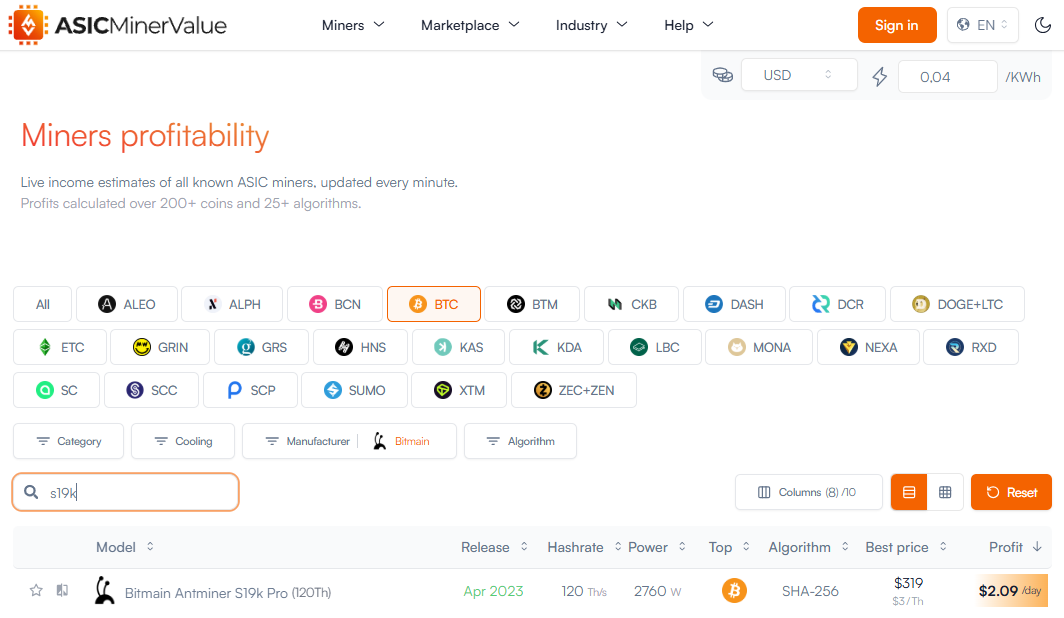
Let's take an inexpensive ASIC miner, the Antminer S19k PRO, with a hash rate of 120 TH/s and energy efficiency of 23.1 W/TH. Using a mining calculator (e.g., on asicminervalue.com) and entering the current conditions, we get an approximation:
Bitcoin price — $93,000, electricity cost — $0.04 per kWh, network difficulty — stable.
This ASIC miner would generate a net profit of about $2-3 per day under these conditions.
A farm with 10 such miners would earn up to $30 per day, and up to $10,000 - 12,000 per year. It's important to remember this is an average estimate. Actual income heavily depends on BTC price volatility and fluctuations in network difficulty, requiring regular recalculation.
Let's assume that Bitcoin price doubles over a year. This happens gradually, and as it does, Bitcoin network difficulty also increases, proportionally reducing your income. In such a scenario, you could earn approximately $15,000 - $18,000. Furthermore, during the uptrend, you could reinvest part of the earnings and other funds to expand your mining capacity and earn even more. However, this approach works both ways.
What risks are associated with mining farms?
Despite the potential profitability, creating and operating your own mining farm is associated with significant risks and potential problems that can reduce profits to zero or lead to losses.
Technological Risks (Hardware Obsolescence). This is the most significant risk. The industry is developing rapidly: manufacturers release new, more powerful and energy-efficient ASIC miners every year or two. Your equipment constantly depreciates, and its profitability declines if Bitcoin network difficulty increases. A top-tier miner purchased today can become unprofitable in 3-5 years, and a simpler miner — in 2-3 years. This requires constant reinvestment in upgrades.
Financial Risks (Market Volatility). Profitability directly depends on the Bitcoin price, which is highly volatile. A prolonged bear market can make mining unprofitable for months, forcing you to shut down equipment while still incurring operational costs (rent, security, personnel). The price of electricity remains the key factor, and its increase can instantly destroy your margin.
Operational and Infrastructure Problems.
- Power Supply and Cooling: A farm consumes megawatts of energy and requires professional electrical system design. Poor-quality wiring leads to fires. Inefficient cooling causes overheating, reduces performance, and drastically shortens the lifespan of expensive equipment (miner chips).
- Noise and Heat: The operation of hundreds of fans creates unacceptable noise levels (75-90 dB) for residential areas, and the heat generated requires costly heat dissipation solutions.
- Constant Monitoring and Repair: Equipment operates at its limit 24/7 and periodically fails. Constant technical supervision, spare parts inventory, and prompt replacement of failed units are necessary, as their downtime means lost profits.
Legal and Regulatory Risks. Mining legislation in many countries is unstable or undefined. Authorities can introduce bans, special taxes, energy consumption restrictions, or even confiscate equipment, as happened in China in 2021. Legalizing a farm is also associated with bureaucratic complexities.
Thus, a mining farm is not a source of "passive income" but a high-tech production facility with high entry barriers, constant capital expenditure, and the need for deep expert knowledge. For a private investor, transferring these risks to a professional operator (host) is often a more sensible strategy. Cuverse invites private and institutional investors to cooperate under equipment hosting terms in professionally maintained data centers.
The future of crypto mining farms
The future of mining lies not in the race for cheap electricity, but in its transformation into a highly intelligent service for the energy systems of the future. Mining farms will cease to be a "parasitic" load and become universal, flexible consumers that stabilize power grids.
Their uniqueness lies in their ability to be instantly turned on and off, making them the ideal tool for balancing grids with intermittent generation (solar, wind). They will absorb excess "green" energy during production peaks, preventing its waste, and shut down during shortages, reducing the load. Thus, mining will evolve from Bitcoin extraction to a key element of "smart" energy, monetizing underutilized resources and making renewable energy sources more economically efficient.
Alternatives to mining farms
Understanding the high risks and complexity of independently managing a mining farm, many investors turn to alternative ways of earning income in the crypto industry. Here are the main ones:
Cloud mining refers to renting computational power from a large company and managing it "in the cloud." The user buys a contract for a specific hash rate and receives the coins mined with it. Pros: no need to purchase and maintain equipment, no need to worry about electricity and cooling. Cons: a high concentration of fraudulent projects in this segment operating as Ponzi schemes.
Staking is an alternative for cryptocurrencies not using Proof-of-Work (like Bitcoin), a way of participating in blockchain support. Instead of computational power, you "lock" (stake) your own coins in a wallet to participate in transaction validation and receive a reward. Pros: does not require energy-intensive equipment, the process is quiet and eco-friendly. Cons: only applicable to coins with a Proof-of-Stake algorithm (e.g., Ethereum, Cardano, Solana); requires an initial investment in the cryptocurrency itself; capital is locked for the duration of staking.
Hosting equipment in professional data centers (e.g., at Cuverse). This is a hybrid model combining the advantages of independent mining and cloud services. The physical ASIC you purchased becomes your property, but it is placed on the provider's infrastructure, which ensures:
- Stable and cheap power supply.
- Industrial cooling.
- Round-the-clock monitoring and technical maintenance.
- A secure facility and internet connection.
- A convenient personal account for monitoring income.
The key advantage over cloud mining: you are mining on your own equipment, which is part of the energy-efficient mining infrastructure of a large enterprise. You only pay for electricity, receiving 100% of the BTC mined on your miner. This is the optimal choice for those who believe in Bitcoin as an asset but do not have the ability to create their own mining enterprise.
How to Invest in Crypto Mining - A Beginners Guide
Bitcoin mining can be approached in different ways
Conclusion
So, mining farms have long ceased to be toys for crypto geeks and have transformed into high-tech facilities with medium-term payback, a high entry barrier, and significant investment risk requiring deep an independent assessment by the investor.
Building your own mining farm today only makes sense for the sake of gaining unprecedented experience with the goal of scaling it later in partnership with a large business. In an ideal world, your own mining farm can be profitable, but it would demand your constant attention and ongoing investment in equipment upgrades to maintain mining profitability.
Hosting equipment in a large data center is ultimately your mining farm, built on the infrastructure of a major player with access to cheap electricity, centralized maintenance of computing power, and the ability to withstand all market turbulence without sliding into losses or changing the rules of the game.
Ultimately, stability is the most valuable asset in any business. Stability breeds trust, and trust holds the highest value when an entity unites many people, similar to what blockchain technology as a whole, and Bitcoin in particular, has demonstrated in recent history.
Entrust your mining to Cuverse and earn bitcoin without diving into technical issues with high productivity!
FAQ
Which hardware is the most efficient?
Today, the market features many modern and highly efficient miner models, such as the Cuverse Antminer S21 XP 270 TH/s, 13.5 W/TH.
According to the Hashrate Index service as of December 5, 2025, the average breakeven point for a miner at an electricity price of ~$0.04/kWh is around 40 W/TH. This means that the Antminer S21 XP can perform well under current conditions and has a substantial safety margin in case of a market downturn.

However, one can also purchase a cheaper miner, e.g., the Antminer S19k PRO with an energy efficiency of 23.1 W/TH — it will earn less but incur lower equipment costs. Thus, you reduce your investment at the expense of increasing market risks, as such a miner would become unprofitable faster than the S21 XP in case of market deterioration.
Therefore, the energy efficiency of an individual miner, as well as the overall energy efficiency of a mining farm, should be chosen not out of maximalist ambition but according to the selected risk management strategy — either you lower capital expenditures and receive lower revenue, or you invest generously but gain maximum resilience.
How much can you earn with a mining farm?
To estimate potential earnings, consider the Antminer S19k PRO as an example. This model offers a hash rate of 120 TH/s with an efficiency of 23.1 W/TH. Using a standard mining calculator and variables like the l Bitcoin price of $93,000 and electricity price of $0.04/kWh, the daily net profit for a single unit comes to roughly $2-3.
Scaling this to a small farm of 10 miners, daily revenue could reach around $30, resulting in an estimated annual income of about $10,000. Real profitability is dynamic and heavily influenced by Bitcoin's price volatility and rising BTC network difficulty.
What are the risks of running a mining farm?
Mining requires significant investment, and the main risk here is failing to recoup it. Furthermore, mining is a long-term business; you cannot just come in, earn money and leave. You have to live it: you must constantly maintain and upgrade the equipment, otherwise, it will stop working or become unprofitable. Mining can only be pursued with a long-term strategy, with a clear vision of what you will do if something goes wrong and with a sufficient reserve fund to withstand a negative market for a predetermined period.
One way or another, mining risks are the risks of any business that requires investment and constant attention. You can avoid most of these risks by transferring them to a larger company for which they are less significant. For instance, Cuverse, as a large operator of mining data centers, offers partnership under equipment hosting terms. This means you will be shielded from all risks except those of the market while mining bitcoin on your own equipment placed in a professionally maintained data center. Join Cuverse and limit your risks to a reasonable level for a private investor!
What alternatives exist to traditional mining?
Beyond classic Proof-of-Work mining, there are several alternatives. Staking allows earning rewards by locking up crypto assets to support a Proof-of-Stake blockchain network (e.g. Ethereum).
Cloud mining, where you rent hashing power, is another option, but this sector has been significantly discredited by numerous fraudulent and pyramid schemes, making it a high-risk choice.
The most reliable alternative is hosting. In this model, you own the physical mining hardware (ASIC), but it is installed and maintained in a professional data center. The provider handles all infrastructure complexities — power, cooling, security, and maintenance — while you earn mining rewards in full. This approach offers the benefits of direct mining ownership without the operational risks and hassles.
Which energy source is best for mining?
Renewable energy sources are most in demand for mining, as they do not leave a carbon footprint. Hydroelectric power plants, wind turbines, and solar panels best match the modern understanding of what Bitcoin should be. However, in most cases, an inexpensive energy source is chosen first, and then data centers are built around it. Therefore, the best answer to the question of which energy source is better is - the one that is closest and cheapest.
If inexpensive electricity is abundant, data centers are being built, turnkey solutions for different categories of users are being created, infrastructure is being developed, etc. Cuverse builds data centers near renewable energy sources and offers an all-in-one solution for Bitcoin mining on equipment hosting terms. All your mined bitcoins will be “green”, in addition, you will not have to deal with technical issues, because they are handled by the data center specialists. Just pay for inexpensive electricity and mine on your own equipment running in first-class data centers!


