
Bitmain's Antminer S21 series represents a line of ASICs that account for over 20% of the total Bitcoin hashrate. This highly efficient equipment enables profitable Bitcoin mining even during significant market downturns. Early 2026 has been marked by considerable difficulty fluctuations following Bitcoin's drop to $60k, yet the S21 series continues to mine steadily. As the leading cryptocurrency attempts to recover, mining conditions are expected to improve.
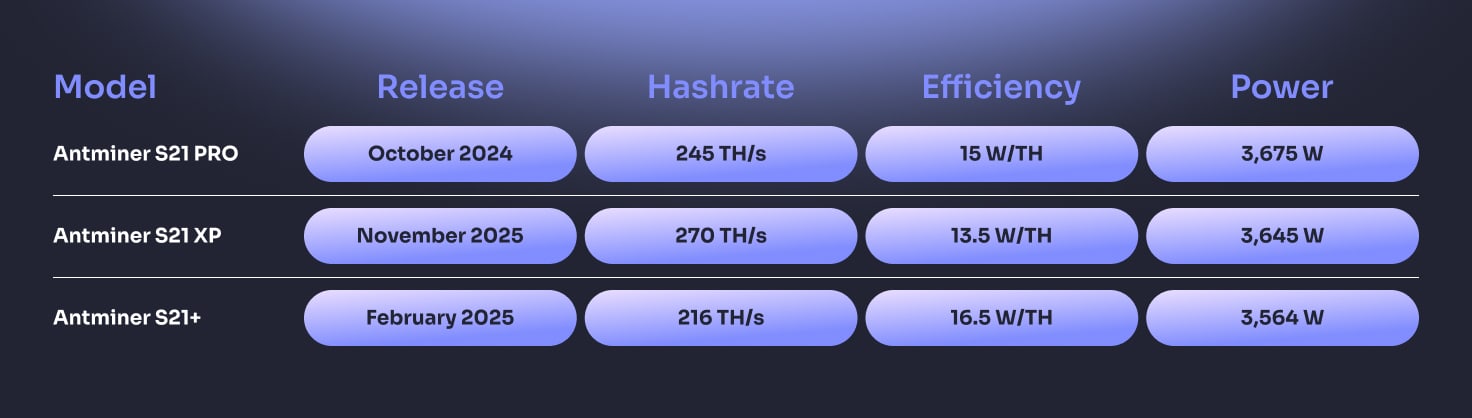
As of early March 2026, Cuverse's catalog features three models:
Overview of Antminer S21
The Bitmain Antminer S21 lineup is more than just advertising — it's a comprehensive series of devices released at different times, yet united by a single engineering vision. Cuverse's catalog features three key models, each with its own release date and distinct character:
- Antminer S21 PRO (October 2024) — 245 TH/s with 15 W/TH efficiency
- Antminer S21 XP (November 2025) — 270 TH/s with an impressive 13.5 W/TH
- Antminer S21+ (February 2025) — 216 TH/s with 16.5 W/TH
Although newer devices are appearing on the market, the S21 family remains relevant: this hardware is suitable for various strategies and different types of mining investors — from those chasing maximum hashrate (XP) to those seeking the optimal price-to-performance ratio (S21+). The series' main innovation is the transition to 5-nanometer chips that allow Bitmain to bring efficiency to a fundamentally new level and make mining more resilient to difficulty fluctuations.
Main specifications
All three representatives of the S21 family operate on the SHA-256 algorithm and are designed for Bitcoin mining. Despite their similar design, the technical specifications differ in details that are important to consider when making a choice. For convenience, we've compiled all the S21 specifications into a single table:
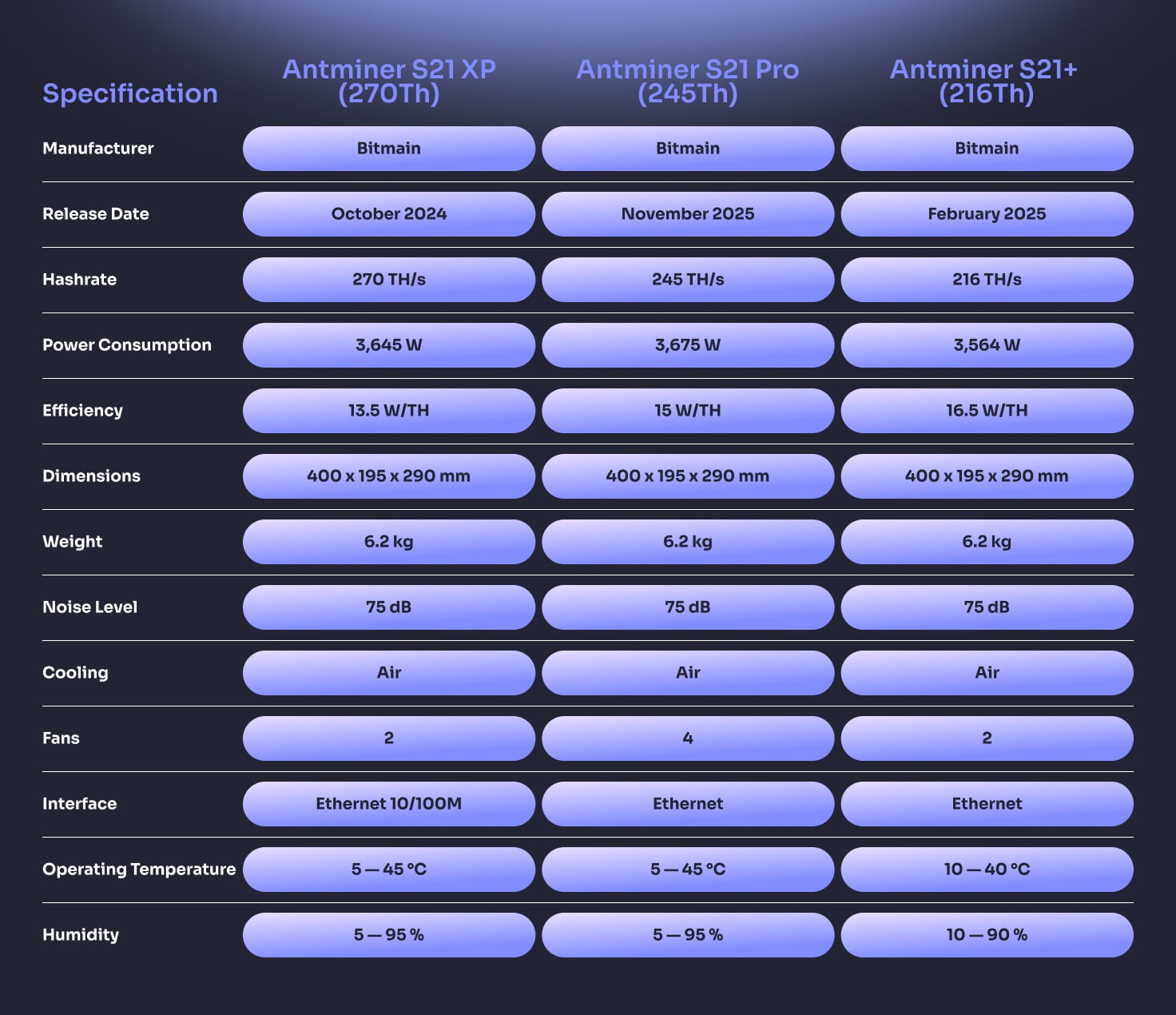
As the table shows, the main differences between models lie in performance and energy efficiency. The flagship XP model is distinguished not only by its record-breaking hashrate but also by its enhanced four-fan cooling system. Meanwhile, the S21+ has slightly more stringent requirements for installation conditions.
Performance overview
The heart of any ASIC miner is its chip, and the S21 family demonstrates impressive evolution in this regard. The lineup utilizes Bitmain's latest developments:
- The Antminer S21 PRO (245 TH/s) and S21+ (216 TH/s) are powered by advanced 5-nanometer BM1370 chips, delivering flagship efficiency of up to 15 W/TH.
- The Antminer S21 XP (270 TH/s) is equipped with the BM1368 chip (also 5nm), which served as an intermediate step toward record-breaking performance.
Let’s take a quick look back to grasp the scale of progress. The legendary BM1397 chips (7nm) from the Antminer S19 Pro delivered efficiency in the range of 29.5–34 W/TH. Then came a breakthrough: the BM1366 (5nm) in the Antminer S19 XP lowered the bar to 21.5 W/TH.
The transition to 5nm in the S21 didn't just match its predecessors — it surpassed them. Compared to the S19 XP (21.5 W/TH), the new S21 XP (13.5 W/TH) operates 60% more efficiently. This is a giant leap achieved through architecture optimization and further process node reduction. Essentially, the modern mining ASIC chip has become a microscopic hash-producing factory, where every watt of energy is utilized with maximum efficiency.
Design and build quality
Externally, the S21 family retains Bitmain's recognizable industrial design language: a thoughtful layout with no unnecessary details. All three models are housed in a unified 400 x 195 x 290 mm chassis — a classic form factor that fits effortlessly into any rack or mining rig.
The first thing that stands out is the casting quality and structural rigidity. The casing is made of thick aluminum and steel, providing excellent heat dissipation and remaining intact during transportation. The power and Ethernet connectors are ergonomically positioned with clear labeling, while the fan protection grilles securely shield the blades from accidental object intrusion — each fan is reliably protected against mechanical impact.
To touch, the device feels like a monolithic industrial tool — no creaking plastic or loose components. Even when running at full power, the S21 stays planted firmly in place thanks to rubber feet that dampen vibration. This is classic Bitmain: reliable, practical, and free of surprises.
Cooling system and noise level
Bitmain's engineers have equipped the S21 family with a thoughtfully designed air-based miner cooling system that directly impacts operational stability. All three models utilize the classic ASIC configuration with powerful fans blowing air through the hash board heatsinks. However, there's a nuance: the flagship Antminer S21 XP (270 TH/s) features an enhanced unit with four fans, while the S21 Pro and S21+ make do with two, albeit with optimized aerodynamics.
What does this mean in real-world terms? The noise level for all three devices falls within the 75–76 dB range. This is comparable to a loud vacuum cleaner or heavy traffic outside your window. For an industrial mining farm with proper ventilation and insulation, this is simply part of the working environment. But for home or office use, it's a serious barrier. Even a single miner creates discomfort equivalent to a noisy, non-stop party next door, and vibration from the XP version's four fans can travel through floor structures. The bottom line: the S21 belongs in a specially prepared space with noise dampening.
Durability and materials
Bitmain's engineers didn't experiment where it wasn't necessary: the S21 chassis is constructed from thick aluminum alloy, serving not only as the load-bearing structure but also as part of the heat dissipation system. Inside, three hash boards feature densely mounted 5-nanometer chips. Each chip die is equipped with its own temperature sensor—a significant step forward compared to predecessors, where a single sensor covered an entire board. This system protects chips from localized overheating and extends their operational lifespan.
The soldering quality and connectors are equally impressive. The S21 utilizes a new type of power connector with a mechanical latch, preventing accidental cable disconnection due to vibration. The controller features a standard Ethernet port protected against static discharge. The manufacturer states that heatsinks are secured with spring-loaded screws, ensuring uniform pressure against the chips even during thermal expansion.
With proper temperature management and regular cleaning, the mining hardware durability of this series is estimated at 3–5 years of continuous operation, backed by a 12-month warranty period.
Mining performance and efficiency
We've examined the technical components, chips, and cooling system — but for a miner, all of this is merely a means to an end. The moment of truth has arrived: it's time to translate terahashes and watts into the cold, hard math of profitability.
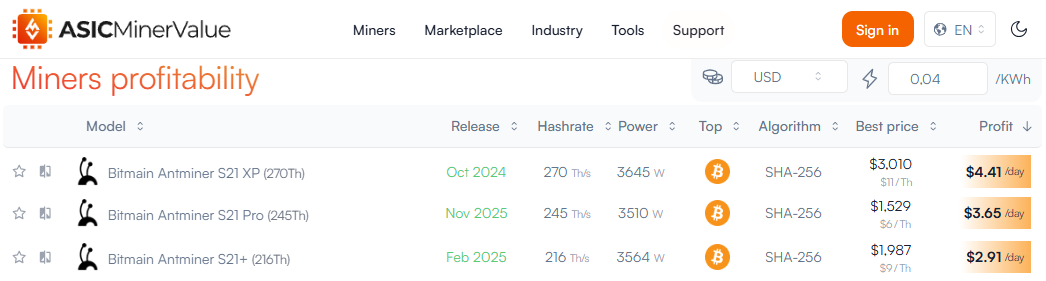
In this section, we'll step away from theory and examine real numbers. What practical Bitcoin mining performance do the models in our review demonstrate in today's network conditions? We've taken current data from mining profitability calculators and obtained a clear picture of what each model can generate at the current difficulty and price as of early March 2026, with an electricity cost of $0.04/kWh.
Hashrate and profitability
The daily profitability figures we mentioned above ($4.41 for the S21 XP, $3.65 for the S21 PRO, $2.91 for the S21+) are not constants etched in stone. They dance to the tune of Bitcoin's price and the network's global difficulty. But an experienced miner knows: the real stability of these numbers is forged not on the exchange, but inside the mining facility.
Any Bitmain device guarantees hashrate with a deviation of no more than ±3%. However, maintaining this at factory-specified levels for years can only be achieved in one way — through proper technical maintenance. Dust on heatsinks, dried-out thermal paste, clogged fans — these quietly steal efficiency: hashrate creeps down while power consumption climbs. As a result, profitability drops even when the market price is ideal.
Therefore, mining profitability is an equation with two variables: market conditions and the state of your hardware. Regular preventive maintenance (cleaning, thermal interface replacement, firmware updates) preserves factory energy efficiency for months on end. Ultimately, it's the maintenance strategy — not just luck in the markets — that ensures the steady stream of satoshis you can count on.
Energy consumption and energy efficiency
The rated power consumption figures we've already covered in the specifications represent default measurements under ideal 25°C conditions. In reality, the S21 XP draws 3,645W from the outlet, the S21 PRO consumes 3,675W, and the S21+ uses 3,564W. But far more important than absolute wattage is efficiency, namely, how many joules (watts) are spent on each terahash.
And here, the S21 family sets a new standard for what defines an energy-efficient Bitcoin miner. The S21 XP with its 13.5 J/TH (W/TH) rating is the absolute leader of the lineup. The S21 PRO (15 J/TH) and S21+ (16.5 J/TH) lag only slightly behind their bigger brother, yet still look fantastic compared to competitors.
To grasp the scale of progress, let's compare with the previous generation. The legendary Antminer S19 XP Pro delivers efficiency around 24.5 J/TH. Its direct competitor from MicroBT — the WhatsMiner M60S—operates at 20 J/TH. This means that under identical load, the S21 XP consumes 45% less energy than the S19 XP and 33% less than the M60S. In practice, this difference translates into hundreds of dollars in monthly savings and makes mining profitable even with less favorable electricity rates.
Setup and usability
Bitmain has done everything to ensure that setting up the S21 doesn't turn into a quest, even for beginners. Physical connection requires only an Ethernet cable and a special P13–C20 power cord (a reinforced industrial connector rated for currents up to 16A that is included or can be purchased separately), designed for high currents. After powering on, you find the IP address using the IP Reporter program or a network scanner.
From there, it's all traditional: enter the IP in your browser, see the familiar web interface, log in with root/root (this is the superuser name and default password for all Bitmain devices). In the Settings section, enter the pool address, worker name, and password, click Save & Apply — within a few minutes, the miner is humming away with its fans and delivering its first hashes.
For those who want more than the standard capabilities, there's alternative mining software like VNISH or NiceHash: these add autotuning, undervolting, and detailed statistics for each board. But even out of the box, the S21 is intuitive and quick to configure.
Reliability and durability
ASIC miner reliability is the main advantage of the S21 family, where all models feature dual protection. On one hand, Bitmain's engineers have implemented a range of protective mechanisms that extend the device's lifespan. During sudden voltage surges in the grid, the miner automatically shuts down, preventing damage to the hash boards. Additionally, the manufacturer has reinforced the power supply unit by installing 500V capacitors — a higher voltage rating than in the S19 series — providing an extra safety margin.
However, reliability directly depends on operating conditions. Tests show that at temperatures above 40°C, the controller initiates thermal throttling (reducing chip frequency), and at 47–48°C, an emergency shutdown occurs. This protects the chips from overheating but means that in a hot room without powerful ventilation, the miner will demonstrate lower performance levels.
Regarding failures, there are instances of individual boards malfunctioning during the first weeks of operation. This is why having an official warranty (12 months) is critically important. With proper maintenance (cleanliness, temperature control, stable power supply), the S21's operational lifespan is estimated at 3–5 years of continuous work.
Advantages and disadvantages
Any equipment represents a compromise, and the Antminer S21 family is no exception. It sets new standards for efficiency but demands a certain level of experience from its owner and readiness for serious investment. Let's weigh all the pros and cons.
Pros:
- Revolutionary energy efficiency. From 13.5 to 16.5 J/TH — this is the best indicator on the market. The miner pays for itself even with high electricity rates or a low BTC price.
- Record-breaking performance. The XP model delivers 270 TH/s, providing maximum income per unit of equipment.
- Stability and predictability. With proper maintenance, the devices sustain their initial hashrate for years.
- Developed ecosystem. A vast community, custom firmware, and software allow fine-tuning the equipment to suit your specific needs.
Cons:
- Entry price. The new generation comes at a high cost, and ROI heavily depends on market conditions.
- Industrial noise level. 75 dB makes home use impossible without serious soundproofing.
- Infrastructure requirements. You need heavy-duty wiring, quality P13-C20 sockets, and professional ventilation.
- Market competition. Late 2025 models (S21 Pro) now coexist with newer devices, affecting perceptions of relevance.
- Environmental sensitivity. Without proper cooling and stable power, reliability decreases and warranty risks increase.
The bottom line: The S21 is the choice of professionals ready to invest in infrastructure with access to cheap electricity. For beginners, the entry ticket may prove too high.
Why is the S21 more profitable for mining in 2026?
February 2026 put miners through a real stress test. Bitcoin plunged to $60,000, and many market participants frantically recalculated their mining ROI. In moments like these, it becomes obvious: survival favors not those with the largest hashrate, but those with the lowest production costs.
At an electricity price of $0.04 per kWh, the profitability thresholds for the S21 family look like this:
- Antminer S21 XP (13.5 J/TH) remains profitable down to $48,000 per BTC
- Antminer S21 PRO (15 J/TH) stays in the green until $52,000
- Antminer S21+ (16.5 J/TH) breaks even at approximately $56,000
Now let's look at what's happening with previous-generation competitors. The Antminer S19 XP Pro (24.5 J/TH) teeters on the edge at $60,000 BTC and $0.04 rates: its breakeven point is around $58,000. Any further price drop or difficulty increase pushes it into losses. The WhatsMiner M60S (20 J/TH) fares slightly better—its "red zone" starts at $53,000.
When we compare mining ROI directly, the gap becomes even more striking. At current $60,000 BTC prices, an S21 XP delivers approximately 20–25% annual returns, while an S19 XP Pro barely breaks even or operates at a slight loss. The S21 PRO and S21+ also maintain positive mining ROI figures that their predecessors can only dream of.
The picture becomes clear: during the February drop to $60,000, the entire S21 family continued earning — admittedly less than at higher prices. But owners of older models were forced to either shut down their equipment or seek electricity at $0.03 or below.
And here’s a crucial piece of information: the next halving isn't expected until 2028. This means the S21 has at least another year and a half to two years of stable operation ahead. By investing in these models today, you're purchasing not just hardware, but insurance against market turbulence. For Cuverse, these devices remain flagships precisely because they've proven that even under the stressful $60,000 scenario, they stay in the game and continue generating coins.
Future-proofing against rising difficulty
Bitcoin mining difficulty is the sword of Damocles that hangs over every miner, striking once every two weeks. In 2026, this sword is particularly sharp: the network continues to grow, and with it, the demands on equipment's technology. However, the S21 family has a built-in protection mechanism against this perpetual pressure.
Let's look at the math. At current efficiency levels:
- S21 XP (13.5 J/TH) maintains profitability at difficulty increases that would have long proven fatal for the S19 XP Pro (24.5 J/TH)
- S21 PRO (15 J/TH) stays in the green even with a 40–50% increase from current difficulty values
- S21+ (16.5 J/TH) also possesses a safety margin unavailable to previous-generation competitors
What does this mean in practice? While owners of older models are forced to urgently sell Bitcoin to cover growing electricity bills or shut down their farms entirely, the S21 continues working. Its low profitability threshold (below $56,000 per BTC) allows it to weather even serious market corrections without losing profitability.
The lifecycle assessment for these devices, considering the next halving (expected around 2028), looks optimistic. With proper maintenance, these models can operate at least until mid-2028, remaining profitable even after the block reward is cut in half. By investing in the S21 today, you're purchasing not just hashrate, but insurance against market turbulence for the next two to three years.
Where to buy the Bitmain Antminer S21?
We've analyzed the technical specifications, performance, energy efficiency, and even stress-tested scenarios with Bitcoin dropping to $60,000. By now, you know exactly which model from the S21 family — XP, PRO, or S21+ — best suits your needs. One key question remains: where to purchase equipment with guaranteed authenticity and reliable service?
Cuverse is an official partner and trusted supplier of mining equipment. Our catalog features all three models from the lineup:
- Antminer S21 XP (270 TH/s) — for those chasing maximum performance
- Antminer S21 PRO (245 TH/s) — the optimal balance of price and efficiency
- Antminer S21+ (216 TH/s) — a reliable workhorse with solid profitability
Why us? When you choose us, you get:
✅ Original equipment with direct shipments from Bitmain
✅ Official 12-month warranty + an additional 1-year warranty from Cuverse
✅ Detailed consultation on model selection
✅ Professional setup and maintenance services
✅ Fixed electricity tariff and 5% discount on your first purchase
✅ Transparent BTC mining economics
Buy Antminer S21 from Cuverse and get more than just hardware, but an investment asset with calculated profitability.
👉 Visit our catalog
📞 Or contact us for a consultation
Invest in efficiency. Invest in the future with Cuverse.
The bottom line
The 2026 mining market leaves no room for error. Bitcoin's volatility, rising difficulty, and electricity costs have transformed cryptocurrency mining into a game for professionals, where every hundredth of a joule (watt) per terahash matters. The Antminer S21 family is precisely the tool that allows you to stay in the black even under intense stress.
The main conclusion we've reached in this review is this: S21 efficiency (from 13.5 to 16.5 J/TH) is not just a number in the specifications—it's a real safety margin. This is precisely what enables these devices to continue earning when prices drop to $60,000, while previous-generation competitors teeter on the edge of profitability or slip into the red.
Which model suits you?
- S21 XP — for maximum income and large-scale farms
- S21 PRO — for the optimal balance of price and return
- S21+ — for a confident start and risk diversification
There's at least another year and a half of active operation until the next halving. Investing in the S21 today means purchasing an asset that is guaranteed to weather the turbulence and deliver a profit over the long haul.
Cuverse offers all three models with official warranty and professional support. Browse our catalog, select the right equipment, start mining under hosting terms, and begin earning efficiently.
FAQ
What are the real-world costs besides the price of the Antminer S21?
Purchasing a miner is just the first line in your investment budget. For full-scale operation of an S21, you need to consider:
- Electricity. At a $0.04 per kWh rate, monthly power costs are: approximately $105 for S21 XP (3,645W), $106 for S21 PRO (3,675W), and $102 for S21+ (3,564W).
- Infrastructure. Heavy-duty wiring, P13-C20 sockets, ventilation or air conditioning systems. Depending on your farm's scale, this can add 10–20% to equipment costs.
- Maintenance. Dust cleaning, thermal paste replacement, preventive service every 3–6 months. You can do it yourself or arrange professional service.
- Shipping and customs. When ordering from abroad — delivery and possible duties.
With Cuverse, all costs are included in your contract price (plus shipping). All technical issues are handled by Cuverse engineers. All that’s left for you to do is mining itself, which you control online.
How does the Antminer S21 handle overheating during 24/7 operation?
Bitmain's engineers implemented multi-level protection:
- Sensors on each chip. Unlike older models where one sensor monitored an entire board, here monitoring is conducted for every individual die.
- Automatic throttling. When reaching 40°C, the controller begins gradually reducing frequencies to maintain temperature within acceptable limits.
- Emergency shutdown. If temperature rises above 47–48°C, the miner automatically powers off, preventing chip damage.
However, it's important to understand: the cooling system is designed for intake air temperatures no higher than 25–30°C. If your facility is hotter, no automation will save you — you need industrial ventilation or air conditioning.
Cuverse specialists ensure optimal operating temperatures for 24/7 mining performance.
Will the S21 justify its high upfront cost if the Bitcoin price decreases?
This is the key question, and the answer lies in the efficiency figures. Thanks to low power consumption (13.5–16.5 J/TH), the S21's profitability threshold is significantly lower than older models:
- S21 XP stays profitable down to $48,000 per BTC at $0.04 rates
- S21 PRO — down to $52,000
- S21+ — down to $56,000
For comparison, the S19 XP Pro (24.5 J/TH) breaks even around $58,000 at the same rate — which means that at $60,000 BTC, it barely survives while the S21 family keeps earning.
Moreover, high efficiency means that when prices recover, the S21's profitability rebounds faster than that of its competitors'. And with at least another year and a half until the next halving, the equipment has time not only to pay for itself but to generate solid returns even with moderate price growth.
The bottom line: The S21 is insurance against volatility. Its higher price is compensated by its ability to earn in conditions where other models are already unprofitable.


