
Cloud mining is a cryptocurrency mining model where a user rents computing power from an operator company without purchasing physical equipment or handling its maintenance. Formally, this allows anyone to start mining without technical complexities or capital expenditures. However, over the years, the term "cloud mining" has gained a mixed reputation due to the large number of fraudulent projects. In practice, this label can conceal both dubious schemes and transparent services offering real hashing power. To understand the difference, it's worth examining the main types of cloud mining and their distinctions.
What is cloud mining?
Bitcoin cloud mining is a service where users are offered the opportunity to rent a portion of computing power from a remote data center to mine Bitcoin. In theory, this eliminates the need to purchase ASIC miners, find facilities with cheap electricity, or handle technical maintenance. The operator company takes care of all operations, leaving the client to merely choose a tariff plan and receive mining rewards.
However, it's important to understand that at the core of any such service lies the actual profitability generated by real BTC mining. This can be easily verified using online calculators that take into account hashrate, network difficulty, and electricity costs. No provider can offer returns higher than this calculated figure — otherwise, they would be operating at a loss. This is where the main risk lies, along with the opportunity to recognize deception: if you're promised significant profits within a short timeframe (for example, 1–3 day contracts offering returns dozens of times higher than realistic annual profitability), this is almost always a sign of a financial pyramid scheme rather than real mining.
How does cloud mining work?
From the outside, the principle behind cryptocurrency cloud mining resembles server rental: a user visits a provider's website, selects a tariff plan with a specific hashrate volume, and pays for the contract. The operator then connects the rented power to a mining pool for the chosen cryptocurrency (such as Bitcoin). All mined coins are distributed among users proportionally to their share of the total hashrate, minus the service's fees for maintenance and electricity.
This is where the similarity with conventional services ends. Unlike server rental, where the client receives a dedicated resource, with cloud mining the user typically doesn't know which specific equipment or which data center is mining for them. They only have access to a personal account showing accruals. This lack of transparency is the main reason for skepticism toward this model.
There is also an alternative approach: host mining, where the investor purchases a real ASIC miner, and the company simply hosts it at their facility, providing service and electricity. We'll discuss the differences between these models later in the article.
Types of cloud mining
Today, the term "cloud mining" encompasses several different models. The main types of cloud mining can be summarized as follows:
- Hashrate rental — the classic option: users pay for computing power for a fixed time period without owning any equipment.
- Physical miner rental — the client leases a specific ASIC device, but ownership rights remain with the company.
- Host mining (equipment colocation) — the investor purchases their own miner, while the provider handles installation, maintenance, and electricity. This option fundamentally differs from the first two because the client owns a real physical asset.
Host mining: a hands-off approach to hardware ownership
Host mining occupies a special place among services often mistakenly categorized as cloud mining. Its key distinction is equipment ownership. In this model, the investor purchases a real ASIC miner, while the operator company hosts it in their data center, handling setup, connection, maintenance, and power supply. The "cloud" aspect applies only to the interface: clients manage their mining through a personal account, viewing statistics and earnings online. But the hardware itself isn't cloud-based — it belongs to the investor and physically resides in an industrial data center.
Host mining with Cuverse is more than just equipment colocation — it's a complete ecosystem for efficient Bitcoin mining. We lock in electricity rates for extended periods, provide centralized ASIC maintenance, and our loyalty program offers users discounts on new miners and cashback on energy payments. The benefits stem from Cuverse's infrastructure advantages: access to cheap "green" energy, professional service, regular mining fleet upgrades with improved energy efficiency, and complete operational transparency thanks to a real, asset-backed business model.
Rental hash power: investing in crypto mining digital shares
Hashrate rental is the classic cloud mining model, where users pay for a specific amount of computing power for a fixed time period. The operator promises to direct this power toward cryptocurrency mining and credit income proportional to the amount invested to the user’s account. The business model itself isn't inherently fraudulent — there are providers who really do own mining fleets and distribute rewards fairly.
However, the main problem with hashrate rental is the lack of transparency. Users never truly know whether real mining power is backing their contract or if it's just numbers in an interface. A service might operate honestly today, but tomorrow — for various reasons (financial difficulties, change of ownership, or an original exit strategy) — it could transform into a pyramid scheme. Catching this moment and withdrawing funds in time is nearly impossible: there's no access to equipment, and all operations remain hidden behind the "cloud" fog.
This is precisely why hashrate rental is considered a high-risk zone compared to models where clients own real assets.
Advantages and risks of cloud mining
Advantages:
- Low entry barrier
- No need to purchase equipment or understand technical nuances
- Ability to start mining remotely
Risks:
- Lack of operational transparency
- No real assets owned by the client
- High risk of fraud (pyramid schemes, misleading terminology)
- Inability to control where and how cryptocurrency is mined
The actual returns from such services are almost always lower than advertised, and there are no guarantees of recovering your investment.
Cloud mining vs. traditional mining
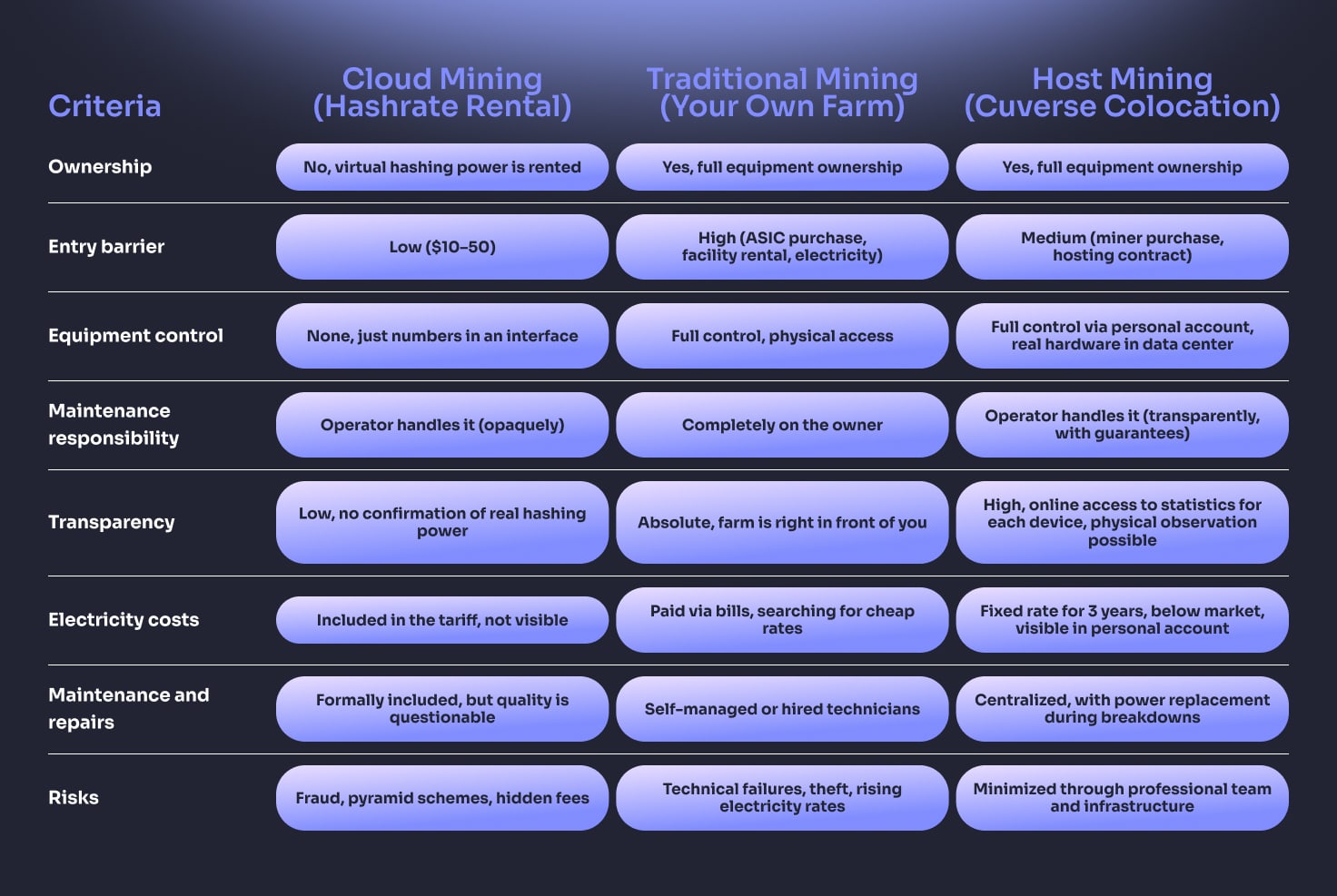
To understand which mining model suits you best, it's important to see the fundamental differences between classic cloud mining, traditional mining on your own equipment, and the hybrid format — host mining (colocation). Let's compare the key parameters:
Why Cuverse host mining is the optimal compromise:
As the table demonstrates, host mining combines the best of both worlds: real asset ownership (like traditional mining) with the convenience of remote management and lower entry barriers (like cloud mining). At the same time, the key risks of classic cloud mining — opacity, lack of guarantees, and hidden fees — are completely eliminated.
Cuverse adds infrastructure advantages to this foundation: fixed electricity rates for 3 years, centralized maintenance by professional engineers, and a loyalty program offering equipment discounts and a cashback of up to 20%. You get more than just "cloud-based" income — it’s real cryptocurrency mining with transparent economics and complete control.
Benefits of cloud mining
Cloud mining attracts users by its accessibility. The advantages of cloud mining include not needing to be an engineer, search for ASIC suppliers, or negotiate electricity rates just to give it a try. A few clicks and a couple hundred dollars are enough for you to get into the game. For someone considering cryptocurrency mining for the first time, purchasing a short-term contract for a few days might seem like an ideal way to test the industry without diving into the technical process, purely from an income potential perspective.
But let's be honest: when you buy a three-day contract promising extraordinary returns, this is no longer an investment — it's pure gambling. The line between wanting to earn and sheer excitement is completely blurred here. Yes, it might occasionally yield a profit, whetting your appetite. However, any experienced gambler knows: the house always wins in the long run. Similarly, many "cloud" services promising mountains of gold in just days are built as pyramids where payouts to early clients come from incoming participants' funds.
Is this experience really necessary? Even if successful, it creates a distorted perception of mining as quick and easy money. In reality, mining is an infrastructure business requiring long-term planning, where returns always lean toward objectively calculated values. If you're going to try it, better to do so with transparent models involving real assets—where your money doesn't just turn into casino chips.
Risks of cloud mining
At every stage of interaction with such services, users encounter risks of cloud mining that are important to understand in advance:
- Funds deposit stage. You transfer money to the provider's wallet or account. Transparency is absent: it's unclear whether funds go toward purchasing real equipment or simply accumulate in the company's accounts. Even if the website looks professional, there may be no physical infrastructure behind it.
- Contract selection stage. Tariffs are often structured in ways that mathematically cannot be profitable in terms of actual mining returns. Projected earnings are calculated based on ideal conditions (low network difficulty, high Bitcoin price), but in reality, you receive only what remains after all the recalculations in favor of the service and hidden fees are deducted.
- Mining stage. You don't see the equipment, don't know the pool's actual hashrate, or the real profitability. Payouts may be reduced, and when the price drops, operators may simply stop paying, citing unprofitability—while your money has already been spent.
- Profit withdrawal stage. This is the most critical moment. Many services impose minimum withdrawal thresholds, delay payments, require verification with document submission, or simply block accounts under fabricated pretenses when you try to withdraw significant amounts.
- Contract closure stage. Even if the service operates honestly, when the term ends, you're left with nothing—the equipment isn't yours, and the "cloud" agreement ceases. An extension is only possible under new, often less favorable conditions.
How to start cloud mining
If you've decided to try a cloud mining service, the first step isn't choosing a tariff — it's researching the market. Find some information about the company: how long they've been operating, whether they have real data centers, if they publish reports, and if they appear in public sources. Read reviews on independent platforms, but be careful — many of them were paid for. Pay attention to whether you can contact support and how quickly and honestly they respond to complex questions.
A reputable cloud mining service never promises extraordinary returns or limits contracts to a few days, as such terms make no economic sense (except for short-term marketing promotions, which have nothing to do with real mining profitability). They offer transparent conditions, allow you to monitor equipment operations, and create no obstacles when withdrawing funds.
A more reliable path is to choose Cuverse's host mining model. This isn't classic cloud mining — it's real equipment colocation in an industrial data center with complete control and transparent economics. You get the same advantages (remote management, no technical complexities) but with real asset ownership and profitability based on the company's infrastructure advantages: low electricity rates, professional maintenance, and a loyalty program. All risks inherent to "cloud" services are minimized here.
Key metrics to consider in cloud mining
To evaluate any cloud mining service and understand real profitability, you need to understand the key indicators. Here are the essential metrics to consider:
Hashrate — the computing power you rent. Measured in TH/s (terahashes per second) for Bitcoin. This indicator directly determines how many computational operations are performed to mine blocks. The higher the hashrate, the greater the probability of receiving rewards.
Network Difficulty — a parameter showing how hard it is to find a new block. Difficulty automatically adjusts every 2,016 blocks (approximately two weeks of mining time) based on the network's total hashrate. The higher the difficulty, the less Bitcoin your power will mine.
Contract Price — the amount you pay for renting hashing power. Usually quoted per 1 TH/s per year or month. It's important to compare this figure with the feasible income from 1 TH/s over the same period.
Energy Efficiency — an indicator of how many watts of electricity the equipment consumes per 1 TH/s (W/TH or J/TH). In classic cloud mining, this parameter is hidden from users, but it directly determines how much the operator spends on electricity and, consequently, what returns they can offer you.
Operator Fee — the percentage the service retains as a maintenance fee. May include electricity costs, facility rental, and their profit margin. Often hidden within complex calculation formulas.
Estimated ROI — the projected return on investment promised by the service. Always verify this through independent mining calculators (such as WhatToMine or AsicMinerValue), inputting current difficulty parameters and Bitcoin price.
Minimum Payout — the threshold at which you can withdraw your mined funds. Some services set unjustifiably high limits to retain users' funds.
Contract Term — the period during which hashing power is allocated to you. Short-term contracts (days, weeks) most often indicate an absence of real equipment, since mining is a business with payback measured in years.
Understanding these metrics helps filter out outright fraudulent schemes. But even thorough analysis won't provide complete guarantees without confirmation that the equipment actually exists. This is the key advantage of host mining: you personally select specific ASIC miners with known specifications and can track their operation in real time, working with the same metrics — but based on facts, not promises.
Is cloud mining profitable?
The answer depends on what you consider profitable and what you're comparing it to. In a rising market, when Bitcoin's price surges, cloud mining returns may look attractive — especially in service advertisements eager to claim credit for market growth. But as soon as the trend reverses, the illusion fades.
In a falling market, everyone survives as best they can. Some operators simply disappear with their clients' money; others stop paying, citing force majeure. Only companies with real infrastructure, their own data centers, and a long-term equipment renewal strategy continue operating regardless of market conditions. This is where professional hardware maintenance plays a key role — timely replacement of outdated models, energy consumption optimization, and competent engineering help maintain profitability even during difficult times.
Such services value their reputation and continue fulfilling obligations even when returns drop critically. But classic cloud mining, unfortunately, rarely falls into this category. Hence the irony: in good times, everything seems profitable; in bad times, almost nothing does — except for those who built their business on real assets rather than sky-high promises.
How to calculate cloud mining profitability
Calculating cloud mining profitability involves many variables, but the basic math is straightforward. The main formula looks like this:
Daily income = (Your hashrate / Total network hashrate) × Blocks per day × Block reward × BTC price
In the case of Bitcoin, there are approximately 144 blocks per day (one block every 10 minutes), and the block reward after the latest halving equals 3.125 BTC.
Calculation example
Let's say you rent 10 TH/s. The current Bitcoin network hashrate is about 1,025 EH/s (1,025,000,000 TH/s). Your network share equals 10 / 1,025,000,000 ≈ 0.0000009756%
Expected blocks from your power: 0.0000009756% × 144 ≈ 0.000001405 blocks per day
In Bitcoin: 0.000001405 × 3.125 ≈ 0.00000439 BTC per day
At a BTC price of $60,000, this yields ≈ $0.26 per day before fees.
What's next
From this amount, you need to subtract:
- Operator fee (usually 5–15%)
- Maintenance fee (may include electricity or be charged separately)
Instead of manual calculations, it's more convenient to use specialized calculators (such as WhatToMine, CryptoCompare, or the platforms' own calculators). They account for current network difficulty, pool fees, and other parameters. However, no calculator can predict future network difficulty or Bitcoin price. Difficulty growth proportionally reduces your BTC income share, and if the price drops, stable BTC earnings depreciate in fiat terms.
Therefore, an evaluation of any cloud mining contract should include the following question: would the investment pay off under the most pessimistic forecasts (rising difficulty + falling price)? If the answer is "no" or "only in an ideal scenario," this might be a lottery ticket rather than an investment.
The relevance of cloud mining today
The cryptocurrency market is going through a challenging period: after the correction, it's trying to bounce from the bottom, but no one has guarantees of a quick reversal. It's at times like these that the moment of truth arrives for mining services. When easy money disappears, the real efficiency of the business is revealed.
Those who possess genuinely efficient mining infrastructure and a long-term development strategy come out ahead. Companies with outdated equipment, high electricity costs, and no modernization plan exit the market or stop paying clients. Meanwhile, services investing in energy efficiency and real assets continue mining even with minimal margins.
In turbulent conditions, cryptocurrency mining transforms from easy earnings into a test of strength. And it's worth sticking with those operators for whom mining is not a way to quickly collect money, but an infrastructure business with a years-long planning horizon. Such companies don't disappear during difficult times — they only become more reliable.
Closing thoughts
Cloud mining remains one of the most controversial ways to participate in cryptocurrency mining. On one hand, it offers a low entry barrier and freedom from technical complexities. On the other, it harbors risks that have shattered the trust of thousands of investors: opacity, lack of real assets, and outright fraud.
The main lesson to take away is this: legitimate cloud mining is only possible where real data centers, professional maintenance, and a long-term development strategy stand behind the contracts. If a company isn't willing to show its equipment, lock in electricity rates, or give you direct control over assets — you're likely dealing with a financial pyramid, not with mining.
The alternative chosen by experienced investors is host mining with real equipment ownership. This isn't a compromise between convenience and reliability, but the best of both worlds: remote management without losing control over physical assets. This approach allows you to keep mining for years regardless of market conditions.
FAQ
How much can you earn with cloud mining?
Earnings depend on many factors: the amount of rented hashing power, Bitcoin's price, network difficulty, and operator fees. It's important to understand that no service can guarantee fixed returns, and promises of extraordinary profits within a short timeframe are almost always a sign of fraud. A realistic approach is to view cloud mining as a long-term investment with estimated payback that can be easily verified through independent calculators.
What is a cloud mining contract?
It’s an agreement between a user and a service where the client pays to rent a specific amount of computing power for a fixed period (from several days to several years). In return, the operator promises to direct this power toward cryptocurrency mining and pay a proportional share of rewards. The contract should specify hashrate volume, contract term, service fees, and terms for accruals and withdrawals. A transparent contract never promises "guaranteed income" and doesn't hide real maintenance and electricity costs.
What cloud mining scams should you beware of?
The most common schemes include: pyramid schemes (paying early clients with new participants' funds), bait-and-switch (selling "virtual" hashrate without real equipment), inflated profitability promises (many times higher than market rates), hidden fees that eat up all profits, and withdrawal problems (excessive minimum thresholds, endless verification, account blocking). Short-term contracts lasting days or weeks require special caution — real equipment almost never backs these, as mining is a business with payback measured in years.
What is the difference between hashrate in traditional/host vs. cloud mining?
In traditional mining and host mining, hashrate represents the real computing power of the equipment you own. You know exactly which ASIC miners you have installed and can monitor their operation, maintenance, and energy consumption. In cloud mining, hashrate is an abstract number in a personal account that may represent no real equipment at all. You don't know which devices you are mining on, in which data center they’re located, or with what energy efficiency your coins are being mined. Essentially, you're not buying power — you're buying a promise of payments, which makes this instrument fundamentally riskier.


