
Mining Bitcoin is an industrial‑scale task. Asking how long it takes to mine 1 BTC is like asking how long it takes to assemble one dump truck. It’s the wrong angle. At a factory equipped with the latest technology, with millions of dollars invested — not that long. But if you fantasize about mining a Bitcoin solo (building your own dump truck from scratch) — you might not live long enough, and toward the end you’ll realize you’d spent your entire life on the wrong thing.
In this article, we’ll try to dispel the most common beginner misconceptions and also suggest more achievable goals — without completely ruling out the possibility of mining 1 Bitcoin on your own.
What is Bitcoin difficulty?
If Bitcoin is digital gold, then Bitcoin difficulty is the depth of the ore seam. Satoshi Nakamoto designed a clever mechanism: every 2,016 blocks (roughly two weeks), the network looks over its shoulder and checks its watch. "Did it take less than ten minutes to mine the blocks?" it asks. "If it did, it means that more miners joined the race or the ASICs got speedier. Raise the difficulty!" If block mining is slower — difficulty drops.
What’s the point of this perpetual motion machine? To keep blocks rolling out with an almost obnoxious predictability: one every ten minutes. Give or take, but the law is the law. Without this auto-correction, Bitcoin would've either been dug up in a single year or its mining would've stretched into an entire geological era.
Bottom line: difficulty is the equilibrium between collective greed and mathematical patience. It rises along with the hashrate (computational power) and, every two weeks, reminds every solo miner: "You're pushing that boulder uphill, and the slope keeps getting steeper. Welcome to Sisyphus & Co."
Understanding Bitcoin difficulty
Network difficulty isn't just a number on a screen—it's a direct regulator of your wallet. As difficulty rises, your share of the reward shrinks. And vice versa.
Imagine a fixed-size pie being divided among all those present every 10 minutes. The more people at the table, the thinner your slice. Difficulty is essentially the number of contenders recalculated into terahashes.
Why does it keep growing? Two reasons. First, new players are entering the game with modern ASICs. Second, the remaining players are upgrading their aging hardware. Total hashrate creeps up, the adjustment mechanism flips the switch, and in two weeks your income becomes slightly smaller.
Difficulty rarely and reluctantly drops. Only when miners shut down en masse, unable to withstand low Bitcoin prices or expensive electricity. The market cleanses itself of the weak, leaving a larger piece of pie for those who remain.
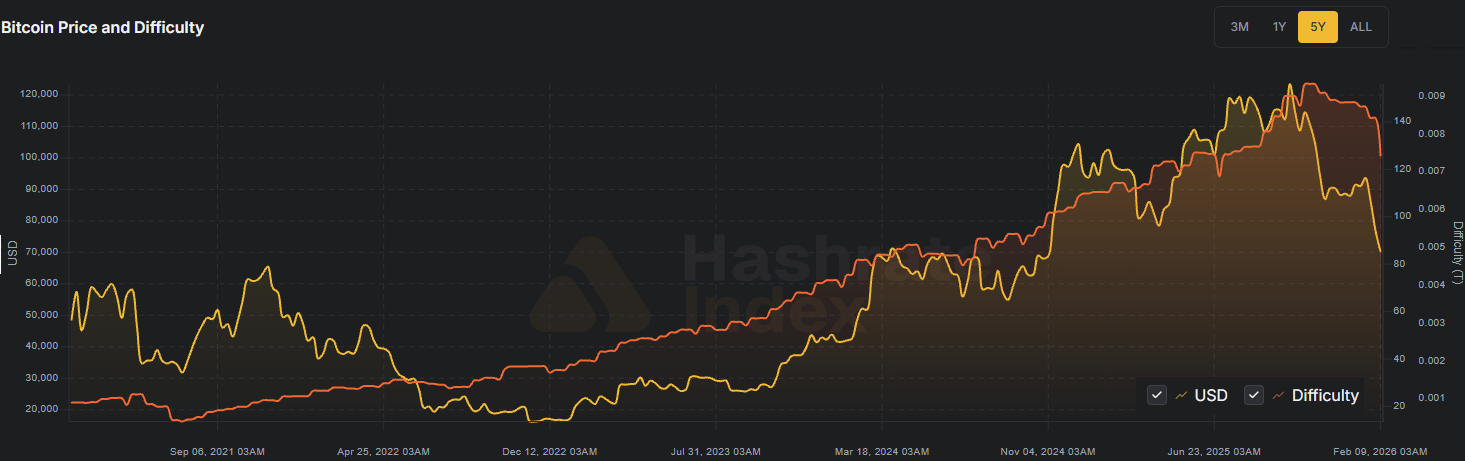
The chart below shows the entire history of these roller coasters, which don't actually look like roller coasters at all. No matter how dramatically difficulty fell during historic periods (like the 2021 China ban), the overall trend is unmistakably bullish. Perhaps only the drop in early 2026 currently looks quite bearish, but that's simply because we're living in the moment.
Adjusting Bitcoin difficulty
The difficulty adjustment mechanism is an automatic regulator that knows no mercy but knows its math. Every 2,016 blocks, the network looks at its watch and asks: "Did we make it in two weeks or not?"
The formula is simple: New Difficulty = Previous Difficulty × (2,016 × 10 minutes) / (actual time taken to mine 2,016 blocks).
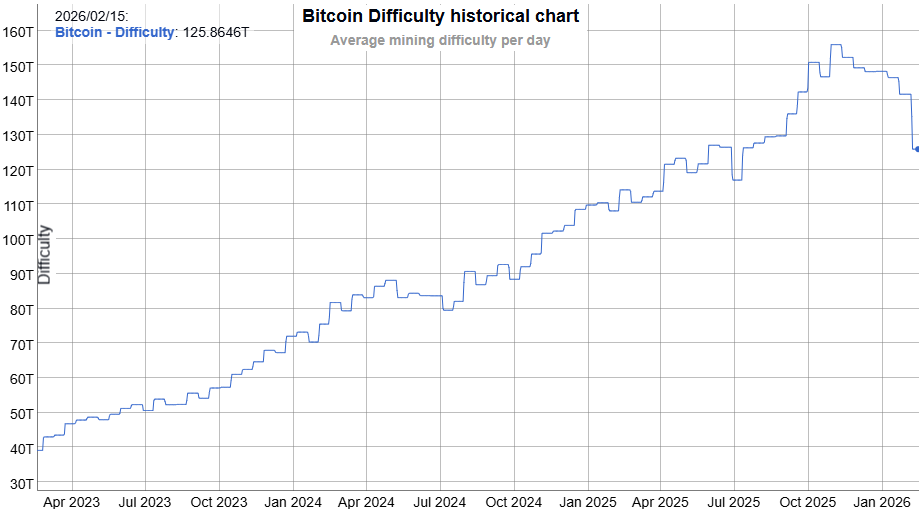
Today, February 15, 2026, Bitcoin's difficulty stands at 125.8646 T. Is that a lot? Absolutely. But just three months ago, in early November, difficulty hit an all-time high of 155.973 T. Since then, the network has recalibrated seven times, and each time the bar has been lowered.
Over these seven adjustment cycles, the total recalculation factor came out to 125.8646 / 155.973 ≈ 0.807. This means the effective time to mine 2,016 blocks over this period was roughly 1.24 times longer than the standard two weeks. Miners were shutting down, and difficulty obediently crawled downward.
Usually, we discuss difficulty when it's relentlessly climbing. "Up again, profits down again." But today is a rare case — we're witnessing a drop. Since November, difficulty has fallen by nearly 20%. Hard to believe, but we have a unique chance to talk about a downward correction while the market and weather have forced the giants to hit the brakes. For how long? That's a rhetorical question.
Factors that influence mining speed
The time it takes to mine one Bitcoin is governed by three ruthless factors that influence mining speed.
- Your equipment's hashrate. The higher your terahashes per second, the more lottery tickets you're holding. One S21 XP — 270 TH/s. One thousand of them — 270,000 TH/s. Speed scales up with power.
- Network difficulty. It readjusts every 2,016 blocks to maintain that ten-minute block interval. The more miners join the network, the higher the difficulty climbs — the smaller your slice of the pie becomes.
- Competition. With Bitcoin's total hashrate sitting at around 800 EH/s, your personal 270 TH/s is roughly 0.0000003% of global power. In solo crypto mining, what’s your average time to find one block? About 3,000 years.
So here's the honest answer: a private miner doesn't get to talk about speed. You just watch the pool statistics and wait. There's only one real way to speed things up: stop digging with a shovel and rent an excavator. With Cuverse, you plug into an industrial cryptocurrency mining fleet, and your personal mining timeline shrinks from a geological epoch down to a reasonable investment horizon. A samurai has only his path — but the reward is still there to collect.
Relationship between difficulty and block generation time
The network doesn't tolerate tardiness. If the actual block generation time starts deviating from 10 minutes, the difficulty adjusts immediately. Think of a subway turnstile: the larger the flow of people (hashrate), the narrower they make the passage (difficulty) so that it takes each person exactly one second to pass through. Fewer people — they widen the passage to keep the speed from dropping.
Thus, difficulty and block time work in tandem: time is the metronome, difficulty is the adjusting mechanism. A perfect balance that has held for 17 years now.
Difficulty and block time are like interconnected vessels. Difficulty itself doesn't slow down or speed up mining. It merely sets the bar: how hard-to-find a hash must be for the block to be discovered on time.
Number of miners and total hash rate
The number of miners and their collective power (hashrate) is the fuel that drives difficulty upward. The more ASIC miner chips are churning through combinations, the higher the probability that a block will be found faster than the prescribed 10 minutes. The network won't let the miners' stubbornness go unnoticed.
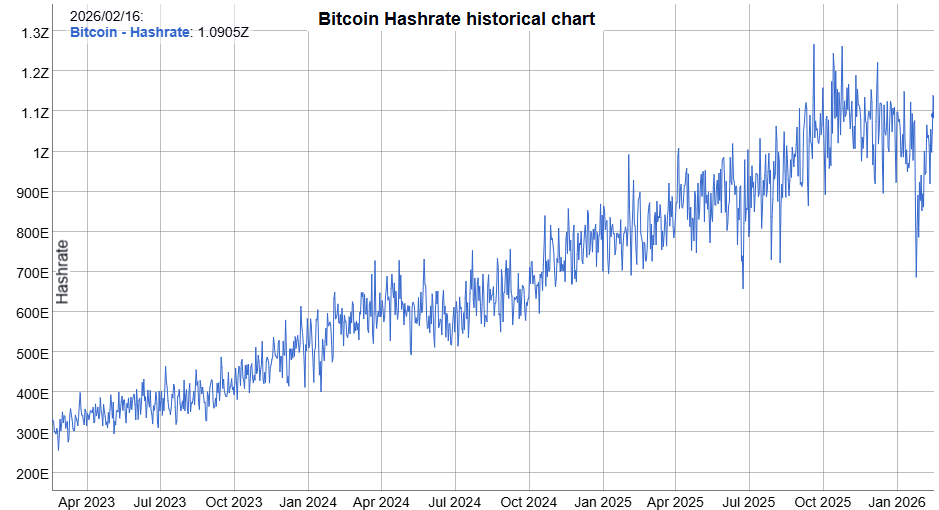
Hash rate growth is a race without a finish line. In 2023, the network's total power crossed 300 EH/s for the first time. Today, February 16, 2026, we're looking at 1.09 Z — that's already nearly 1,100 EH/s (1 Zetta = 1,000 Exa). More than a 3.5x increase in under three years. Every new terahash pushes difficulty up and individual miner profitability down.
The paradox is that even the shutdown of thousands of machines doesn't reverse the trend. Those who remain bring in more efficient hardware. Difficulty might dip for a month or two, but in the long run, it only crawls upward.
The chart below shows the evolution of hashrate. Each new peak is higher than the last. Every crash is just a springboard for the next leap.
Changes in Bitcoin network activity
Bitcoin network activity is its pulse. It's measured not only by hashrate but also by transaction volume, mempool congestion, and fee sizes.
When activity spikes, miners roll in fees. Blocks fill to capacity, and senders compete to pay more for speed. When activity drops, blocks sit half-empty, and fees dwindle to pocket change.
For a miner, this is a wave they can't control but can ride. High activity means not only more income but also difficulty increases in its wake. Low activity means a breather before the next surge.
The network doesn't know weekends or holidays. It doesn't care if it's night or morning. But waves of activity inevitably roll in, each time with renewed force.
Impact of difficulty on miners
Rising difficulty level is a tax on survival for miners, which increases every time someone plugs in a new ASIC.
First — reduced earnings limit. With the same power, you get fewer coins. Not because you're not working as efficiently, but because the bar has been raised. Yesterday's S19 Pro was still making $10 a day back in 2023. Today, it's barely breathing on the edge of profitability.
Second — competition. The higher the difficulty, the fiercer the fight for each block. Victory does not go to the most persistent, it goes to those with modern hardware and cheap electricity. The rest drop out.
Third — the profitability threshold. When difficulty shoots through the roof, mining on old models turns into charity. Electricity costs money, and the output is zero or negative.
In simple terms: the difficulty level is a sieve that filters out the weak. It gets finer every year, leaving only those who've managed to upgrade their fleet or entered the game through industrial hosting.
Strategies of adapting to difficulty changes
Difficulty rises — that's a given. The question isn't how to stop it, but how to stay in the race.
The first strategy is fleet upgrade. Old hardware loses to new by definition. The once wildly popular Antminer S19 Pro now yields to the S21 series, which currently accounts for over 20% of global mining power. Those who upgrade their fleet in time stay in the game.
The second is power consumption optimization. Custom firmware, undervolting, switching to night tariffs. Every watt saved converts into a safety margin when the next difficulty spike hits.
The third is diversification. This one's tricky. A different algorithm means different hardware, but sometimes it's the way out. When SHA-256 gets too crowded, it's wise to glance at other algorithms. LTC, KAS, even classic ETC can offer a breather while Bitcoin miners figure out who survives.
The fourth is entering professional hosting. Carrying the burden of rising difficulty alone is tough. When you have infrastructure with cheap energy and regular equipment updates behind you — with a company like Cuverse — every difficulty jump feels less like a punch to the gut and more like just another day at work.
The main thing is not to freeze in place. A strategy that worked yesterday might knock you out tomorrow.
Upgrading hardware for better performance
When difficulty rises, the only way to stand still is to run faster. And running faster in mining means one thing: better hardware.
Modern ASICs like the S21 series achieve the efficiency of 13–17 W/TH. Their predecessors from three years ago were stuck at 25–30 W/TH. The difference isn't academic — it's the line between profit and loss at the next difficulty peak.
Upgrading mining hardware isn't about chasing hashrate records. It's about staying above water when the tide comes in. Each new generation extends the runway, allowing miners to remain profitable longer after each difficulty adjustment.
The math is simple: more efficient gear means lower cost per terahash. Lower cost means more tolerance for rising difficulty. Those stalling on outdated equipment get priced out first.
Joining mining pools for more stable earnings
Solo mining in 2026 is a lottery with a ticket costing thousands of dollars and a prize that comes once every few years. For regular income, you need a pool.
Mining pools combine the power of thousands of miners, split the reward proportionally to each contribution, and pay it out in small portions every single day. Instead of gambling on "will I get lucky or not," you receive a predictable stream of satoshis.
Pros: stability, transparency, no multi-year downtime waiting for a block.
Cons: pool fees (typically 1–4%) and some centralization concerns — if a pool accumulates too much power, the community starts asking questions.
But for the individual miner, the choice is clear: better to get 0.0001 BTC daily minus a fee than to pray for luck 24/7. Mining pools turn hype into routine. And routine is what real business is all about.
Optimizing energy efficiency
The internet is full of advice for solo miners: install solar panels, put up a wind turbine in your backyard, heat your greenhouse with ASIC exhaust. Sounds romantic. In practice — it's nonsense.
The cost of electricity isn't a menu item you can order like a side salad. It's a survival condition. Either you have access to wholesale rates of $0.03–0.04 per kWh, or you're not in mining.
A solar array capable of powering an S21 XP costs as much as three of those miners and doesn't work at night. A backyard wind turbine is a point of pride, but not a source of stable 24/7 hashrate. Heat recycling? When your miner sits in a data center alongside thousands of others, your job isn't to heat greenhouses — it's to avoid getting burned by your electricity bills.
Energy optimization in 2026 isn't about "green" power. It's about undervolting, custom firmware, and most importantly — choosing the right location: where electricity costs pennies, not where the wind blows the right way or the sun shines 24/7.
Leveraging financial management tools
The financial world has invented things that supposedly save you from uncertainty: investing, trading, futures, options, hedging. In theory, a miner can lock in the price of future coins and sleep soundly, even when difficulty crushes profitability.
In practice, it's more complicated. To play with derivatives, you need an exchange account with a corresponding appetite for risk, margin requirements, and nerves of steel. Price drops — insurance works. Price skyrockets — you're left with a fixed ceiling and missed profits.
Perfect protection doesn't exist. If there were a tool guaranteeing 100% capital preservation in any scenario, we'd be living in some other world — one where mining requires neither courage nor calculation. But we live here. And here, any derivatives are just a complication, not a panacea.
Optimizing mining tax strategy
Taxes aren't something you want to think about when you're mining Bitcoin. But you have to. In most jurisdictions, mining is considered entrepreneurial activity, which means expenses can and should be deducted.
Equipment depreciation, electricity costs, facility rent, repairs, pool fees — all of this reduces your taxable base. Calculate wisely, and you can save dozens of percent.
But no matter how you optimize, bitcoin mining rests on three pillars: hashrate, difficulty, and electricity tariff. Taxes come later. You can deduct every single operational expense, but if electricity costs too much, no tax authority will save you.
First, survive. Then, report. Without cheap power, all tax deductions are just a consolation prize.
Optimizing mining operations further
If all internal reserves are exhausted, there's a radical move left relocation. Literally. There are regions in the world where a kilowatt costs pennies, and local authorities hand out mining incentives like candy.
Paraguay, Texas, parts of Africa — electricity tariffs there can be several times lower than the market average. Moving a farm is expensive and troublesome, but sometimes it's the only way to keep your business afloat when the next difficulty spike hits.
Just don't get your hopes too high. They'll welcome you with open arms, of course. But only as long as you pay your bills and don't make more noise than local regulations allow.
Historical trends in Bitcoin mining difficulty
The history of Bitcoin mining difficulty is a chart that only looks up, but with caveats.
2021. China expels miners, and the difficulty drops by 27%. The network sneezes, rebuilds, and returns to growth after a couple of months.
2023. 27 adjustments, 20 increases, 7 decreases. The result: +74% over the year. The average difficulty is approaching 70 T. The miners from 2019 are dying out like mammoths.
2025. The historical maximum was almost 156 T in November. And then there comes the anomaly. Winter storms in Texas, blackouts, falling prices. Over the course of three months, the difficulty drops by 20%. A rare shot: the chart is creeping down, and miners exhale.
The trend is clear: difficulty grows like a weed, but sometimes freezes. It's a respite for the survivors. For the weak, it is the point of no return.
Predictions about mining difficulty
Predicting difficulty is a thankless task. It's like guessing how many people will show up at the gym in January — and then wondering why it's so crowded.
Difficulty is a derivative of hashrate. Hashrate depends on Bitcoin's price, hardware availability, and geopolitics. All these variables change faster than you can update your firmware.
Someone will say: "By 2028, the difficulty will reach 300 T." Maybe. But another scenario is just as possible: another crisis, mass shutdowns, and a difficulty crash of 30%, like in 2021.
The only sensible forecast is as follows: over the long haul, difficulty crawls upward. In the short term, it's a lottery where whoever has the biggest safety margin wins.
So don't prepare for specific numbers. Prepare to withstand any numbers. Energy efficiency, here and now — that's the one prediction that won't let you down.
Limited Bitcoin supply
The internet loves to repeat: there's not much Bitcoin left, that's why it's so hard to mine. A beautiful theory that has nothing to do with reality.
Mining difficulty doesn't know how many coins are still in the ground. It couldn't care less about the 21 million number. It responds to only one thing — how many people are currently throwing themselves at the blockchain, shovels in hand.
That Bitcoin is limited is a brute fact. But the miner couldn't care less. His income isn't determined by coin scarcity — it's determined by competition and the cost of electricity. You could be mining the very last satoshi, or you could be mining when the network is empty, earning several times more.
Theorists need theories. Miners need wattmeters.
Factors influencing mining difficulty
Mining difficulty isn't Satoshi’s whim — it's hard math dependent on several variables. Here they are, ranked by degree of influence:
The golden rule: difficulty always catches up with hashrate. What drives hashrate — price, technology, or just a solar eclipse — is a secondary question. Bitcoin halving is another factor, but it’s not our concern in 2026.
Implications of mining difficulty
Rising difficulty level doesn’t just refer to numbers on a chart. It has three inevitable and very real consequences.
First — the weak get weeded out. Every difficulty spike washes out those who haven't upgraded. S19 gives way to S21, individuals give way to industry. The escalator moves up, so you have to run in order to stay in place, and run twice as fast in order to go up.
Second — the arms race. ASIC manufacturers never sleep. Bitmain drops new models, MicroBT fires back. Difficulty propels technological progress, and progress propels difficulty. A vicious cycle with no exit, but plenty of participants.
Third — rising production costs. Mining Bitcoin gets more expensive not because it's physically harder to find, but because your neighbor flipped a bigger switch. The coin's price has to rise just to keep miners in the black.
Difficulty level is a tax on enthusiasm that everyone pays, but only the prepared survive.
The bottom line
Bitcoin mining difficulty isn't a sentence — it's just the rules of the game. It doesn't ask if you're ready. It doesn't care about your plans. It simply increases when too many want in, and falls when the weak walk away.
For the solo miner, this race long ago turned into rowing against the current. Upgrade your hardware every two years, hunt for absurdly cheap electricity, pray over custom firmware — you can do it, but the payoff doesn't justify the headaches. Industrial scale demands industrial solutions.
The only way not to fall off the next difficulty spiral is to stop playing solo. Plug into a fleet of modern ASICs where efficiency is measured not in dreams, but in joules per terahash. Where electricity costs pennies and service is built into the deal.
At Cuverse, that's exactly how it works. Don't think about difficulty — just watch your balance grow. Because difficulty is no longer your problem. It's the engineers' problem. And they're using industrial power rather than a calculator.
FAQ
How is mining difficulty calculated?
Every 2,016 blocks (roughly two weeks), the network compares the actual time it took to mine those blocks against the ideal 14 days (20,160 minutes). New Difficulty = Old Difficulty × (20,160 / Actual Time). If blocks come out faster than 10 minutes on average, difficulty goes up. If the speed is slower — difficulty drops. No emotions, no exceptions. Just math with a stopwatch and daily rewards for survivors.
Why is network difficulty constantly increasing even when Bitcoin is falling?
Because miners don't switch off their machines the moment the price dips. They've already paid for hardware, signed power contracts, and installed cooling. They keep running, hoping for recovery or at least to cover variable costs. Also, new, more efficient ASICs keep arriving regardless of BTC rate. The network hashrate — and thus difficulty — responds to price changes with a lag. Sometimes a long one.
Can mining difficulty decrease?
Yes, but it's as rare as a solar eclipse. Difficulty drops only when miners mass-exit because of power outages, bans (China 2021), or price crashes so deep that even efficient hardware operates at a loss. In early 2026, we witnessed exactly that — winter storms in Texas knocked out hashrate, and difficulty fell nearly 20% over three months. For survivors, it's a temporary breather. For the network power, it's just another adjustment.


