
Passive income in crypto: a guide to staking, lending, and yield farming
Cryptocurrencies have long ceased to be merely a speculation and short-term trading tool. Today, they represent a full-fledged financial ecosystem offering dozens of ways to put digital assets to work for you. In 2026, generating passive income with cryptocurrency has become more than just a passing trend, but a genuine alternative to bank deposits and traditional investments. From staking and mining to decentralized finance (DeFi) — opportunities are multiplying while entry barriers continue to decline. The key is understanding the mechanisms, recognizing the risks, and choosing strategies that align with your goals. In this article, we'll explore the most relevant and reliable ways to earn passive income in the crypto market in 2026.
Understanding passive income in crypto
Cryptocurrency is a digital asset built on blockchain technology. Unlike traditional money, it isn't controlled by central banks or governments — it exists on a decentralized network where every transaction is transparent and secured by cryptography. Bitcoin, Ethereum, and thousands of other coins have evolved beyond simple payment methods into full-fledged investment instruments.
Passive income refers to regular earnings that require minimal effort after an initial setup. In traditional finance, examples include interest on deposits or stock dividends. In the crypto world, the principle remains the same, but the mechanics differ: rather than simply holding assets, you actively use them to support blockchain operations, provide liquidity, or validate transactions. The rewards generated from these activities create what we call passive crypto income — a concept that's becoming increasingly attractive to investors worldwide.
Comparison to traditional finance
Over the past few years, cryptocurrency has transformed from a niche asset for enthusiasts into a mainstream financial instrument accessible to millions. But the explosive growth in popularity of passive crypto income isn't just about accessibility — it's driven by the stagnation of traditional earning models. Bank interest rates in most countries barely keep pace with inflation, leaving depositors with only illusory profits.
Cryptocurrencies have offered an alternative. They offer more than one passive income approach, allowing you to grow assets that previously just sat idle in a wallet. Staking, lending, liquidity farming — these mechanisms generate returns that often exceed traditional yields by multiples. Moreover, the industry is evolving rapidly: new protocols emerge, interfaces become more user-friendly, and entry barriers continue to recede. Investors have realized that crypto can work for them 24/7, no weekends or holidays. And that has changed everything.
Passive crypto income overview
Cryptocurrencies offer unprecedented opportunities for passive income that just don't exist in traditional finance. From simple holding to complex DeFi strategies — every investor can find a tool that matches their budget, time horizon, and risk appetite. However, it's important to remember the golden rule: high returns always come with high risks, and promises of extraordinary profits most often lead to capital loss.
For clarity, let's summarize all the methods we've examined in a comparative table:
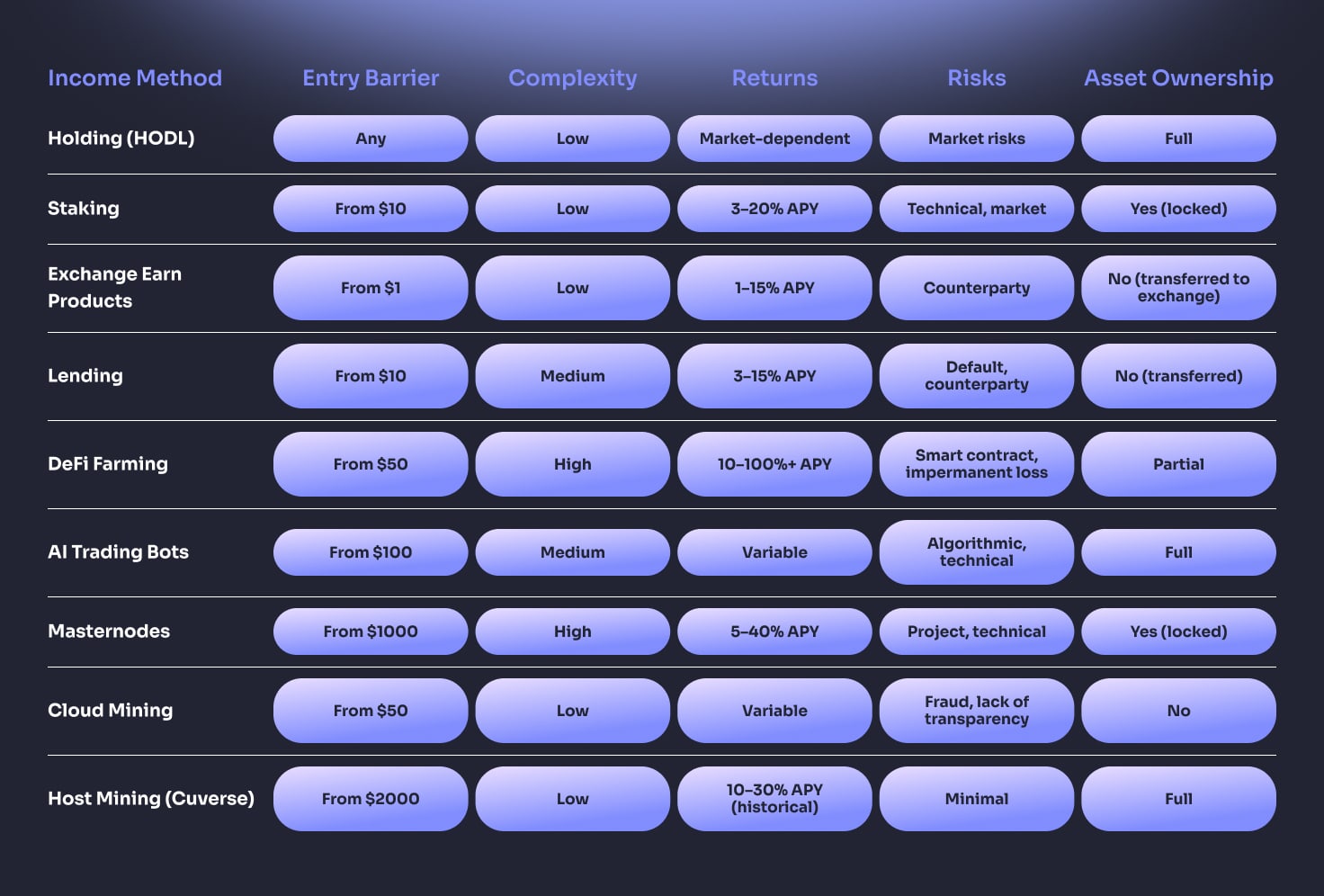
The main takeaway from this table is clear: maximum reliability and transparency come from methods where the investor retains ownership of a real asset — from coins in staking to physical equipment in host mining. This approach generates stable passive income backed by real economic activity, not just the redistribution of funds between system participants.
Host mining from Cuverse occupies a special place in this comparison. It combines the advantages of real asset ownership (ASIC miners), professional industrial data center infrastructure, and fixed electricity rates — all while eliminating the technical complexities of solo mining. It's the choice of investors who value transparency, long-term strategy, and want to earn Bitcoin mining income at the level of large mining corporations.
Staking
Cryptocurrency staking is a popular passive income instrument based on the Proof-of-Stake (PoS) consensus mechanism. Coin holders lock their assets in a wallet to support blockchain operations — validating transactions and maintaining network security. In return, they receive regular rewards paid in the same coins.
The process resembles a bank deposit: you lock up funds for a certain period and earn interest. Staking yields typically range from 2–3% to 20% APY or higher, depending on the chosen coin and specific conditions. Its main advantages are predictability and no need for expensive equipment. The drawbacks include potential fund lockup periods ranging from days to months, and the risk that the staked asset's price may drop — potentially zeroing out all interest earned. This is staking's biggest weakness, often overlooked but worth noting: it serves as a reminder that risk management matters, and to some extent, every investment carries venture-like characteristics.
Lending
Cryptocurrency lending is a passive income method where digital asset owners lend their funds to other users or platforms in exchange for interest. The mechanism resembles traditional lending, but in the crypto world: you provide your coins as a loan, and borrowers pay a fixed percentage for using them.
There are two main formats of crypto lending: centralized (through exchanges that act as intermediaries, distributing funds among borrowers) and decentralized (through protocols like Aave or Compound, where everything operates via smart contracts without intermediaries). Returns typically range from 3% to 15% APY, depending on asset demand and lock-up period. Its main advantages are predictability and relatively low risks on reliable platforms. The drawbacks include borrower default risk in centralized services and code vulnerabilities in decentralized ones.
Yield farming
Yield farming is a way to earn passive income in decentralized finance (DeFi) where users provide their crypto assets as liquidity to decentralized exchanges and protocols. You deposit a pair of tokens (such as ETH and USDT) into a liquidity pool and receive rewards in return — typically a share of trading fees plus additional bonus tokens from the project.
The returns from yield farming can be impressive — ranging from 10–20% to hundreds of percent APY on popular pools. However, this approach requires close attention: the main risks include impermanent loss (when the price of one of the tokens in the pair changes dramatically) and smart contract vulnerabilities. Unlike staking or exchange products, yield farming demands more active participation and a solid understanding of DeFi fundamentals. Beginners should start with established protocols and small amounts, gradually learning the mechanics as they go.
Liquidity pools
Liquidity pools are smart contract-based funds where users lock their tokens to facilitate trading on decentralized exchanges. In return, they earn fees from trades and sometimes additional protocol rewards. This is fundamentally different from mining pools, though both involve "pooling" resources.
For those interested in Bitcoin mining specifically, pool mining remains the standard approach. It involves combining your hashrate with other miners to increase the chances of earning rewards. An even more accessible entry point is cloud mining, where users rent hashrate from remote data centers without purchasing hardware. However, as discussed previously, traditional cloud mining carries significant opacity and fraud risks.
A more transparent alternative is host mining, where you own physical ASIC miners while a professional operator handles infrastructure. This model, which Cuverse specializes in, combines the convenience of remote management with real asset ownership — similar in spirit to how liquidity pool providers maintain ownership of their deposited tokens while earning passive yield. Both approaches share a core philosophy: you retain control of your assets while leveraging professional infrastructure to generate returns.
Masternodes
Nodes are servers that store a copy of the blockchain and maintain its operation by validating transactions. Running a regular node typically doesn't generate income — it's more like volunteer support for the network. However, masternodes are a special type of node that perform additional functions (instant transactions, privacy features, governance) and receive rewards for doing so.
Running masternodes requires locking up a specific amount of the project's coins — ranging from a few hundred to tens of thousands of dollars depending on the blockchain network. In return, owners receive regular payouts in the native cryptocurrency. Yields typically range from 5–10% to 30–40% APY. The main challenge is technical: a masternode must run 24/7 on a dedicated server or VPS. Many projects offer simplified setup or shared ownership options to lower the entry barrier. Risks include potential drops in the coin price and the overall viability of the project itself.
Cloud mining
Cloud mining is often positioned as the most accessible way to mine cryptocurrencies: you pay for a contract and receive regular payouts without dealing with technical details. No equipment, no noise, no electricity bills — just a personal account with a growing balance.
However, behind this simplicity lies a fundamental problem of opacity. In traditional mining or host mining, investors own a real asset — ASIC miners physically located in a data center that generates income. With cloud mining, users purchase not equipment, but a promise of income from non-existent or ambiguously located hashing power.
The main risk lies precisely in this disconnect between payment and real assets. As long as the service makes reliable payouts, questions don't arise. But when problems occur, there's no one to hold accountable — and more importantly, nothing to claim. There's simply no physical asset that users could take possession of or verify.
This is why after understanding the mechanics, many investors choose host mining — a model where only the management interface is in the cloud, while the equipment itself belongs to the client and resides in a professional data center with transparent economics and fixed electricity rates.
Crypto savings accounts
Crypto savings accounts are one of the simplest and most accessible ways to earn passive income, especially for those just starting their journey with digital assets. Their mechanics resemble classic bank deposits: you place your coins on a platform (an exchange or specialized service), and the provider pays you interest.
The platform uses your assets for various operations — lending to traders, margin trading, or providing liquidity. The profits generated are distributed to depositors as interest payments. Yields can be either fixed or variable, typically ranging from 3% to 15% APY, with the most attractive rates usually offered on stablecoins.
Main advantages: low entry barrier (you can start with minimal amounts), ease of use (all operations within the exchange interface), and flexibility — many accounts allow withdrawals at any time without losing accumulated interest.
Key drawbacks: risks are tied to the platform's reliability — unlike bank deposits, crypto accounts typically aren't government-insured. Yields may also fluctuate based on market conditions, and when storing funds on an exchange, you're entrusting your assets to a third party, which requires trust in the chosen service.
How to choose the best passive income strategy?
The optimal passive income method for you depends on your goals, budget, and willingness to dive into technical details. There's no one-size-fits-all solution, but several key criteria can help guide your decision:
Capital size. For staking and exchange Earn products, minimal amounts are sufficient, while running masternodes or purchasing ASIC miners requires significant investment.
Investment horizon. If you're willing to wait for years, holding and mining tend to deliver the best results. Short-term strategies are better suited for farming or exchange products.
Technical complexity. Exchange-based staking is extremely simple, DeFi farming requires an understanding of mechanics, and solo mining demands engineering skills.
Risk profile. The highest yields typically come with maximum risks (new projects, farming). Reliable options include staking established coins, lending on major exchanges, and host mining.
The ideal passive income strategy for those seeking a balance of reliability and returns is host mining with Cuverse. You obtain real physical equipment that mines Bitcoin with the efficiency of a large mining corporation, without the need to build a farm or master the technical side. Cuverse's infrastructure provides access to cheap electricity, professional maintenance, and fixed rates, while the loyalty program boosts final returns. This approach is for those who want to own an asset, not just numbers on an interface.
How to reduce passive income risks?
Passive income in cryptocurrency offers broad opportunities but comes with risks that need to be minimized. Here are the key principles of a safe strategy:
Diversification. Never allocate all your funds to a single instrument. Combine staking, lending, exchange products, and mining, distributing capital across different protocols and platforms.
Reliability verification. Research platform history, read smart contract audits, and pay attention to team reputation. If a project promises returns significantly above market rates — this itself is a red flag.
Asset control. Where possible, choose non-custodial solutions that keep coins in your wallet rather than transferring them to an exchange.
Realistic return assessment. Calculate potential passive income based on objective metrics, not marketing promises.
The most reliable way to reduce passive income risks is to prioritize strategies where returns are backed by real assets and business models, not just fund redistribution between participants. Mining with physical equipment ownership, host mining in professional data centers, and staking in established L1 protocols — these methods generate income backed by real economic activity. In the long term, this approach preserves capital and delivers stable returns regardless of market cycles.
Final thoughts
The world of passive crypto income offers something for everyone — from absolute beginners with $10 to institutional investors deploying millions. Staking, lending, exchange products, farming, masternodes, and mining each have their place in a diversified portfolio. However, as we've explored throughout this article, not all passive income methods are created equal.
The fundamental distinction that separates sustainable strategies from speculative ones is simple: do you own a real asset, or just a promise?
Methods where you retain ownership — whether it's coins in non-custodial staking, or physical ASIC miners in host mining — consistently demonstrate greater resilience through market cycles. They generate returns backed by genuine economic activity: blockchain security, transaction validation, or actual Bitcoin production. In contrast, strategies built on opaque rehypothecation or unverified "cloud" promises often reveal their fragility precisely when markets become challenging.
This is why host mining with Cuverse deserves consideration as a core component of any solid passive income portfolio. It combines the most attractive elements of crypto investing: real asset ownership (you own the miners), institutional-grade infrastructure (industrial data centers with fixed electricity rates), and Bitcoin exposure through actual production rather than synthetic derivatives. The returns — historically 10–30% APY — are backed by physical hardware, transparent operations, and a business model that aligns Cuverse's interests with those of its clients.
For investors seeking balance between reliability and yield, host mining isn't just an alternative to riskier strategies — it's the foundation upon which a resilient passive income portfolio can be built. In a space where promises are cheap and results are rare, owning real infrastructure that produces real Bitcoin remains the most dependable path to long-term passive income.
FAQ
How much can you earn from passive income in 2026?
Potential returns can range from 1–3% to 100% APY or higher, depending on the chosen instrument. Conservative strategies (stablecoin staking, lending on major exchanges, Earn products) typically yield an average of a 3–15% APY. Higher-risk methods (liquidity farming, masternodes, mining) can deliver 20–50% or more, but come with increased risks. It's important to understand that guaranteed returns don't exist, and promises of extraordinary profits almost always lead to capital loss. A realistic approach is to view passive income as a complement to your investment strategy, not as a path to quick riches — carefully weighing all factors influencing returns and always keeping a couple of stress-test scenarios in mind.
What is the difference between staking and liquidity farming?
Staking involves locking coins to support blockchain operations (transaction validation, network security). You receive rewards for your asset functioning as part of the infrastructure. Liquidity farming means providing your tokens to decentralized exchange pools to facilitate trading. Income comes from trader fees and protocol bonus tokens. The main difference: with staking, you support the blockchain itself; with farming, you support trading liquidity. Farming is technically more complex, requires an understanding of the concept of impermanent loss, and carries higher risks due to smart contract vulnerabilities.
Is it possible to earn passive income with Bitcoin (BTC)?
Yes, but the methods differ from those available for Proof-of-Stake coins. Bitcoin operates on Proof-of-Work, so classic staking isn't possible. The main options for passive income with BTC include lending (providing Bitcoin as loans through centralized or decentralized platforms), exchange Earn products (placing BTC in flexible or fixed deposits), participating in DeFi protocol liquidity through wrapped versions (WBTC, renBTC), and of course — Bitcoin mining through equipment purchase or host mining. The last option lets you earn new BTC mined by your own equipment, which is particularly attractive for long-term investors who believe in the growth of the world's first cryptocurrency.


