
How long does it take to mine 1 Bitcoin
Imagine you've decided to build a skyscraper. You have a trowel, a bucket of mortar, and boundless enthusiasm. The question isn't even how many years it'll take you to reach the hundredth floor. The question is what the point is of doing it at all since while you're laying your first brick, tower cranes, concrete plants, and entire crews with engineering degrees are already operating somewhere out there. By the time you make it to the second floor, the skyscraper next door will have been delivered turnkey.
How long does it take to mine one Bitcoin is exactly the same kind of question. Going solo with a single ASIC miner isn't just falling behind — it’s entering a race where your competitors are moving on jet propulsion. And it's not impossible. Technically, anything is possible. But the stakes rise faster than your equipment can pay itself off.
In this article, we'll break down what actually lies behind that coveted "1 BTC" figure, why calculators lie while your electricity meter never does, and where exactly the line is drawn — that line beyond which solo mining transforms from a business into a hobby with a lifetime warranty.
How is a block mined?
Bitcoin mining sounds romantic. In reality, it resembles a pulp mill: giant halls, the roar of industrial fans, rows of server racks, and an electricity bill that would shatter any homeowner's reality.
Mining is 24/7 blockchain maintenance work. Thousands of ASIC chips brute-force trillions of combinations per second, trying to guess a 64-digit hash, confirm transactions, and earn a reward. Without this, Bitcoin would become a ledger that any hacker could rewrite with a marker.
Today, there are three ways to mine:
Solo. One against thousands of industrial giants. The chance of mining a block with a single ASIC in 2026 is once every 6-8 years. Sure, people win lotteries, but staking your life on it is a questionable strategy.
Mining pools. A collective "piggy bank." Thousands of miners pool their power, share the reward, and earn stable income. It's fair, predictable, and resembles working in a large workshop — no one carves your name in granite, but everyone gets paid according to their contribution.
Industrial hosting. You simply order the equipment, and the plant (Cuverse) does the work. You pay for electricity, monitor your balance through an app, and never hear the fan noise. It's your personal well-maintained machine in a high-performance cooperative.
All these approaches answer the same question of how long it takes to mine 1 Bitcoin? The difference lies in who pays for the electricity and how much time you're willing to spend waiting.
What was Bitcoin mining like in the beginning?
Once upon a time, in a prehistoric era (read: 2009–2010), you could mine bitcoin on an ordinary laptop. The CPU churned hashes, enthusiasts mined 50 BTC per block, and nobody calculated electricity costs. It was the era of romantics and geeks.
Then graphics cards arrived. GPUs turned out to be dozens of times faster than any processor (CPU), which faded into oblivion. The gold rush began — but now with a proper pickaxe, not just a shovel.
And then came ASICs — monsters built for a single purpose. GPUs went the way of the dinosaurs. Since then, evolution has been irreversible: there's no going back to home mining. Only industrial scale, only hardcore.
How many bitcoins are still there to be mined
Just over a million bitcoins remain to be mined. Sounds like it's all about to end and there'll be nothing left to mine. But that's a mental trap.
Mining Bitcoin gets harder not because there are few coins left, but because a line of giant machines has formed behind them. Difficulty grows not because of competition rather than scarcity.
The 21-million cap is Bitcoin's constitution. But what matters more to a miner isn't how much is left — it's how many others are hammering at the same rock.
What happens when all bitcoins are mined?
According to the official version — in 2140, when the last satoshi is mined, miners will switch to a "dietary ration": transaction fees only. Boring, plausible, but too predictable.
Now let's imagine that by then, quantum computing has finally reached industrial scale. If today's quantum algorithms can accelerate mining and reduce energy consumption by thousands of times, then by 2140, SHA-256 will be cracked like a nut. However, this raises a more complex question than that of fees: what would network difficulty need to be to withstand quantum acceleration?
Suppose a quantum computer finds a block in one second instead of ten minutes. The Bitcoin network doesn't know the block was found quickly — it just sees that 2,016 blocks were mined in a day instead of two weeks. The adjustment mechanism kicks in automatically: difficulty would increase 14-fold. But would that be enough? If the quantum skew runs deeper, hash length would have to increase. 256 bits against a quantum attack gives only 128 bits of security under Grover's algorithm. Doubling the length to 512 bits would restore the safety margin — but it would require a hard fork, new hardware, and consensus of the entire community.
Would Bitcoin become a lightning-fast payment service? Technically — yes. Blocks in seconds, negligible fees, the network working like Visa on steroids. But the price is an eternal quantum arms race between miners and breakers. Or, more likely, humanity will have invented something even crazier by then, and we'll be guessing about fees in 2140 the same way people in 1920 guessed about the internet.
Better to focus on what you can mine today.
How do you calculate the cost of one bitcoin?
The internet is full of calculators that cheerfully spit out a number: "The cost price of one bitcoin is X thousand dollars." They take computing power (hashrate), electricity price, equipment efficiency, divide, multiply, and produce a magic number. Looks scientific. In reality, it's fortune-telling with an engineering twist.
Why? Because the cost of bitcoin for a specific miner depends on where they're located, what they're digging with, and how much they paid for their gear yesterday.
The formula goes something like this: (Equipment price / Service life) + (Power consumption × Tariff × 24) + (Rent + Maintenance + Pool fees) = Your daily expenses. Divide by daily BTC yield — and you get the cost price of one coin. If the market price is higher — you're in profit. Lower — you're taking losses.
But here's the catch: all of this is calculated post factum. You don't know how many coins you'll mine tomorrow because mining parameters will change unpredictably. You don't know if electricity will get more expensive next month. You don't know how many fans will break down tonight.
So the real cost of bitcoin isn't a number from a calculator — it's the intersection of three curves: market price, your efficiency, and, like it or not, luck. If they intersect in the green — you're a genius.
For the solo miner, calculating cost price is a way to calm the nerves. For an industrial miner, it's a production plan where every variable long ago turned into a constant. That's exactly why Cuverse doesn't guess with calculators, but develops the most energy-efficient mining infrastructure possible.
What equipment do you need to mine bitcoins?
The short answer — ASICs. Everything else is either a museum piece or a way to burn electricity in maximum comfort.
Mining equipment for Bitcoin in 2026 refers only to specialized integrated circuits that know how to do exactly one thing: churn through hashes from morning till night until they burn out or become obsolete. CPUs, graphics cards, laptops with helicopter-sized fans — all of that belongs to an era when blocks were found in minutes and difficulty was measured in megahashes.
Today, the choice comes down to a few manufacturers: Bitmain, MicroBT, Canaan. Their models differ in hashrate, energy efficiency, and price. A device like the Antminer S21 XP (or a similar model of Whatsminer) delivers 270 TH/s at 13.5 W/TH . Last year's versions are slightly less efficient, but cheaper. Used ones are a lottery with a guarantee that yesterday will arrive faster than the purchase pays for itself.
It's important to understand: mining equipment isn't just hardware. It's a system that requires cooling, stable power, maintenance, and a space where 75-decibel noise won't drive your neighbors insane. Putting a miner in your bedroom — an idea that either your wife or the fire inspector will surely talk you out of.
So choosing the right equipment isn't about choosing a model — it's about choosing a strategy. Either you buy one or two ASICs, put up with the noise, and wait 3 years for payback, hoping for a miracle. Or you join industrial hosting, where someone else has already chosen, configured, and maintained everything for you. At Cuverse, for example, the bet is on the most efficient S21 series. Because in a world where difficulty only keeps rising, what matters in mining equipment isn't volume or design — it's joules per terahash.
Can you mine for bitcoins without the right equipment?
Technically — yes. You can dig a trench with a spoon. The question isn't about the possibility, it’s about results.
Trying to mine Bitcoin on a CPU or GPU in 2026 is like going into battle against an Abrams tank with a slingshot. You'll be doing something, electricity will burn, fans will whir, and at the end you;ll have absolutely nothing. After a year of such "work," you'won’t have mined enough satoshis to even buy a cup of coffee.
Today's Bitcoin network is an ocean liner powered by turbines running at hundreds of exahashes. Your laptop in this picture isn't just a grain of sand — it's not even a grain, it's a molecule that no one notices.
So the answer is simple: you can mine without an ASIC. But it's mining in name only. In reality, it's a way to feel connected to something great while getting nothing in return except an electricity bill.
What is the difficulty rate at the moment?
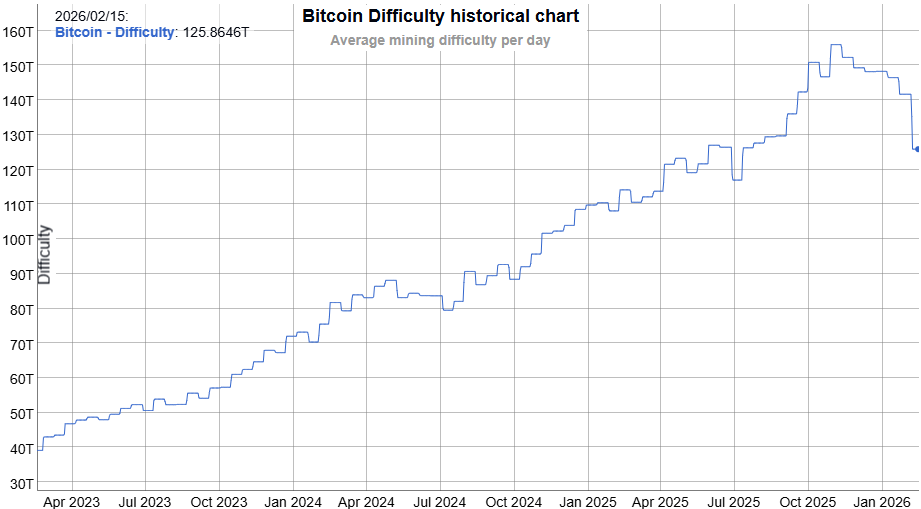
Today, February 15, 2026, Bitcoin's network difficulty stands at approximately 125.86 T. This isn't just an abstract number. It's the height of the bar that every miner in the world tries to clear every 10 minutes.
The last few months have been a unique period. Since November, difficulty has dropped by nearly 20%. That happens less often than snow in the desert. Usually, we talk about how it rises and squeezes profitability. But today is a rare moment of respite, when miners can catch their breath. Until the next spike.
Impact of difficulty and halvings on mining profitability
Difficulty and halvings are the visible part of the iceberg — what miners see in news headlines. But their impact on your wallet is anything but abstract.
Network difficulty is the network's way of saying: "Too many of you showed up, so everyone now has to run faster." When difficulty rises, your share of the pie shrinks. Not because you're not as good as before, but because there are more forks at the table.
Bitcoin halving is different. It doesn't care how many miners there are. Every four years, it simply cuts the block reward in half. Your share of the pie stays the same, but the pie itself gets smaller. Twice as small, to be precise.
Together, these two aspects form a pincer movement. Difficulty eats at your daily yield; halving cuts your base reward. One grinds you down gradually, the other hits like a scheduled execution.
The magic happens when they overlap. After a halving, some miners drop out, and difficulty follows. Those who stay get a temporary breather. Then new, more efficient hardware arrives, hashrate climbs, and difficulty resumes its upward march.
The result? Mining profitability is a constant battle against two forces: one that never sleeps (difficulty) and one that never misses an appointment (halving). Survive both, and you're either extremely efficient or extremely lucky. Possibly both.
Factors that influence mining speed
Equipment power. The higher the hashrate, the more lottery tickets in the pool. But power without efficiency is just a space heater with ambitions. A modern ASIC needs to not only calculate quickly but do it with minimal expenses.
Energy costs. The holy of holies. If electricity is expensive, you could own a thousand S21 XPs — they'll run at the breakeven point or even a loss. Tariff decides everything. A miner without preferential rates is like an oil rig in the middle of the ocean with no oil.
Mining pool. You can't survive solo today. A pool smooths out volatility but takes a cut. Choosing a pool is choosing between stability and greed. Too big a pool means centralization risk and side-eye from the community. Too small — payouts once every six months.
Temperature and cooling. The underestimated killer. When ASICs overheat, efficiency drops. When fans run at max, noise and consumption rise. When dust clogs radiators, the miner suffocates. In an ideal world, every chip has its own air conditioner. In reality you need proper ventilation — and no skimping on the cooling budget.
The economic side of mining 1 bitcoin
Mining one bitcoin isn't just an engineering challenge — it's pure economics sprinkled with probability theory. Behind the beautiful figure of 1 BTC lies a four-factor estimate where every line item can either make you rich or send you broke.
Equipment. This is your capital asset. An Antminer S21 XP today costs as much as a used car. Next year, the cost will be down to that of spare parts. Depreciation in mining is merciless: hardware becomes obsolete faster than it can pay for itself. Simple formula: the more expensive the miner today, the less chance it will die of old age before returning your investment.
Electricity. Not just an expense line — it's the judge that delivers the verdict. At $0.04 per kWh, you're still in the game. At $0.08 — already an extra. At $0.12 — a charity case heating the air at your own expense. The outlet doesn't forgive mistakes.
Cooling and Maintenance. The invisible profit-eaters. An ASIC without proper cooling is like a mountaineer without an oxygen mask. Works at the limit, quickly exhausts itself, and drops dead. Dust, overheating, power surges — these aren't dramatic accidents but a daily routine that can eat up 10–15% of income if left unchecked.
Profitability of mining. The bottom line. The total of all additions and subtractions. It’s not a number on a calculator, but is built from coin price, network difficulty, your electricity rate, hardware efficiency, and the number of sleepless nights spent doing maintenance.
In reality, mining profitability isn't a number, it's a state of equilibrium. You balance between a price that fluctuates and expenses that only keep growing. You can stay on the tightrope in two ways: either be the most efficient, or ask someone more qualified to walk for you.
How many BTC can be mined in a day?
Asking how many bitcoins you can mine in a day is like asking a fisherman how many fish he'll catch tomorrow. The answer is always: "Depends on your net and where you cast it."
One modern ASIC (say, an S21 XP) yields roughly 0.000117 BTC per day. A thousand such miners — that's 0.117 BTC. Industrial-scale infrastructure delivers industrial-scale numbers.
But what matters more than the absolute figure is the ratio of what you get to what you spend. You could mine 0.0002 BTC but pay so much for electricity that every satoshi turns to gold. Or you could mine 0.0001 BTC with a $0.03 tariff and feel like a king.
So the right question isn't "how much," but "how much is left after expenses." Mining time required to obtain 1 BTC isn't measured in days — it's measured in the profitability of each day. You can dig forever. What matters is the outcome.
How has bitcoin mining time changed over the years?
Bitcoin mining difficulty is the industry's barometer. The higher it climbs, the more people are crowding at the mine entrance. Let's see how this barometer has shifted over the years.
|
Year |
Approximate Difficulty |
What Happened |
|
2009 |
1 |
The era of laptops and romantics. Satoshi is mined on CPUs; nobody believed this would ever take off. |
|
2013 |
15 billion |
ASICs arrived and tore everything apart. GPUs died, difficulty skyrocketed into space, mining stopped being a hobby. |
|
2021 |
25 trillion |
China ban crashed difficulty by 45% in a month — the rarest of events. Survivors got a head start. |
|
2024 |
101 trillion |
Difficulty crossed 100 T for the first time. Every new ASIC just threw more fuel on the fire. |
|
2025 |
156 trillion (November peak) |
All-time high. Miners from 2020 went extinct like dinosaurs. Only S21s with cheap power survived. |
|
2026 (February) |
~125.86 trillion |
Anomaly. After Texas freezes and shutdowns, difficulty dropped by 20%. A rare moment to catch your breath. |
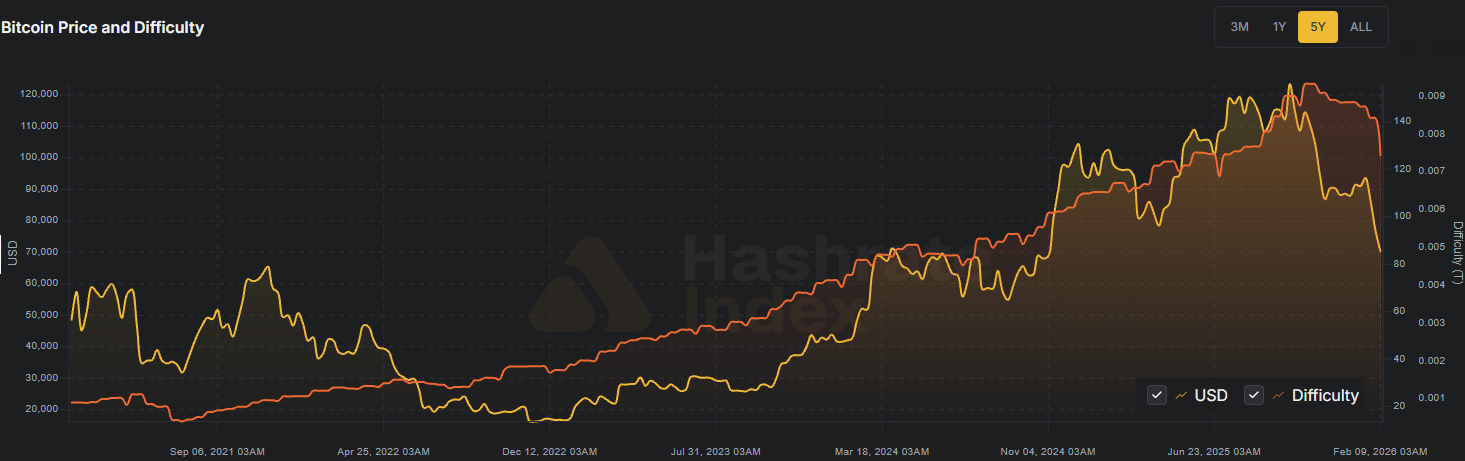
The main takeaway: difficulty grows like a weed, but sometimes frost hits. The chart below shows this roller coaster, which, nevertheless, keeps crawling upward.
In conclusion
Mining one bitcoin solo today isn't a business — it's a philosophy. You can do it, but why bother? Technically, you'll be digging for 23 years, replacing your equipment three times, and by the time you finally accumulate that coveted coin, it'll either be worth as much as a mansion — or a cup of coffee.
Mining stopped being a "one ASIC — one bitcoin" story long ago. Now it's all about industrial scale, cheap energy, and engineering infrastructure. Difficulty keeps rising, halvings punch you in the wallet, and the power outlet never forgives mistakes.
The only way not just to mine, but to mine efficiently, is to stop playing solo. Cuverse gives you access to a fleet of modern ASICs, industrial cooling, and electricity rates that no solo miner could even imagine. You don't worry about difficulty, you don't guess with calculators, and you don't pray over fans. You just watch your balance grow.
1 BTC is real. The only question is how many lifetimes you're willing to spend on it.
FAQ
What is the average time to mine one Bitcoin?
With one modern ASIC (like S21 XP) — roughly 23 years, that is the unadorned truth. With a hundred miners — about 84 days. With a thousand — just over a week. The math is simple: 1 BTC divided by your daily yield. The real question isn't "how long," but "how many machines are working for you." With solo mining, it’ll take until the next geological era. In an industrial setup, it's on a feasible investment horizon.
How does network difficulty affect Bitcoin mining?
Difficulty is the network's way of keeping everyone honest. It rises when more miners join, falls when they leave. For you, it means one thing only: when difficulty goes up, your share of the reward goes down. Not because you're not as efficient, but because there's more competition. Think of it as a pie that stays the same size while the number of hungry mouths keeps growing.
What are the risks and challenges in Bitcoin mining?
Start with hardware obsolescence — today's flagship model is tomorrow's scrap metal. Add electricity costs that can turn profit into loss overnight. Throw in network difficulty that only knows how to climb, halvings that cut rewards in half every four years, and the occasional regulator who decides mining is bad for the environment. And if that's not enough — fans fail, power surges happen, and dust kills more ASICs than old age.
What is hashing power or hash rate?
Hash rate is how many guesses your machine makes per second to solve the cryptographic puzzle. Measured in terahashes (trillions) or exahashes (quintillions). The higher your hash rate, the more lottery tickets you hold in the global mining raffle. But hash rate without context is just a number. What matters is hash rate per watt — because electricity bills don't care about your terahashes, only about what's left after paying them.


